
Tokenization and Embedding Choices That Decide AI Cost and Risk
Tokenizer, embedding and index choices decide what your AI can distinguish, what it costs, and how safely you can upgrade it.
Yash Sharma5 min readModel architecture and training
Research area 11: Tokenization, embedding and representation engineering
In brief
- Tokenizer, embedding and index choices decide what an AI system can tell apart and what it costs to run.
- The representation manifest keeps tokenizer, embedding model and index versioned as three separate decisions.
- Skipping version control on an embedding upgrade can silently break retrieval and let regulated identifiers vanish into false matches.
Tokenization, embedding and representation engineering decides what an enterprise AI system can tell apart and what every query costs to run. Get the boundary between exact matching and vector search wrong, and a regulated identifier or a dosage unit can vanish into a similarity score that looks fine on average. Get version control on an embedding model wrong, and a routine vendor upgrade silently breaks retrieval estate-wide.
What it is
A tokenizer converts raw input into the units a model processes: subwords, bytes, characters, or a learned segmentation the industry calls token-free. An embedding model turns a unit into a vector trained so similar meanings sit close together. An index approximates search over millions of vectors for millisecond lookups. Treat these as one blurred step called AI search and diagnosis becomes guesswork.
Four principles hold this together. Changing the tokenizer changes sequence length, parameter count and training exposure at once, so a swap must be evaluated as one combined change, never a free upgrade on an unchanged model. A fixed subword vocabulary is efficient on frequent strings but fragments rare scripts and identifiers, while byte level encoding avoids unknown characters but lengthens sequences and does not itself fix normalization or fairness. Similarity is not logic: two sentences placed close together have not proven the model understands negation or entailment, and a benchmark average can be excellent while that capability is missing. Some information belongs in a structured field next to the vector, not folded into it, since an exact identifier, date or unit needs a lookup that cannot drift with retraining.
Why it matters now
Three 2026 developments make this an executive question. In March, F2LLM-v2 released multilingual embedding models spanning 80 million to 14 billion parameters, trained on 60 million examples across 282 languages, with ablations showing average task performance rise from 53.37 to 58.04 on its 350-task subset once distillation was added. That is evidence of scale, not proof the largest embedding is the right default for a regulated task. In late August, a stress test of 163 ontologies and 171,007 triplets found Qwen3-Embedding-0.6B scoring .739 overall but only .572 on harder logical relations, a gap the headline figure hid. Earlier in August, a separate paper proposed disentangling language modeling from token boundaries using bytes: a hypothesis to track, not a result to deploy.
Attention computation scales roughly with the square of sequence length, so a tokenizer needing 1,600 units for content another covers in 1,000 carries a 2.56 times larger attention cost at equal model width. Byte length is unequal across languages under Unicode, so bytes are not an automatic fairness fix. Ignoring this shows up first as an unexplained cost curve by market, then as an untraceable retrieval failure.
The architecture
The representation manifest is the discipline that keeps tokenizer, embedding model and index legible as three separate, versioned decisions instead of one opaque capability labeled AI search.
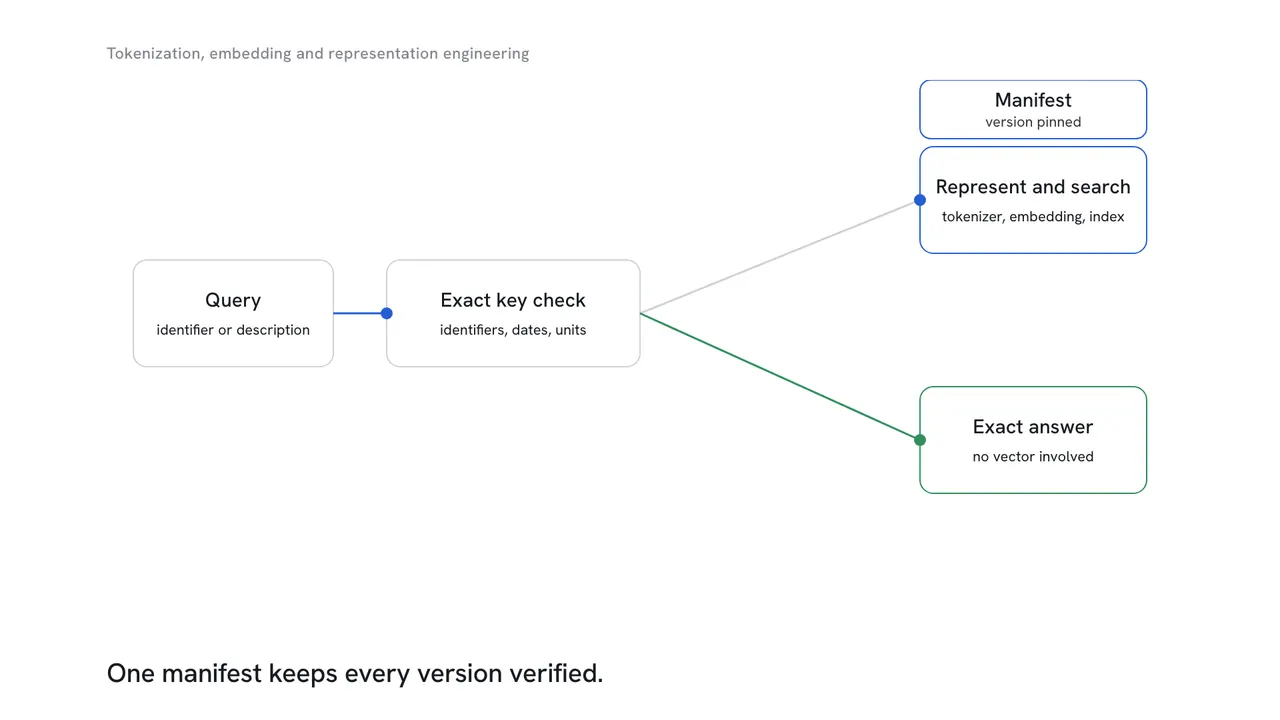
It has three parts. First, separation at the task boundary: every query is classified before it reaches a vector, so a known invoice number, patient identifier or product code routes to an exact lookup, and only an underspecified description reaches semantic search. Structured fields for identifiers, dates and units travel alongside the vector permanently, and contrast sets such as before and after, or 5 milligrams and 5 grams, confirm the vector layer preserves the distinction.
Second, a written manifest pinned for every representation in production: model or provider version, tokenizer, normalization rule, pooling method, vector dimension, precision and distance function. Equal dimensions do not mean two versions are compatible: a rotated vector space can rank an old query differently even when nothing looks broken. Every vector needs a traceable source identifier so a deletion request removes every version.
Third, how a change moves through production: snapshot the corpus, build the new encoder and index as a matched pair, compare both against a frozen query suite, run in shadow, switch over by version, and keep the old encoder available for rollback until proven on labeled outcomes. Log every update as a migration, regardless of the vendor's marketing name.
How to lead it
Ownership belongs with whoever owns data platform decisions, not a single vendor relationship, since a manifest is a governance artifact as much as a technical one. Fund a shadow testing pipeline for old and new representation pairs, a contrast set suite covering the business's identifiers, units, negations and languages, and ongoing measurement of tokens per task and latency by script rather than one blended average. Stop funding any embedding decision resting on a leaderboard average with no test against the business's hard cases.
The executive alone sets, ahead of evaluation, the smallest improvement worth shipping and the largest tolerable regression, and decides when an upgrade counts as a full migration. A similarity score never overrides an access control decision, and a lexical fallback stays available wherever the vector layer is unproven.
What it is worth
The money and risk show up in three places. Compute cost scales with sequence length and tokenizer choice. Storage cost scales with vector count, dimension and precision: ten million 768-dimensional vectors at standard precision already require roughly 30.72 gigabytes of raw components before metadata, replicas or a multi-vector index multiply that further. Incident cost arrives when a silent migration or a missed exact match reaches a customer, a clinician or a regulator, discovered downstream rather than at the point of change.
Measure retrieval recall and false matches on contrast sets, tokens and truncation rate per task by language, and rank changes across a migration checked against a declared tolerance. The 2026 evidence supports testing hard semantic contrasts and reporting cost by language. It does not support a claim that byte level tokenization, a larger embedding model or a general purpose vector index automatically beats exact and lexical retrieval, and no return figure for any representation choice was established in the underlying research. Treat every vendor efficiency claim as a hypothesis to test against your own workload first.
Questions leaders ask
- Should we move to byte-level tokenization for fairer multilingual pricing?
- Not on current evidence. Byte length is still unequal across languages under standard Unicode encoding, so switching to bytes does not automatically equalize cost or fairness. A 2026 proposal to separate language modeling from token boundaries is a hypothesis, not a measured result. Test any tokenizer change at equal content and equal compute across your actual languages before committing budget to it.
- Can we trust an embedding model's benchmark score for a regulated use case?
- Not on its own. A 2026 ontology stress test found a widely used embedding model scoring .739 overall but only .572 on hard logical relations, a gap the overall number hides completely. Build a contrast set of the exact distinctions your regulated task depends on, such as negation or unit differences, and test against that before trusting any single benchmark average.
- How should we handle upgrading to a new embedding model or provider?
- Treat it as a versioned data migration, never a drop-in swap, even if the vendor kept the same product name. Pin every parameter in a written manifest, re-embed a shadow corpus, compare against a frozen query set, rebuild the index, switch by version, and keep the previous encoder available for rollback until the new one is proven on labeled outcomes.
- Does a bigger or newer embedding model always beat simple keyword search?
- No. Lexical matching still wins on rare exact strings, version numbers, names and domain vocabulary that general embedding training rarely covers well. Compare exact key lookup, lexical search, hybrid retrieval and dense only search at matched depth and cost before choosing, and let a vector approach earn its place through validated coverage rather than assumed superiority.
- What is the biggest blind spot leaders have about tokenization cost?
- That equal token limits buy equal content. They do not: script, language and content type change how much meaning fits inside a fixed token budget, and attention computation grows roughly with the square of sequence length. Measure tokens per meaningful task and cost by language and content type, not one blended average across the whole estate.


