
The Time-to-Quality Ledger for Training System Spending
A faster training step is not a cheaper training run. The time-to-quality ledger shows what distributed optimization choices actually cost.
Yash Sharma5 min readModel architecture and training
Research area 14: Training-systems and distributed-optimization engineering
In brief
- A faster training step is not a cheaper training run once setup, checkpoint and recovery costs are counted.
- The time-to-quality ledger adds setup, step, checkpoint and recovery cost before any speedup counts as savings.
- Ignoring the ledger means wasted accelerator hours, unverifiable reruns and silent corruption that trains for days unnoticed.
Training-systems and distributed-optimization engineering decides how much a company actually spends to reach a validated model, not how fast any single step runs. A faster kernel or lower step time is not yet a lower total cost: a change to communication, precision or asynchrony can quietly increase the steps needed, the risk of a corrupted run, or the time lost to recovery. The discipline that puts every claim on one shared ledger is what a chief technology officer is actually funding when a platform team asks for a distributed training budget.
What it is
Training-systems and distributed-optimization engineering is the operational layer between a model design and a finished, validated model: how work and state split across machines, how precision and communication are managed, how progress is saved, and how a run recovers when something fails. None of these choices change what the model learns, only what that learning costs.
The unit that matters is time to a validated model state, not one step's latency: a faster step needing more steps to reach the same quality can cost more overall. A checkpoint must capture a consistent cut of the whole system, weights, optimizer state, scheduler, random state and exact data position, since restoring weights from a different point starts a new, unplanned run. Reducing communication or letting components run out of step changes training's statistics, not only its speed, so every gain needs its own convergence check. A crash is visible, while a corrupted value can train undetected until an evaluation catches it. Every reported speedup needs a declared boundary, since numbers measured against different boundaries cannot be added together.
Why it matters now
Four 2026 studies quantify these tradeoffs. A sparse-communication system reported in July 2026 by Zheng, Chen, Xie and Zhang took a 500 million parameter run from 2.47 to 1.40 days on 32 GH200 processors, validation loss moving from 2.32 to 2.31 and SuperGLUE from 53.04 to 52.93: communication cut sharply without a dramatic quality cost in that setup, though a no-loss claim still needs a stated tolerance. The same paper's 1.8 billion parameter figure, a 3.26 times speedup, is step only and should not be added to the days figure above.
A June 2026 study by Kang and colleagues found the safe staleness limit for asynchronous distillation depends on which distillation objective is in use, so one setup's limit misbehaves in another. A July and August 2026 recovery system and corruption study report recovery under 40 seconds and detection overhead of roughly 1.7 to 6.8 percent, but both are fault-injection appraisals, not observed production incidence or real hardware failure rates. These four systems used different models and hardware and should not be ranked against each other or read as a benchmark.
The architecture
I call this the time-to-quality ledger, and I run every training-systems proposal through it before funding it. Four line items must be added, never compared in isolation. A proposal improving only one, usually step cost, must show its effect on the other three to count as a saving.
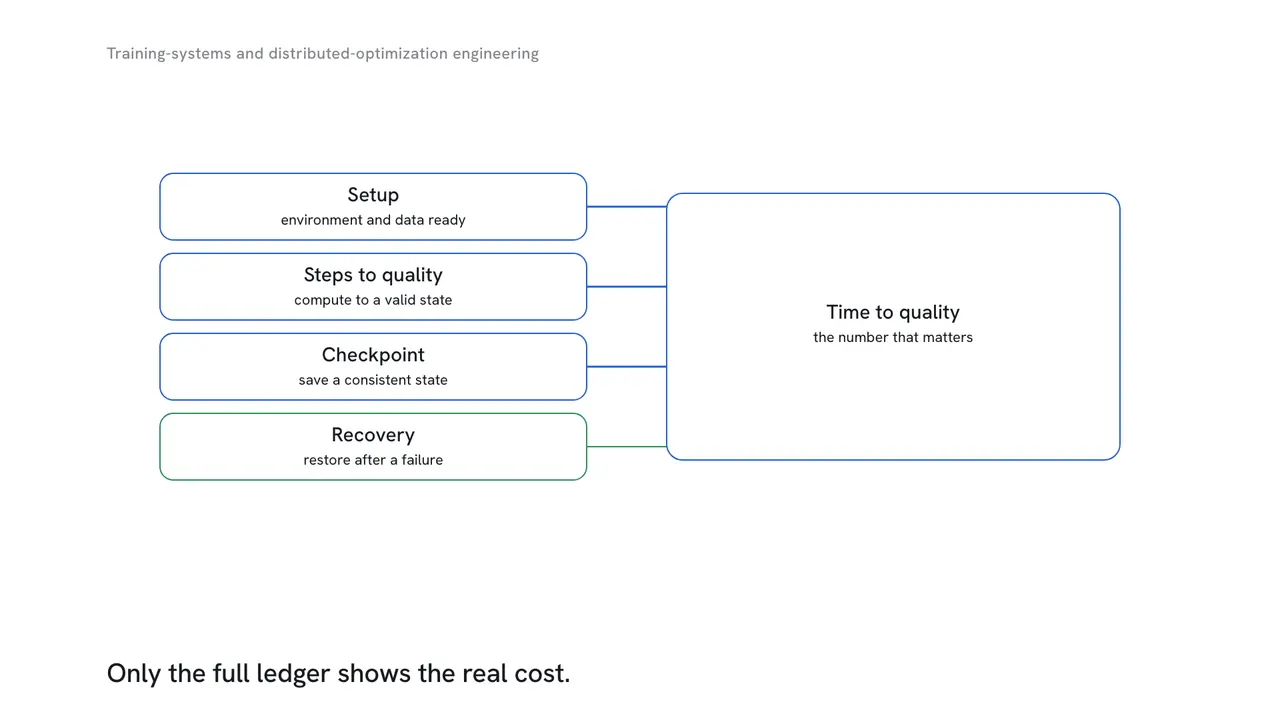
Setup cost covers what happens before the first useful step: environment, staging, topology, warmup. Step cost is one step's price times the steps actually needed: a cheaper step needing more of them can lose to a pricier step needing fewer. Checkpoint cost is what it costs to record a trustworthy state, verified beyond a file checksum, since a file can be intact on disk yet hold a corrupted state. Recovery cost only shows up when something goes wrong, why teams without a serious failure underprice it. A team proposing sparse or asynchronous communication must show a convergence check, not only throughput, since compressing or staling updates changes what the optimizer sees, and a team proposing recovery must state its redundancy and fault assumptions, since a recovery time against losing one replica says nothing about losing every replica at once.
A real cost often hides inside a line item nobody is watching, revealed only after the money is spent. Silent data corruption is the sharpest version: training can look stable on ordinary metrics for days before an evaluation exposes it, so a stable loss curve is evidence only that nothing has been caught yet.
How to lead it
This belongs to whoever owns the machine learning platform, reporting through infrastructure rather than a single model team, since its decisions affect every model that trains there. Fund three things before any speed feature: a checkpoint format with a full, verified state cut, a recovery path tested against declared faults, and a staleness or drift monitor for any asynchronous component, insurance cheapest before the first bad incident. Measure the ledger, not the demo: every proposal states its four costs separately, labeled against the boundary its speedup was measured against, with any quality-match claim stating its tolerance.
Three decisions only an executive should make: the redundancy budget for recovery, the quality tolerance for an acceptable loss in exchange for speed, and the staleness limit an asynchronous system may run at before its output counts as unverified. Governance is those three numbers written down and reviewed before production, not discovered after a failed run.
What it is worth
The clearest value evidence is the sparse-communication example above: a 500 million parameter run cut from 2.47 to 1.40 days with a validation loss difference of about one hundredth, a real reduction in accelerator hours in that one setup. The evidence does not support a universal saving across scales, a measured incidence of silent hardware corruption in production, only injected-fault sensitivity, or a full accounting of federated or decentralized training's recovery and privacy cost.
The honest value is avoided waste: fewer accelerator hours spent past validated quality, fewer reruns from an unverifiable checkpoint, a smaller window before a corrupted run is noticed. Each is real money with no dossier-backed average figure, and a leader offered one before a pilot should ask which boundary it was measured against.
Questions leaders ask
- Why isn't a faster training step the same as a cheaper training run?
- Step time is one line item in a larger ledger. An intervention that halves step time can still need more steps to reach the same validated quality, and it still carries setup, checkpoint and recovery costs that do not shrink just because each step got faster. A 2026 sparse-communication study reported a step-only speedup at one scale and a smaller end-to-end gain at another, and the two numbers cannot be added together.
- How much can sparse communication or asynchronous training actually save?
- The 2026 evidence is real but narrow. One sparse-communication system took a 500 million parameter run from 2.47 to 1.40 days with a validation loss difference of about one hundredth in that setup. A separate asynchronous distillation study found the safe amount of staleness depends on which distillation objective is used, so neither result should be read as a fixed percentage that applies to a different model or setup.
- What does a checkpoint need to contain to be considered trustworthy?
- More than the model's weights. A trustworthy checkpoint records one consistent moment across the whole system: weights, optimizer state, the scheduler, random number state, the exact data position and, for asynchronous systems, the policy version in use. A 2026 hot-swap recovery study reported recovery in under 40 seconds, but that number describes its own redundancy and fault assumptions, not a guarantee after every replica is lost.
- How do we know if a training run has been silently corrupted?
- Not from the loss curve alone. Training can look stable on ordinary metrics while it trains on corrupted values underneath. A 2026 study that injected faults into two smaller open models found that targeted numerical checks caught the injected corruption at an overhead of roughly 1.7 to 6.8 percent of training cost, though injected faults are not the same as the rate of real hardware failure.
- Who inside the company should own training-systems and distributed-optimization engineering?
- The machine learning platform team, reporting through infrastructure rather than through any single model project, because its choices affect every model that trains on the platform. My rule is that the platform team funds checkpoint integrity, tested recovery and staleness monitoring before it funds any new speed feature, since those three are the insurance that makes every other speedup safe to adopt.


