
The Four-Gate Audit For Geometry-Aware Training Optimizers
A new optimizer can solve its geometry problem exactly and still not lower your model's loss. Here is the audit before you fund the swap.
Yash Sharma5 min readModel architecture and training
Research area 66: Geometry-aware optimization and training-dynamics engineering
In brief
- A geometry-aware optimizer that solves its shape problem exactly can still fail to lower your loss.
- The four-gate audit checks geometry, descent, cache and groups before funding a production run.
- No return figure is proven yet, only a lower cost path if your own models clear all four gates.
Geometry-aware optimization decides how a neural network's weights move at each training step, treating a weight matrix as a shape rather than a list of independent numbers. This year's most discussed variant, a curvature-aware descendant of the Muon optimizer, proves it solves that shape problem exactly. That is not the same as proving the update lowers the loss on the batch in front of it, and a leader who conflates the two claims funds the wrong evidence.
What it is
Most optimizers, Adam among them, rescale each weight on its own running estimate of scale. Geometry-aware optimization treats a weight matrix as one object with a shape and updates the whole matrix accordingly.
Four ideas define the field. Coordinatewise adaptivity, the Adam family, remains the practical baseline. Matrix-aware methods use a matrix's row and column structure, and spectral methods, including Muon and its descendants, constrain the singular directions along which it stretches space the most. Natural-gradient methods use a metric from the model's own probability distribution instead of a fixed matrix norm.
A fifth idea matters for governance: curvature is not one thing. The empirical Fisher information, the model Fisher information, the generalized Gauss-Newton approximation, and the Hessian are four distinct objects that coincide only under conditions that rarely hold in practice. Calling an optimizer second order does not say which of these four it approximates. Treat "curvature aware" as a label requiring unpacking, not a guarantee.
The pressure is compute cost: an optimizer reaching the same quality in fewer steps lowers every future training bill. Two bounded papers from early August 2026 define the current evidence. On 10 August, "Second-Order Muon Done Right: A Principled Marriage of Spectral Geometry and Curvature" proposed GOMuon, an exact solution to a constrained matrix problem, tested on small language models with no independent replication reported. On 7 August, a separate study reported Muon-trained transformers collapsing late in training, at the interface between internal representation and output readout layer, in toy modular-arithmetic models, with freezing part of the model as one working fix. The same study found Adam collapsing in some of the same runs, so this is not unique to the new method. This second paper's evidence is preliminary, author-reported, and its own authors frame it as bounded, not a forecast for large models.
The architecture
I use what I call the four-gate audit: a claimed geometry-aware optimizer must clear four separate checks before it earns a place in a production run, and clearing one says nothing about the others.
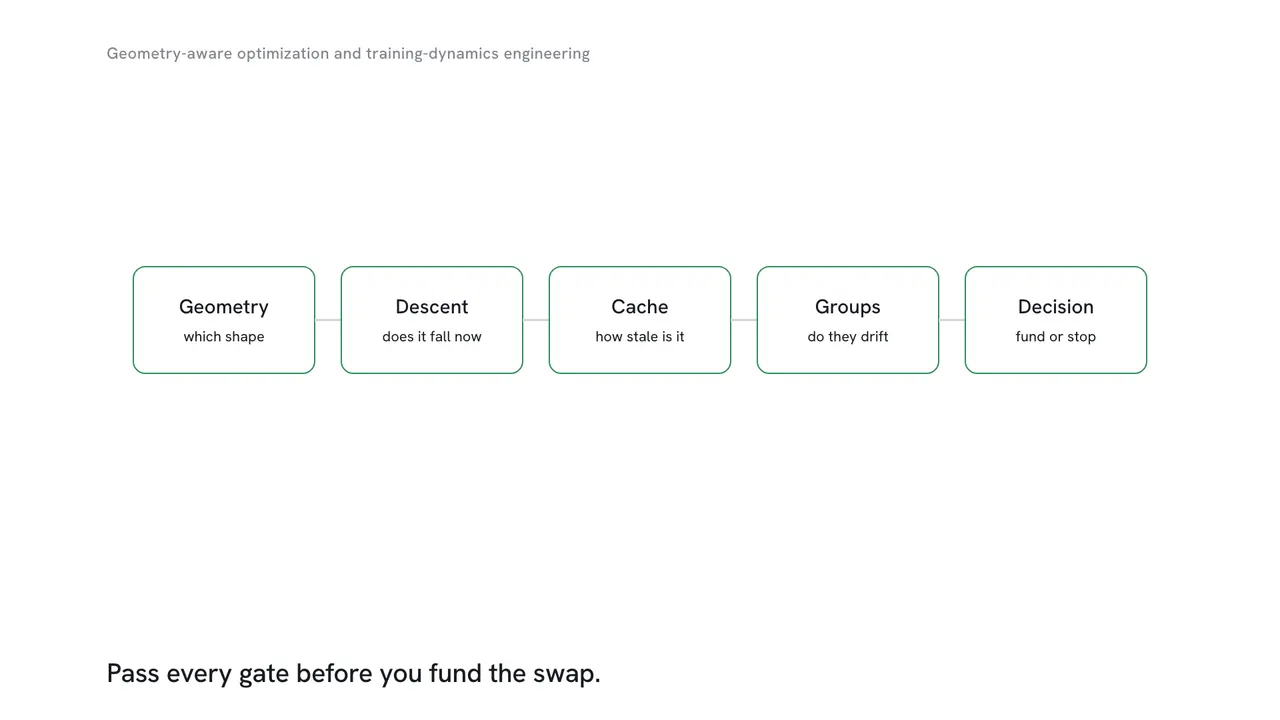
The geometry gate asks what exact shape problem the update solves and whether that shape matches how this model's matrices actually behave. The descent gate, most often skipped, asks whether the step still points downhill on the live gradient once solved, or is following a momentum term gone stale: a current gradient and a stale momentum term pointing opposite ways can produce an update that is the exact answer to the geometry problem and still moves the model uphill. An elegant proof and a falling loss are different claims, and only one is what the business pays for.
The cache gate covers reused curvature estimates: every reuse introduces staleness, measured as bias, variance and lag, not assumed away because the long-run average looks right. The group gate covers embedding, hidden and output matrices updated under different rules, whose representations can drift out of alignment with the readout layer, the failure mode behind the collapse the August study observed. The most common failure is treating a passed early gate as a finished audit: a low loss at one checkpoint is not evidence the run stays healthy at the checkpoint you plan to ship.
This belongs with whoever owns training infrastructure, not only the team proposing the optimizer, since the audit changes recovery cost. Fund paired experiments with the same seeds and tuning budget against a well-tuned baseline, and count every failed or divergent run inside that budget. Measure held-out loss, downstream quality, time and compute to a declared target, memory and full tuning cost, across the entire run rather than early checkpoints, since the collapse this area documents shows up late. Stop funding any comparison that reports only an early loss curve or picks the winning checkpoint after seeing the final result.
Two decisions belong only at the executive level: predeclaring the target quality and evaluation point before a comparison starts, and approving any change to what the training system checkpoints, including the optimizer's momentum and cache state. No optimizer change goes into production without clearing all four gates on a protected final test nobody has seen.
What it is worth
The evidence does not support a specific return figure, and none should be attached to it. Both sources are small-scale, not independently replicated, with broad scaling advantages unestablished. What it does support is where money and risk sit. The cost side is near-term: engineering time to build and maintain an audited geometry estimator, plus the checkpoint and recovery complexity that comes with caching curvature. The risk side is false confidence: an exact proof mistaken for a production guarantee, funded past the point a well-run comparison would have stopped it. The upside, if an optimizer clears all four gates on your own models, is a lower time and compute cost to the same quality target, the only return this method can plausibly deliver.
If a model is consumed only through a vendor's API, its training optimizer is not something you can change. For that reader this area is not a production decision. It is an experiment plan, ready to run the day your organization trains a model of its own.
One boundary matters for most enterprises. If a model is consumed only through a vendor's API, its training optimizer is not something you can change. For that reader, the output of this area is not a production decision at all. It is an experiment plan, ready to run the day your organization trains a model of its own.
Questions leaders ask
- Does a geometry-aware optimizer guarantee faster training?
- No. The evidence behind the newest variant, GOMuon, proves it solves its geometry problem exactly, on small language models, which is a different claim from proving the loss falls faster on your run. Treat the proof as a starting point for the four-gate audit, not as a result you can bank.
- Should we switch our training runs from Adam to a spectral optimizer now?
- Not on the strength of a proof alone. Run a paired comparison with equal tuning budgets against your current optimizer, measure held-out loss and downstream quality across the full run, and count every failed trial. Switch only after the new method clears the four-gate audit on your own models.
- What causes a model to collapse late in training?
- One August 2026 study found toy transformers collapsing at the interface between their internal representation and their output layer, with freezing part of the model as one working fix. The same runs showed the older Adam optimizer collapsing too, so this is a representation drift risk to monitor, not a defect unique to newer optimizers.
- We only use vendor AI APIs. Does this apply to us?
- Not directly. You cannot change the training optimizer behind a model you consume through an API. This area matters once your organization trains or fine-tunes its own models, at which point the four-gate audit becomes the plan for that first experiment.
- What should we measure before trusting an optimizer change?
- Training loss alone is not enough. Track held-out loss, downstream task quality, time and compute to a declared target, memory, and total tuning cost, measured across the whole run rather than early checkpoints, since the collapse risk this area documents tends to appear late.


