
The Four-Clock Model for Mixture-of-Experts Costs
Mixture-of-experts savings are set by four clocks, router, dispatch, expert and combine, not by active parameter counts alone.
Yash Sharma5 min readModel architecture and training
Research area 64: Mixture-of-experts and communication-aware conditional computation
In brief
- Mixture-of-experts savings depend on four clocks, not active parameter counts alone.
- The four-clock model tracks router, dispatch, expert and combine time separately.
- Ignoring any one clock turns a communication-efficient design into an expensive one.
Mixture-of-experts routes each token to a small subset of a model's parameters instead of running all of them every time. The pitch is a smaller compute bill for the same or better quality, and it can deliver exactly that, or a smaller compute bill and a much larger network bill, because the arithmetic saved by routing is only one line in the true cost.
What it is
Conditional computation means a model activates a fraction of its parameters for a given input. A router looks at each token and sends it to a small number of experts, chosen from a much larger pool.
Total and active parameters are different budgets: total counts every expert a model owns, active counts only what one route uses, so a model can look enormous on a spec sheet and cheap on a bill, or the reverse. Balanced load is not useful specialization: routers can be pushed to even utilization with auxiliary losses, and a clean chart says nothing about whether experts learned anything different. Changing which layers route is an architecture change, not a speed change, even when the goal is only to cut communication. And the real cost is paid mostly in coordination, not arithmetic: moving tokens, waiting on the slowest expert and merging results back can outweigh the expert computation itself.
Three 2026 studies show how a headline efficiency number hides this. One from August 28 reconfigured routed layers across models from 2 billion to 31.5 billion parameters, reporting up to 33.3 percent fewer GPU hours on its largest configuration, but changing which layers route also changes expressivity, so this is an architecture comparison, not a faster version of the same graph. This review grades its evidence C, author-reported and not independently corroborated. One from August 8, on expert caching, found that replaying access events one at a time, instead of preserving the set a live fused request needs at once, can manufacture cache hits a real deployment would never see. One from August 4 trained a 30-billion-total, 3-billion-active diffusion model, LLaDA MoE v2, on 23.5 trillion tokens, whose masked, noise-dependent objective revisits blocks repeatedly, so active parameter count also omits repeated passes, router work and memory residency.
The architecture
I call this discipline the four-clock model: every routing decision's true cost is the sum of four clocks, and treating any one as the whole story is how a communication-efficient design turns into a communication-expensive one in production.
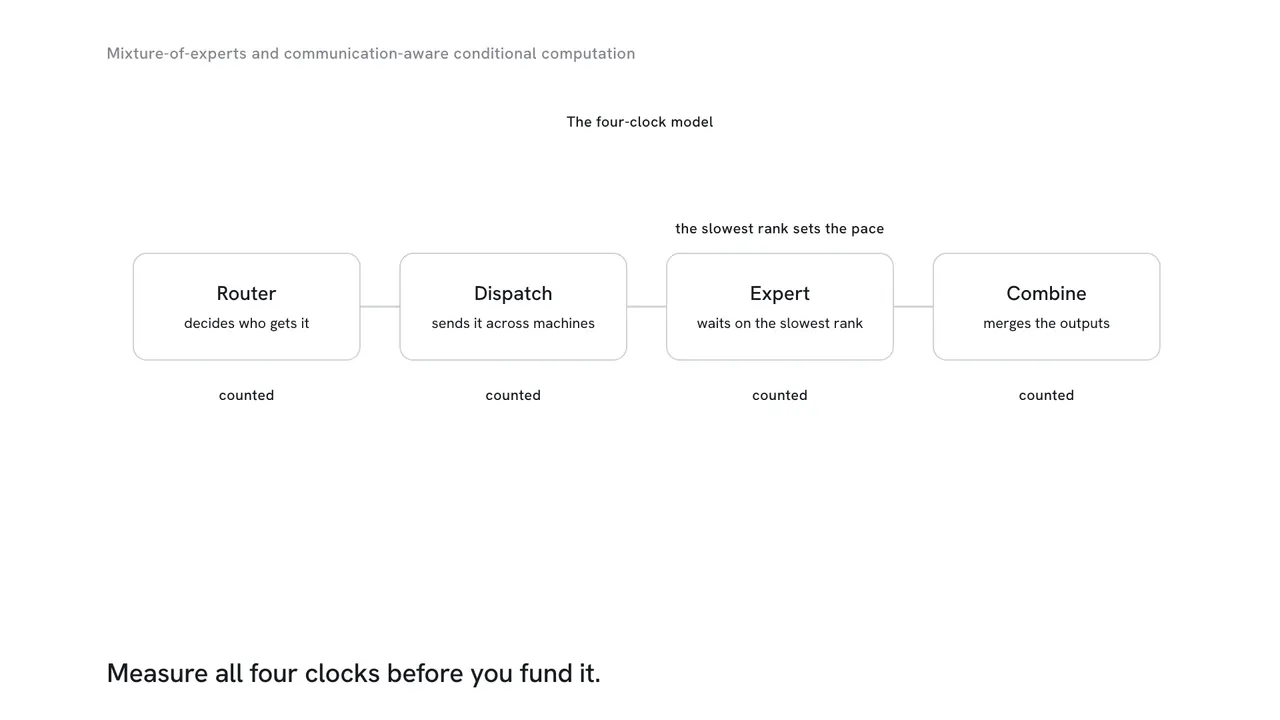
The router clock is the time deciding which experts a token goes to, small alone but not free at scale as router precision adds up across every token in a batch. The dispatch clock is the time moving tokens and activations to the machines holding the chosen experts, growing with batch size, hidden width, top-k and the collectives a topology requires. The expert clock is bounded by whichever rank is still working, not the average one, so an imbalanced route can hold up the whole layer. The combine clock is the time merging the experts' outputs into a single result, on the same collective infrastructure as dispatch. Total time is approximately the sum of all four, not simply the arithmetic any single expert performs.
Two questions sit inside this flow: does a change touch architecture, such as reallocating routed layers, or only implementation, such as better placement on an unchanged graph, since both can look identical on a GPU-hours chart, and has a caching layer been validated against live event semantics, since a cache warmed by an isolated replay can report hits a real, fused request could never produce. Skipping those checks is how sparse arithmetic ends up costing more and a cache ranking built on contaminated replay reverses the moment it meets a live workload.
A named conditional-computation owner keeps all four clocks measured separately, alongside FLOPs, and funds live-trace validation for any cache policy and an unchanged-architecture baseline beside any new configuration. Stop crediting a claim that reports only active parameters or a hit-rate improvement without that baseline.
Two decisions belong to an executive alone: whether to fund an architecture change that requires full requalification, since reconfiguring routed layers is a new model, not a patch, and when a degraded expert requires a trained, tested fallback rather than a quiet drop, since that decides what the model is allowed to do when a part of it goes missing.
What it is worth
The money shows up in three places: GPU hours on a layer-reconfiguration bet, network spending driven by dispatch and combine traffic an active-parameter estimate never counted, and the risk cost of an untested fallback when an expert is pruned, merged or lost to hardware failure.
Measure before and after with the same yardstick the evidence uses: keep predicted and achieved numbers in separate tables, and revalidate any cache ranking against live event semantics after a workload or hardware change.
The 2026 evidence supports that layer reconfiguration can cut communication meaningfully, that cache-policy rankings are sensitive to how they were benchmarked, and that active parameter count alone cannot normalize total work across different objectives. It does not support a specific return figure for any of these moves, a universal mixture-of-experts advantage over dense models, or a general ranking of one caching policy over another outside the conditions it was tested under. Dense models can still win at low batch, tight latency or limited residency, and the right choice is decided from a measured frontier.
Questions leaders ask
- What is the four-clock model?
- It is a discipline for costing mixture-of-experts and other conditional-computation systems. Every savings claim must account for four stages: the router clock, which decides which experts see a token, the dispatch clock, which moves work across machines, the expert clock, bounded by whichever rank is slowest, and the combine clock, which merges the results.
- Does a lower active-parameter count always mean a cheaper model?
- No. A 2026 study of a 30-billion-total, 3-billion-active mixture-of-experts diffusion model, trained on 23.5 trillion tokens, shows why. Its masked, noise-dependent objective revisits blocks repeatedly, so active parameter count alone cannot normalize the total denoising work, and router time, dispatch traffic and memory residency sit outside that count too.
- Can a reported gain in expert-cache hit rate be trusted on its own?
- Not without checking how it was measured. A 2026 evaluation found that replaying access events one at a time, instead of preserving the full set of experts a live fused request needs at once, can manufacture cache hits a real deployment would never see. This evidence carries a grade C rating and was not independently reproduced.
- Should we reconfigure mixture-of-experts layers to cut communication costs?
- Only after separating the architecture change from the implementation change. A 2026 study reconfiguring routed layers reported up to 33.3 percent fewer GPU hours on its largest configuration, but reconfiguring which layers route also changes the model's expressivity and learning dynamics, not only its traffic pattern, and the study's full cost accounting was not available for review.


