
The Four-Layer Test Before Betting on Joint-Embedding Models
Predictive, contrastive and joint-embedding objectives need a four-layer test before any executive funds a language-replacement claim on them.
Yash Sharma4 min readModel architecture and training
Research area 67: Predictive, contrastive and joint-embedding objective engineering
In brief
- A four-layer test separates objective, representation, decoder and decision before funding any predictive or joint-embedding claim.
- The four-layer test names which layer earned a reported gain before credit or blame is assigned.
- Skipping the test risks funding a decoder's gain as if it were the representation's, or a robotics result as if it proved a language replacement.
Predictive, contrastive and joint-embedding objective engineering decides what a model's internal representation is trained to keep, discard or average away, before any business decision is built on top of it. Executives meet this area when a vendor pitches a world model or joint-embedding architecture as a faster, cheaper alternative to next-token language training. Companies get burned funding a representation before checking what its objective, decoder and downstream decision each contributed to the number on the slide.
What it is
This area covers every way to train a model without a hand-labeled answer per input. Autoregressive likelihood training predicts the next symbol as a real probability over what comes next. Contrastive learning tells related pairs apart from unrelated ones, and the result depends on how those pairs are chosen. Joint-embedding prediction, the family that includes JEPA-style architectures, skips reconstructing raw pixels or tokens and instead trains one learned representation to predict another.
A loss's name tells you little: its context, target and sampling distribution must be specified before any comparison means anything. A representation is only useful relative to a specific downstream decision, so a design that discards information one task never needed can ruin a rarer, costlier task that did.
Why it matters now
Joint-embedding and world-model architectures have moved from research curiosity to a live procurement question, and 2026 evidence is narrower than the marketing. A study made public August 10, 2026, describes JEPA-WAM, a vision-language-action system that trains its policy against frozen visual targets from a joint-embedding predictive architecture and drops the prediction step once deployed: evidence for a robotics auxiliary signal, not for replacing next-token training in language.
A study made public July 26, 2026, on what its authors call a JEPA paradox in language, ties deterministic latent regression to a collapse toward a conditional average, using five data seeds across matched text and image comparisons: a warning about one design choice, not language predictive learning generally. A third study, made public August 2, 2026, on evaluating novel driving data, found a representation can discriminate well within one dataset while its unsupervised novelty score looks weak across datasets, and a supervised head recovers use of it. All three are author-reported findings, not yet independently corroborated, by the researchers' own account.
The architecture
I call this discipline the four-layer test: every claim about a predictive, contrastive or joint-embedding objective rests on four separable layers, and the costliest mistake is crediting or blaming the wrong one.
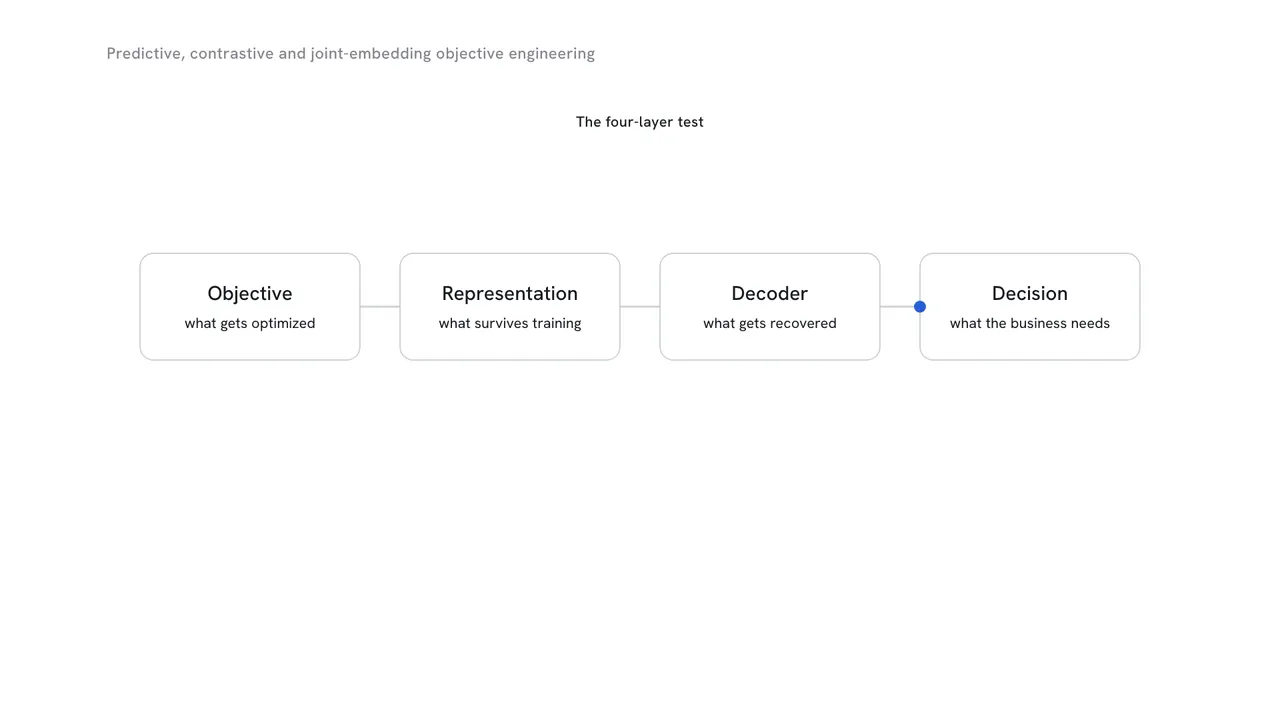
The objective layer is the context, target, sampling process and compatibility function actually optimized: a label like joint-embedding prediction does not say whether the target is a frozen vision encoder's output or a text token, and that choice changes everything downstream. The representation layer is what the trained encoding actually keeps, tested against the specific decisions it must support, including rare, high-cost cases a smooth average score can hide. The decoder layer is the readout attached to the representation, whose own capacity and pretraining can recover behavior that has nothing to do with the representation's quality. The decision layer is the downstream use: exact-fact lookup, ambiguous completion, multistep plan or an untried action.
Each layer can mask a problem in the one below it: a gain credited to a new objective must survive a decoder held at matched capacity, and a one-step accuracy number must be checked under its own rollout, since a squared-error predictor that averages plausible futures together can look accurate step by step while matching none of the real alternatives. The clearest failure mode treats a result from one narrow setting as a verdict on an entire objective family.
How to lead it
Ownership sits with a named objective-and-representation owner, who tracks each production representation's objective, target, paired decoder and capacity, and which decisions it has been tested against.
Fund matched-budget comparisons that hold representation size, data, compute, decoder capacity and supervision fixed before an objective earns credit, decoder-controlled tests separating a frozen decoder from a jointly trained one, and a minimal, controlled language-only test on matched small models against a likelihood baseline.
Measure exact-fact accuracy, ambiguous-completion handling, rollout quality and cross-dataset discrimination as separate numbers, never blended into one score. Two decisions belong to an executive alone: how much production budget to commit before a matched, controlled test exists, since a broad language-only version has not been run, and when a standing replacement claim must be re-reviewed.
What it is worth
Money, risk and time here show up in three places: engineering time chasing an objective regression that is actually an unmatched decoder capacity difference, production risk from deploying a deterministic joint-embedding predictor against ambiguous language tasks, and the opportunity cost of generalizing a robotics or driving result into a language-architecture bet it was never designed to support. Every comparison should disclose the decoder's capacity and training history alongside the result.
The 2026 evidence supports three narrow conclusions: a joint-embedding objective can be a credible auxiliary signal for a multimodal action policy, deterministic latent regression carries a specific, demonstrated collapse risk for linguistic alternatives, and a weak unsupervised novelty score does not by itself prove a representation is useless once a supervised head is added. It does not support a validated language-only replacement for likelihood training, a calibrated measure of uncertainty at production scale, or any causal planning guarantee, and no return figure should be assumed from any of it.
Questions leaders ask
- What is the four-layer test?
- It is a discipline for judging any predictive, contrastive or joint-embedding claim by separating four layers that otherwise get blamed for each other's problems. The objective layer is what a training signal actually optimizes. The representation layer is what a learned encoding actually keeps for the task at hand. The decoder layer is the readout attached to that encoding. The decision layer is the real business use the whole chain has to serve.
- Can a joint-embedding objective replace next-token training for language models?
- Not yet, on the evidence available. A 2026 study connected deterministic latent regression to a specific collapse risk for linguistic alternatives, using five data seeds in matched text and image comparisons. That is a direct caution against one design choice, not proof every predictive or contrastive language objective fails. No controlled, matched language-only replacement test has been reported, so treat a language-replacement pitch as unproven until that test exists.
- Does a weak novelty score prove a representation is useless?
- No. A 2026 driving-evaluation study found a gap between how a representation scored on cross-dataset novelty and how well it discriminated within one dataset, and adding a supervised head improved use of that same representation. A weak unsupervised score describes the scoring method, not automatically the representation underneath it. Test both before discarding an architecture on one number.
- Who should decide whether to fund a predictive-embedding architecture bet?
- A named objective and representation owner should run the four-layer test day to day, keeping a record of what each layer contributes to any reported gain. Two calls stay with an executive: how much production budget to commit before a matched, controlled test exists, and when a standing replacement claim must be re-reviewed, since broad language-only evidence for these objectives remains, by the researchers' own account, insufficiently appraised.


