
Byte-Level and Hierarchical Models: A Leader's Guide to Text Units
Byte-level and hierarchical language models change sequence length and interface risk. The four-unit ledger for what to fund, measure and test first.
Yash Sharma5 min readModel architecture and training
Research area 65: Byte-level, hierarchical and multi-unit language representations
In brief
- Byte-level input does not by itself make a model safer, faster or more correct.
- The four-unit ledger names and tests the input, segment, prediction and output units separately.
- Skipping the ledger means paying for a migration or an incident the evidence never covered.
Byte-level, hierarchical and multi-unit language representations decide what a language model actually reads, in what pieces, and what it is allowed to know about the next piece before it commits to an answer. The honest 2026 position is narrower than most vendor pitches suggest: reading raw bytes instead of a learned vocabulary does not automatically make a system safer, faster or more correct, and the freshest evidence includes two explicit negative results alongside the progress. The one defensible habit, and the framework this essay names, is the four-unit ledger: naming and testing every unit in the pipeline separately instead of treating byte-level as one settled claim.
What it is
Byte-level, hierarchical and multi-unit representations describe the different pieces a model can be built to read, hold internally and produce. Byte-level BPE, the most common form in production, still learns multi-byte vocabulary units from data, so it behaves like a fine-grained subword system rather than true byte generation, which predicts individual byte symbols directly, sometimes several per step. A tokenizer-free encoder learns where boundaries between meaningful chunks fall and hands the result to an ordinary token-based backbone. Characters, code points, graphemes, bytes, subwords and semantic units are different measuring sticks, and a result proven for one does not transfer to another. Boundaries can be set by fixed width, an entropy signal, learned rules, tokenizer alignment, or a separate hierarchical encoder, each trading supervision cost against runtime cost. Byte coverage is a related trap: a vocabulary that can represent any input has solved an availability problem, not a safety problem.
The architecture
Four papers posted in the final three weeks of August 2026 are the direct evidence for this area, best read as early signals. One, posted August 16 and revised August 21, describes dynamic multi-byte prediction, a hierarchical encoder with boundary-aware causal attention emitting several bytes per step, though its full text could not be retrieved for this review, so its causal masking remains a reproduction task. Another, posted August 27, reports byte chunking that transfers tagging and morphology performance to six low-resource languages through a frozen-backbone adapter, useful but silent on generation. A pre-registered study posted August 28 found nested byte-level vocabularies cheap to slice but expensive to share without hurting the specialists inside them, a formal negative result. A fourth, posted August 31, questions whether hierarchical byte architectures outperform flat processing at all, none replicated.
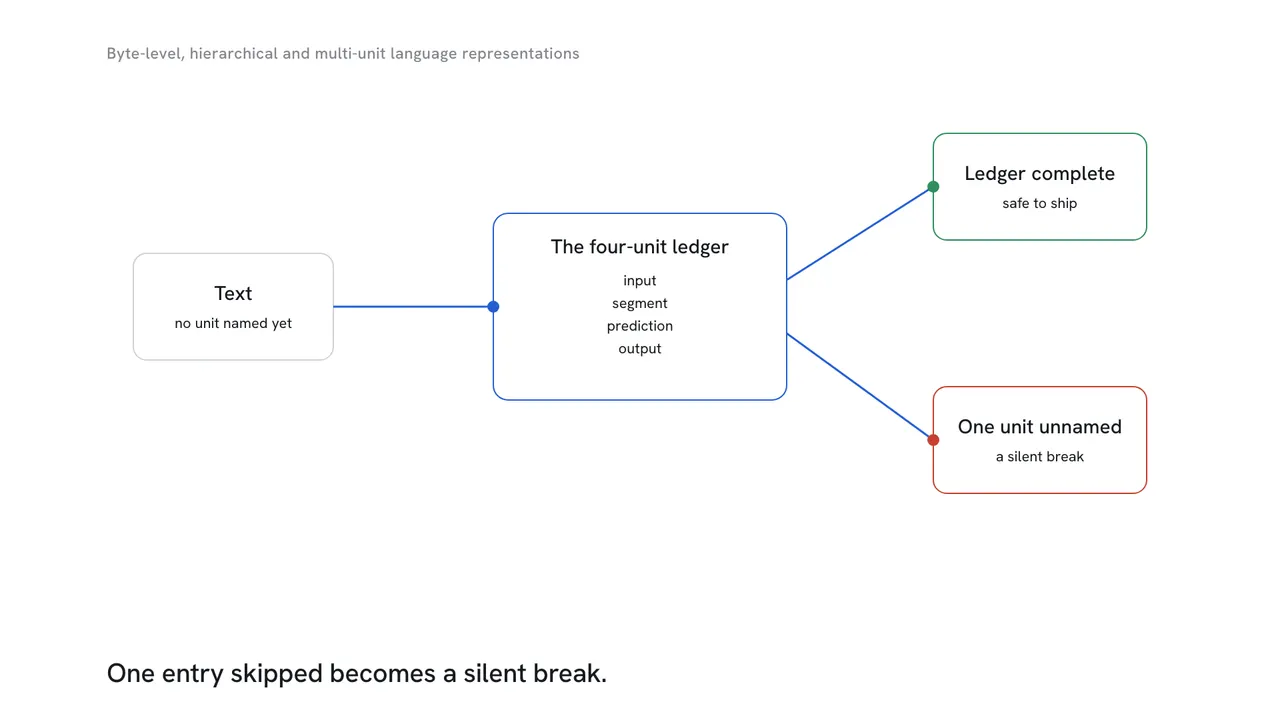
The clearest way to hold a vendor, a research team or your own engineers accountable is what I call the four-unit ledger, four entries any byte-level, hierarchical or multi-unit system should name and defend before production traffic: the input unit that arrives (raw bytes, code points, characters or a subword vocabulary), the segment unit that groups it internally, the prediction unit committed to at each step under a given causal mask, and the output unit, the exact contract a downstream system receives, valid UTF-8, exact numerals and identifiers, a schema validated rather than assumed.
The sharpest failure sits in the prediction unit. Predicting several bytes at one step with independent output heads does not reproduce the joint distribution an autoregressive model would produce one byte at a time: independent heads assign real probability to combinations that can never occur, because they assume an independence the data does not have. A correlated joint prediction, or a decoder where the second position sees the first's committed output, closes that gap. A second failure sits between the segment and output units: a shared vocabulary that slices cheaply at inference has proven only that slicing works as engineering, not that the specialists kept their quality once trained jointly.
How to lead it
Ownership belongs with whoever runs model serving and the data platform, not the research group behind a benchmark. Fund three comparisons before funding a new hierarchy: a flat byte model, a fixed-vocabulary specialist, and a frozen-backbone adapter, since a new hierarchy demands substantial pretraining and an adapter is cheap only because it inherits the base model's supervision. Measure normalized bits per byte, not per-token perplexity, and bytes processed per second, not tokens per second. Report fidelity, numeral accuracy, code compilation and multilingual generation as separate numbers, and test typos, mixed scripts, homoglyphs and invalid byte sequences in every evaluation. Stop funding any pitch treating cheap slicing as proof of preserved quality, or a tagging result as evidence of generative capability. Two decisions belong to the executive alone: whether to approve a migration at all, since it touches embeddings, output heads, decoders and token budgets, and whether raw byte provenance is preserved for audit.
What it is worth
The money and risk show up in four places: compute on longer sequences once vocabulary shrinks, memory in the output layer, migration cost when caches and retrieval chunking break against a changed unit, and incident cost when an untested encoding lets a typo or invalid byte sequence through a boundary coverage alone was assumed to handle. The evidence does not support a numerical ranking between flat byte, hierarchical and shared-vocabulary designs. All four fresh studies are author claims from limited, uninspected detail, none independently replicated, and the mask implementation behind the most consequential one was not extracted for this review, a real gap stated rather than papered over. What the evidence supports: measure bits per byte and throughput on matched text, price a migration as its own infrastructure project, and require the ledger answered first.
Questions leaders ask
- What is the real difference between byte-level BPE and true byte generation?
- Byte-level BPE still learns multi-byte vocabulary units from data, so it behaves like a very fine subword system. True byte generation predicts individual byte symbols directly, sometimes several per step. Treating the two as interchangeable because both mention bytes hides a real difference in sequence length, output dependencies and what the model commits to at each step.
- Does reading raw bytes instead of a vocabulary make a model safer?
- No. Byte coverage means a vocabulary can represent any input, which removes the concept of an unrepresentable symbol. It does not confer robustness against typos, mixed scripts, homoglyphs or invalid byte sequences, and it says nothing about security. An exact-byte check and a normalized semantic check answer different questions, and a serious evaluation runs both.
- Is a shared or nested vocabulary a free way to serve several model sizes?
- Not on current evidence. A shared head can expose vocabulary prefixes or slices cheaply as an engineering operation, but a pre-registered study posted in August 2026 found that cheap slicing does not guarantee joint training preserved every specialist's quality. Compare a shared design against single-capacity specialists under an equal training budget before relying on it.
- Does a tagging or transfer result prove a byte-level model can reason or generate well?
- No, and this is one of the most common overreaches in the area. A study posted in August 2026 showed byte chunking improving tagging and morphology transfer across six low-resource languages using a frozen-backbone adapter, a real result. It says nothing about open-ended generation, factual reasoning or exact tool-call arguments, which are different evaluation regimes.
- What should we test before migrating a production system to a new tokenization scheme?
- Treat it as an infrastructure migration with its own budget, not a model swap. Changing the input or segment unit touches embeddings, output heads, constrained decoders, prefix caches, retrieval chunking and any budget defined in tokens. Store the tokenizer, normalizer and causal-mask version with every artifact, and validate the migration end to end before production traffic.


