
The Sealed-Evidence Arbiter for Multi-Agent AI Risk
Multi-agent AI rarely beats one accountable decision process. The sealed-evidence arbiter shows when coordination earns its cost and where risk hides.
Yash Sharma5 min readAgentic AI in production
Research area 72: Strategic multi-agent mechanism design and collective-risk engineering
In brief
- Multi-agent AI rarely beats one accountable decision process unless its evidence is independently sealed and its authority is enforced outside the conversation.
- The sealed-evidence arbiter seals, traces, arbitrates and enforces before any agent action can execute.
- Skipping any step lets correlated evidence, budget overruns and unauthorized commitments pass as safe decisions.
Strategic multi-agent mechanism design and collective-risk engineering asks a narrower question than how many AI agents to put on a problem: whether their evidence is independent, whether their incentives reward correctness over persuasion, and whether the authority to spend money or take an action ever leaves the hands of a system built to enforce it. The 2026 evidence reviewed here does not hand a swarm of agents a general advantage over one accountable decision process with independently elicited evidence. Call that baseline the sealed-evidence arbiter: treat every departure from it as a claim that has to earn its keep.
What it is
Strategic multi-agent mechanism design and collective-risk engineering is the discipline of deciding what kind of multi-agent problem an organization has, then designing the incentives, information flow and authority limits that problem calls for. The dossier separates four situations often collapsed into one word. A team shares one objective while agents observe different things, an information problem. A game gives agents conflicting objectives, an incentive problem. Principal-agent delegation hands a proxy the goal but not its full information or restraint, a supervision problem. Resource allocation splits scarce compute among agents that would each use more given the chance. Debate, agents arguing before answering, can appear inside any of these four but is not a solution to any of them.
One principle matters most: shared weights, prompts, training data and retrieval sources correlate errors between agents even when the conversation looks unscripted, so evidence should be elicited independently before agents see each other's answers.
Why it matters now
Wiring several AI agents together now costs an afternoon, not a research program, so the assumption that more agents means more intelligence gets tested against real budgets fast. An August 2026 Anthropic article on patterns and problems in emerging multiagent systems reports a vulnerability-finding swarm using roughly 27 million tokens against a narrower baseline using 6.5 million, calling core-only efficiency between the two comparable, not a clean win for the swarm. The same piece ran a hidden-profile experiment, four agents over 400 episodes per model, where the fact that would change the answer sits with one agent and majority pressure buries it. The burden of proof sits with whoever adds the second, third and fourth agent.
The architecture
The sealed-evidence arbiter has four moves, and skipping any is where risk enters. It seals: every agent with relevant information states its recommendation, sources and uncertainty independently, before it sees what anyone else said. It traces: sealed statements are deduplicated by source, not by agent, so three agents citing the same document count as one piece of evidence, leaving only disagreements that carry information. It arbitrates: a designated decision process, not a vote, resolves the traced disagreements into one proposal, with any bounded discussion kept inside a fixed budget.
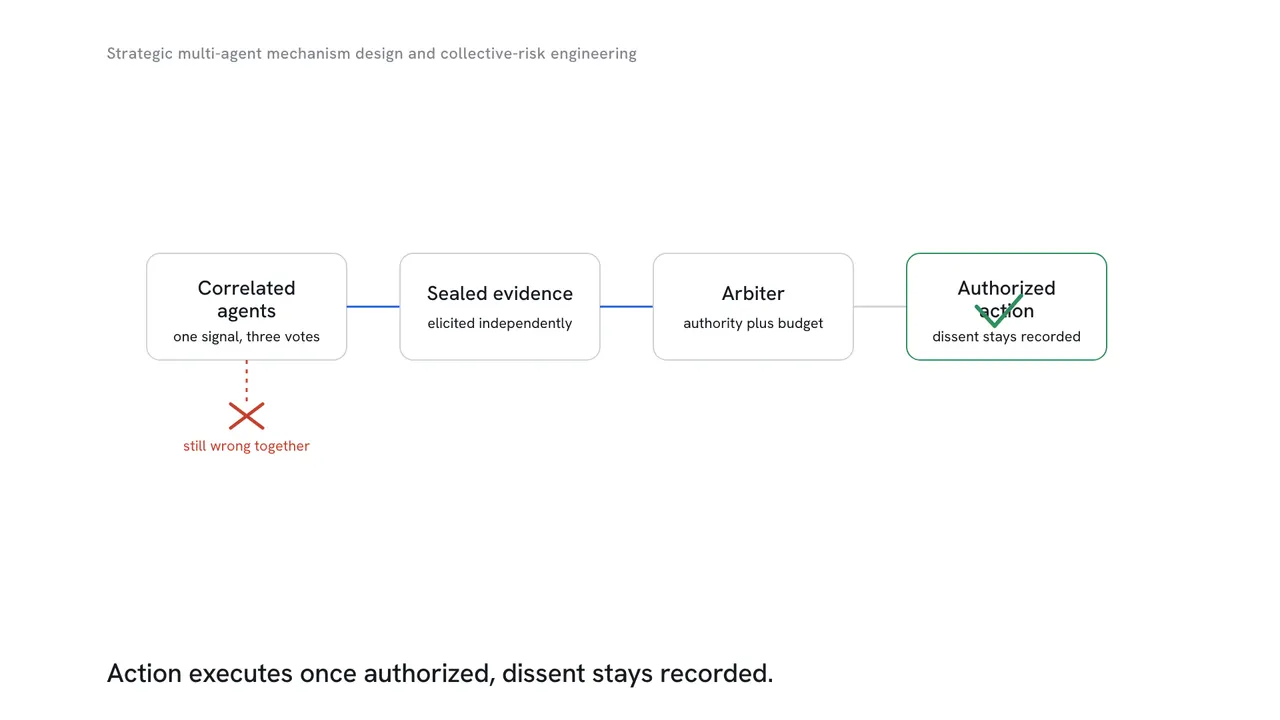
It enforces. A proposal out of arbitration is not an authorization: it must be checked against the current, externally held record of what its principal may spend, touch or commit, and that check must be atomic. Two agents that each see ten units of remaining budget and independently spend eight are individually within bounds and together forty percent over, unless the system reserves budget the moment it is committed rather than reported. Once the reservation clears, the effect executes, and the result, with any sealed dissent, is written to a record that survives the decision. Skip sealing and correlated evidence masquerades as consensus. Skip tracing and a majority becomes three votes for one fact under different names. Skip the deliberation budget and discussion turns into negotiation that reintroduces the conformity sealing was meant to prevent. Skip atomic enforcement and a resource limit respected by every agent still gets violated by the group.
How to lead it
Ownership belongs with whoever is accountable for the committed action, not the team with the most agents. Fund sealing and tracing at the same level as the model calls: a pipeline that passes correlated sources as independent ones defers its cost to whoever acts on the decision. Measure effective independence, not agent count: one untrusted tool result can turn well-behaved agents into a correlated failure no agent's success rate would predict. Stop funding any debate step used to establish correctness before checking whether the agents' errors are independent, and any workflow that treats agreement as authorization outside an agent's scope. Two decisions belong to an executive: how much budget a multi-agent process gets before a human approves the next tranche, and what standard of evidence a new design must clear against the single-decision-maker baseline before it earns a larger share of a live workflow.
What it is worth
The money collects in three places: congestion on shared compute and API quota that agents create the way reasonable drivers create traffic, correlated failures agents made together from a shared flawed source, and unauthorized commitments that slipped through because no single request looked wrong alone. What the evidence does not support is a return figure for multi-agent coordination. The dossier is explicit that no 2026 evidence establishes truthful, incentive-aligned autonomous collectives under real deployment incentives, that the swarm comparison carries an unequal compute confound, and that the delegated-play truthfulness proofs have not been fully checked. Measure effective independence, joint tail risk and unauthorized-attempt rate on the organization's own workload before and after adding an agent, and build the case from those numbers, not an external claim.
Questions leaders ask
- Does adding more AI agents to a decision make it more reliable?
- Not automatically. The dossier behind this piece works a constructed example where three advisers copying one shared signal are right seventy percent of the time by majority vote, while a single adviser with an independent, more reliable signal is right ninety five percent of the time. Counting agents instead of asking where each one's evidence actually came from can make a crowd less accurate than the one adviser who genuinely knows.
- Can AI agents grant each other more authority just by agreeing in conversation?
- No, and treating agreement as authorization is the exact failure the sealed-evidence arbiter is built to prevent. Every effect has to be checked against a principal's currently valid budget and approval, held outside the conversation, with reservations made atomic. Two agents that each see ten units of budget and each independently commit eight are both individually within bounds and together forty percent over it unless that check is atomic.
- Is letting AI agents debate each other a reliable way to reach a correct answer?
- Debate is a communication procedure, not a solution by itself. The dossier treats it as something that can appear inside a team problem, a game or a delegation problem without resolving any of them on its own, and left unbounded it can reintroduce the conformity that sealing evidence independently was meant to prevent. Bound the discussion and seal judgments before it starts, rather than trusting the conversation to converge on the truth.
- Does training AI agents against adversarial scenarios make a multi-agent system safer?
- The available evidence does not go that far. One 2026 red-teaming study evolves the environment agents are tested against while keeping the attacker and target models themselves frozen, which searches for weaknesses at test time. It does not demonstrate that training a target model on those evolved environments produces a durable strategic safety gain, and that distinction should not get collapsed in a board presentation.
- When should a business use one AI decision-maker instead of a multi-agent system?
- When authority is genuinely concentrated, the relevant facts can be made explicit, and arbitration is cheap, a single accountable decision-maker with independent advisers usually beats a multi-agent design outright. Distributed execution earns its place when tasks are genuinely separable, agents truly observe different things, and any latency benefit survives the coordination and reconciliation cost, not merely on the assumption that more agents feels safer.


