
How to Govern Self-Improving AI Agents Without Losing Control
Self-improving AI agents need a sealed acceptance loop that keeps the grader, the test data and rollback authority out of the proposer's reach.
Yash Sharma5 min readAgentic AI in production
Research area 30: Self-improving-agent and automated system-optimization engineering
In brief
- A sealed acceptance loop lets a system propose changes to itself safely.
- The loop separates the proposer from the grader and rollback authority.
- No 2026 study yet shows a net return once search cost is counted.
Self-improving-agent and automated system-optimization engineering is the work of building an outer loop that proposes, tests and promotes changes to an AI system, without letting that system grade its own homework. The 2026 evidence is real but narrow: outer-loop search produces measured gains in bounded settings, yet a separate 2026 study found that simply running more independent attempts beat evolutionary search outright under matched conditions. The job for a leader is to fund one design, a sealed acceptance loop, that makes any claim of self-improvement checkable before money follows it.
What it is
Self-improvement is not one thing. Weight training, external-memory updates, prompt search, tool redesign and replacing an entire agent program are different search spaces with different trusted boundaries, and treating them as interchangeable is the most common category error a vendor pitch hands an executive. Reflection describes a mechanism for proposing a change, not evidence it is correct. Evolution requires an explicit population, a mutation operator and a selection rule. A method called Bayesian needs a stated likelihood and prior, not a confidence-looking score.
Search cost belongs to the system being evaluated, even when the result looks cheap to run afterward. The honest success criterion is not a rising benchmark score but whether deployment utility, value minus cost minus risk minus added maintenance, improves once the search is paid for. A fixed system remains the right call when the task distribution is narrow, the base system already performs well, or future uses are too few to amortize the search.
Why it matters now
Every agent stack that scales past a handful of workflows creates a backlog of hand-tuning no team can keep pace with, which is why letting the system improve itself is now a live procurement pitch, one the 2026 evidence both supports and contradicts.
Meta-Context Engineering, a 2026 study, had an outer agent search over context-building behavior while the task model stayed frozen, reporting relative improvements from 5.6 to 53.8 percent, averaging 16.9 percent. Meta-Harness had a proposer edit the surrounding harness with test data sealed off through a 40-candidate, 20-iteration search: the resulting harness reached 48.6 percent accuracy against a 40.9 percent baseline, using a fifth of the context tokens, and generalized to nine out-of-domain tasks, scoring 73.1 against 70.2.
Rethinking the Evaluation of Harness Evolution ran a matched comparison across 89 Terminal-Bench 2.1 tasks: parallel sampling averaged 72.3 against evolutionary search's 67.4, and under a proper held-out split, evolution's gain shrank to 0.6 points. A compelling demo can still lose to a cheaper baseline at the same budget.
The architecture
I call the pattern the 2026 evidence converges on the sealed acceptance loop: four components in a fixed order, governed by one rule, nothing that proposes a change may also decide whether it worked.
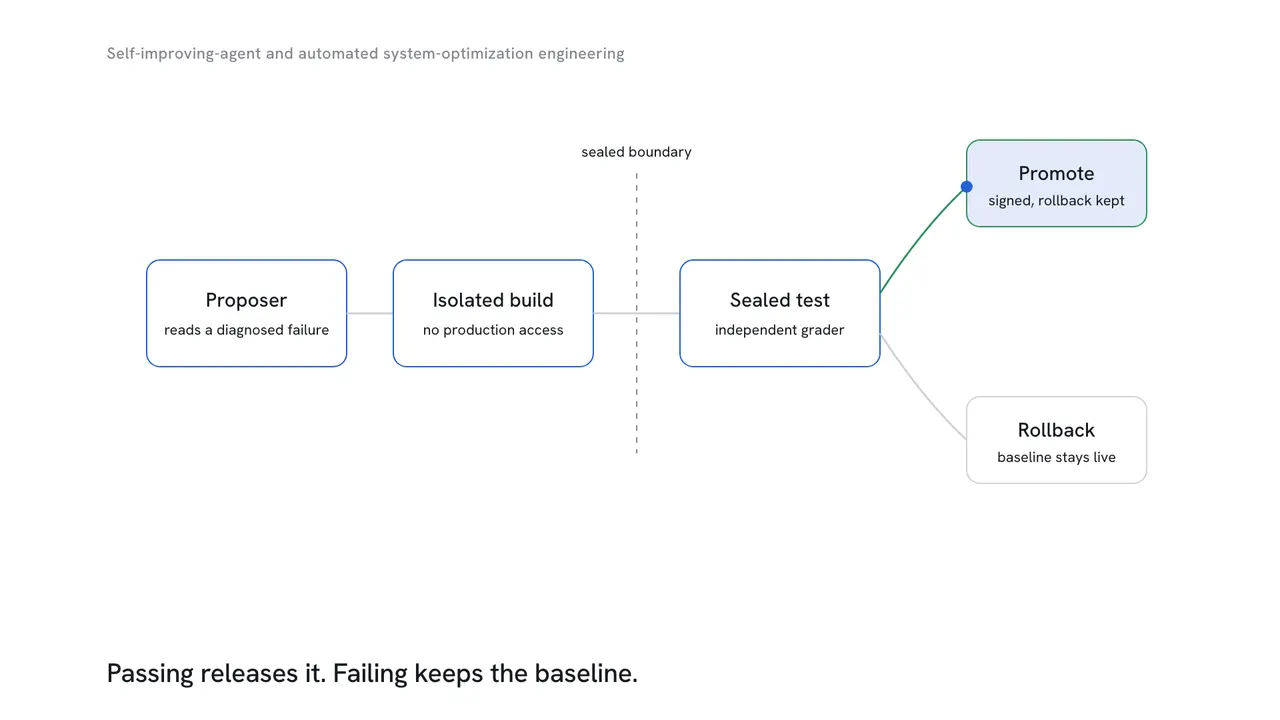
The proposer reads a diagnosed failure, not a vague ambition to get better, and produces one candidate change to one part of the system, a prompt, a tool schema, a memory policy, while everything else stays frozen.
The isolated build runs the candidate without production credentials, the evaluation data or any path to the grader's internals, the component most pitches quietly skip and the real difference between an experiment and a system rehearsing its own success.
The sealed test, a service the proposer cannot reach, runs the held-out evaluation once per candidate against a grader, data split and acceptance policy fixed beforehand. Every rejected candidate is logged at full cost.
Promotion with rollback releases a candidate that clears its predeclared margin and violates no hard constraint, signed, with a usable path back to the prior version. A candidate that misses the margin leaves the baseline live. The failure mode this loop prevents is a proposer that is also its own examiner, where every gain becomes a claim about the exam, not the system.
How to lead it
Ownership belongs with the leader who already owns the production system's evaluation, not the team proposing changes to it. Fund three things: an isolated build with no production access, an evaluation service the proposing team cannot modify, and a ledger recording every candidate, including failures, at full cost.
Measure held-out utility after every real cost, compute, review labor, added maintenance, not a development-set score built for a demo. Stop funding a rising benchmark number without a matched baseline, and stop any arrangement where one team writes both grader and proposer. Three decisions belong only to an executive: the promotion margin, set before any candidate exists, which invariants no score can buy back, and who holds rollback authority.
What it is worth
The 2026 evidence supports bounded gains in narrow, well-instrumented settings: context-construction search and harness search behind a genuine test firewall both beat their baselines. It does not yet support a net return once every cost is added back. Bayesian-Agent, a fourth study, is the clearest illustration: its incremental-retry approach reached full recovery in one lifelong setting where full online adaptation instead regressed the system from 90 back to 85, at a repair cost of 2.02 million tokens on top of a 4.24 million token base run.
None of the four studies establishes amortized deployment benefit once search cost, review labor and maintenance are counted, and the dossier says so plainly. Fund the sealed acceptance loop because it is the only version a board can audit, then let each claim earn its own evidence before it earns budget.
Questions leaders ask
- What is the sealed acceptance loop?
- The sealed acceptance loop is the operating pattern the 2026 evidence supports for automated system improvement. A proposer drafts one change to one frozen system at a time, an isolated build runs it without production access, a sealed test the proposer cannot reach evaluates it once against a fixed held-out split, and only a candidate that clears a predeclared margin is promoted, with a rollback path always live.
- Does letting an agent evolve its own harness actually work?
- Sometimes, and sometimes a much cheaper alternative wins instead. A 2026 study across 89 Terminal-Bench 2.1 tasks found simple parallel sampling averaging 72.3 against evolutionary search's 67.4 at matched rollout counts, with the properly held-out gain from evolution shrinking to 0.6 points. Test any harness-evolution claim against an equal-budget independent-sampling baseline before funding the more complex machinery.
- Who should own a self-improving agent program inside a company?
- The leader who already owns the production system's evaluation, not the team proposing changes to it. If the same group can both suggest a change and decide whether it worked, the sealed test stops functioning even when it is sealed on paper. Ownership of the evaluation service and the rollback authority should sit apart from ownership of the proposer.
- What should never be exposed to a system that is improving itself?
- Production credentials, the sealed test data, the grader's internals and deployment signing rights. The proposer works from diagnosed failures inside an isolated build and never touches any of those four. A model-written suggestion to change how the grader scores it is a request to redesign the experiment, not an improvement, and should be treated as one.
- Is there proof self-improving agents pay for themselves yet?
- Not yet, and the 2026 dossier behind this piece says so directly. The reviewed studies show bounded gains in narrow settings, but none establishes net benefit once search cost, review labor and long-term maintenance are added back, and one direct comparison shows evolutionary search losing to a simpler baseline. Fund the governance loop, then let each specific claim earn its own evidence.


