
Loop Engineering: How to Control When an AI Agent Stops
AI agent loops need a controller that can accept, repair, wait, reconcile, escalate or stop, not one that runs until it claims success.
Yash Sharma5 min readAgentic AI in production
Research area 22: Loop, feedback-control and termination engineering
In brief
- A controller must decide after every step whether an AI agent should keep going, not the agent itself.
- The named framework is the six-verdict controller: accept, repair, wait, reconcile, escalate or stop.
- Skipping this layer wastes budget on unaudited retries and lets confidence, not correctness, decide when work stops.
An agent that keeps looping until it succeeds is not being thorough. It is running an unaudited retry engine against the company's budget. Loop, feedback-control and termination engineering designs the rule that runs after every step: verify the evidence, then accept, repair, wait, reconcile, escalate to a person, or stop, measured against a goal and budget the agent cannot quietly rewrite for itself. Get this wrong and an agent's confidence, not its correctness, decides when the work stops.
What it is
Loop engineering designs the controller that sits between an agent's actions, deciding after every observe, act and verify cycle what happens next. It differs from a state machine, which only defines legal transitions, a planner, which chooses the action, and a verifier, which supplies evidence the action worked. The controller turns that evidence into one of six decisions.
Four principles hold this together. A bounded number of remaining steps guarantees only that the agent will eventually stop, not that it will be right. Progress must be measured by an independently verified milestone, never activity, since a rising count of tool calls can climb while the agent circles the same unresolved problem. The objective and acceptance evidence must live outside the workspace the agent can edit, since an agent that can lower its own bar can always claim it cleared it. A stalled agent, returning to the same state without new evidence, should trigger human review, not another attempt.
The stakes are rising because more production systems run unattended in a loop with a real budget and real external effects on every cycle. A large 2026 scan of public repositories found loop patterns confirmed in 217 of 256 heuristic matches across 36,710 repositories screened, though the same study's controlled test of whether the practice improves outcomes was still planned, not executed, so adoption reflects habit, not proven gain. A 2026 study of semantic early stopping on 60 held-out HotpotQA tasks found a cheap, judge-free stopping rule cut token spend 38% against a measured quality difference of just 0.004, while a full per-round judge cost 129% more, a gap the authors did not certify as proof the approaches are equivalent.
The architecture
I call this the six-verdict controller: after every cycle, independent verification hands it evidence, which it must resolve into one of six outcomes rather than defaulting to another attempt.
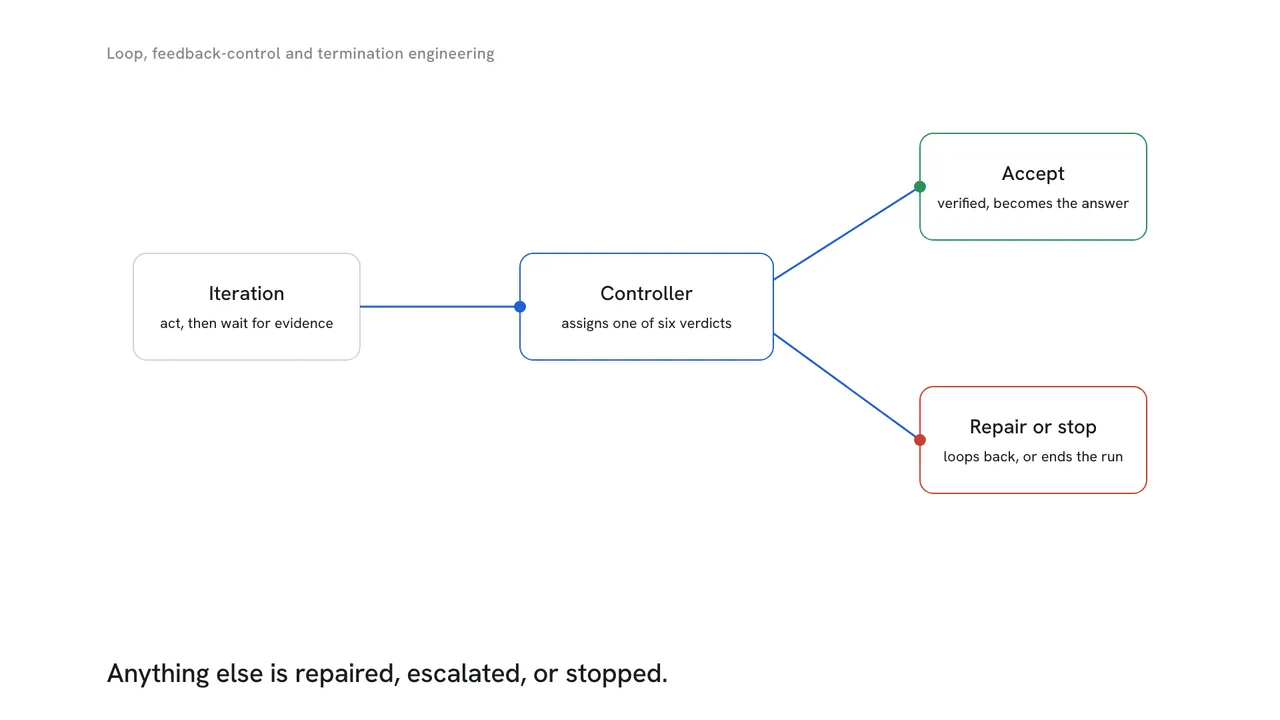
The agent observes the current state, proposes an action, and executes it under an authorization rechecked at the moment of effect, not only when the plan was made. Verification then runs independently of the agent's own account, returning not just a verdict but the property checked, the evidence for it, and its scope, so a partial pass is never mistaken for a general one.
The controller assigns one of six verdicts. Accept applies only when evidence proves the required end state was reached. Repair applies to an actionable error whose expected gain, priced against the chance of damaging a correct answer, beats the cost of the next step. Wait applies to a real external dependency and always carries a deadline. Reconcile applies to an ambiguous effect, such as a partially succeeded action, and is resolved against the authoritative record, not by repeating it. Escalate applies when authority is missing, the goal has shifted, or the state repeats without new evidence. Stop applies once a hard budget or deadline is reached, returning the best verified artifact so far, not silence.
An unknown verdict must never quietly become a pass, since a controller under pressure to finish will round uncertainty in its own favor. Agreement is also not independence: three reviewers sharing one hidden blind spot, each wrong 20% of the time, will agree unanimously and still be wrong 20% of the time.
Ownership belongs with whoever is accountable for what the agent's actions cause. Fund independent verification that does not ask the agent to grade its own work, a budget ledger enforced deterministically, and a bounded repair loop compared against a one-shot baseline before anything adaptive. Measure the controller by its verdicts: false accepts, escalation rate and cost, and total cost per accepted outcome against a matched baseline. Two calls belong to the executive alone: the budget ceiling, retry limit and escalation recipient set in advance, since stopping at a partial result is itself a policy choice, and whether a workflow may run an agent unattended past a fixed time horizon at all.
What it is worth
The money, risk and time at stake show up in three places: spend burned by a loop with no real stopping signal, the cost of a repair that damaged a correct answer, and the cost of building an escalation path only after it was needed. None of the three primary studies reports a validated dollar return, and none should be assumed here.
Measure before and after against matched baselines: a one-shot response, a fixed short loop, and blind retries at the same budget. Treat a clean result with caution: with zero observed failures across 30 independent trial runs, the honest one-sided upper bound on the true failure rate is still about 9.5%, not zero.
The available 2026 evidence supports testing verification and repair together against a one-shot and a fixed short-loop baseline. It does not support a single best controller for every workload, a proven general productivity gain from looping itself, or a dollar figure for what any of this returns.
Questions leaders ask
- What is loop, feedback-control and termination engineering, in practical terms?
- It is the discipline that decides, after every step an AI agent takes, whether to accept the result, repair it, wait, reconcile an uncertain effect, escalate to a person, or stop, using a goal and a budget the agent cannot rewrite for itself. In practice that means independent verification runs after every action, and continuing is treated as a decision an agent has to earn each cycle rather than a default it falls into.
- Does letting an AI agent loop longer usually produce a better answer?
- Not reliably. A 2026 study of verify-repair-stop controllers found that repairing an already strong answer can carry more expected downside than upside once the chance of damaging a correct result is priced in, and a separate study on semantic stopping found only a 0.004 quality difference between a cheap stopper and a costlier one, a gap the authors did not certify as proof the two are equivalent. More iteration can add real evidence, or it can just add cost and risk.
- How can a business tell whether an AI agent stopped safely or just gave up?
- By which of the controller's six verdicts closed the run. Accept means independent evidence proved the required end state was reached. Stop, on a hard budget or deadline, should still return the best independently verified result produced so far rather than silence. Escalate means the system recognized it needed a person. A safe stop is a documented, evidenced decision, never an agent quietly running out of turns and reporting success anyway.
- What decisions about agent loops should stay with an executive rather than an engineering team?
- Two decisions. Setting the budget ceiling, retry limit, and named escalation recipient in advance, before any run's evidence exists, since stopping at a partial result is itself a policy choice. And deciding whether a given workflow is authorized to let an agent operate unattended past a fixed time horizon at all, since a controller that convinces itself the work is finished is a worse failure than one that stops and asks.
- If three separate AI checks all agree, can that be trusted like three independent human reviewers?
- Not automatically. The research behind this essay models three reviewers who share one hidden blind spot and are each wrong 20% of the time: they will agree unanimously and still all be wrong 20% of the time, not the much smaller rate that treating their agreement as three independent confirmations would suggest. Real assurance requires a genuinely different check, such as an independent recomputation, not another AI reviewer built the same way.


