
Workflow Orchestration: Why Durable AI Needs an Effect Ledger
Durable execution replays a workflow's own history, not the actions it takes outside itself. The effect ledger framework, and what leaders should fund.
Yash Sharma5 min readAgentic AI in production
Research area 24: Workflow, orchestration and durable-execution engineering
In brief
- Durable execution replays a workflow's own history, not the effects it caused outside itself.
- The effect ledger separates that history from a governed record of external actions, tied by one identifier.
- It cuts duplicate charges and lost actions, though no dollar return figure exists yet.
Workflow orchestration and durable execution engineering keeps a long running AI process correct after a crash, a retry or a wait, not just fast when everything goes right. The mechanism worth funding is durable execution: an engine that remembers every completed step of a workflow's history so a run can resume exactly where it left off. That mechanism does not, by itself, guarantee an email was sent once, a payment cleared once or a record changed once. Those are effects outside the engine, a separate promise from durability inside it.
What it is
A workflow is an explicit transition system: a defined set of states and rules for moving between them. A saga recovers processes that cannot be made atomic across systems through compensating actions, new actions in their own right, not an undo. Event sourcing reconstructs a workflow's true state by replaying its ordered history of events, not by reading one mutable record.
The principle a leader has to hold is the difference between a workflow's own history and everything it touches outside itself. It can replay its own decisions with complete fidelity, not a payment that already cleared. A model's running notes are not authoritative workflow state and must never be treated as a transaction log.
A study first published in August 2026 tested a data analysis agent on KramaBench, 104 tasks spanning 1,700 files: one model's task score rose from 64.0 to 74.6, a gain of 10.6 percentage points, after adding semantic transaction structure, while a second model's score rose from 74.2 to 77.4 as its cost per task rose roughly fivefold, from about 12 cents to about 61 cents. Both results show higher task accuracy at a higher price, not proof that external writes became atomic, isolated or durable. Temporal's August 2026 report on durable multi agent systems states that durable control flow does not remove the obligation to deduplicate a retried effect on the receiving side. Oracle's September 2026 report on transaction aware durable execution adds that coordinated transactions only hold across resources that support that protocol.
The architecture
The clearest way to hold this together is what I call the effect ledger: a discipline that keeps a workflow's own durable history separate from a governed record of every action it takes outside itself, joined only through a stable identifier.
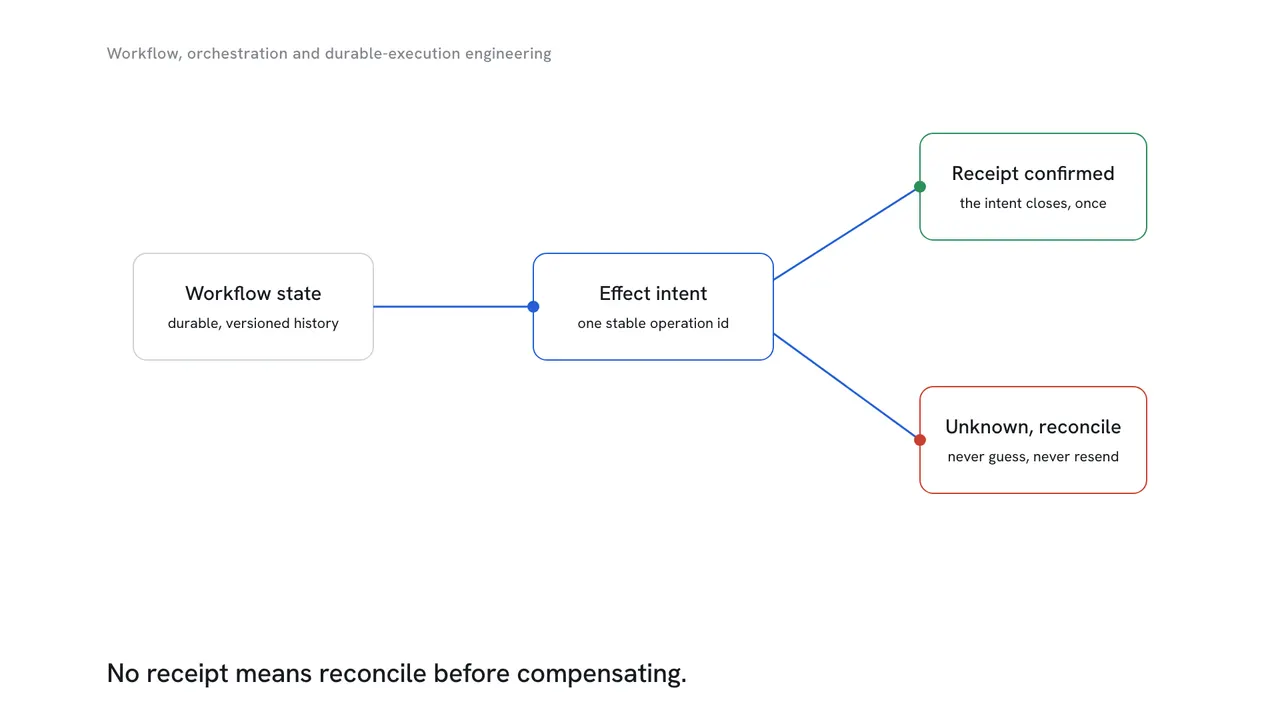
The ledger has four parts. Workflow state is the durable, versioned record of the transition system. An effect intent is created the moment the workflow decides to act outside itself, carrying one stable identifier and its arguments, written durably before anything is sent. Dispatch sends that same intent to the external system, making a retry safe rather than a duplicate. An effect receipt is the external system's confirmation, tied to that identifier, that the action completed.
The decision point that matters most sits right after dispatch. A returned receipt lets the ledger commit it. No receipt within the expected window means marking the effect unknown and reconciling it by querying the external system's authoritative status, before proceeding, retrying under the same identifier or compensating. Reconciliation depends on the receiving system offering a real status check, which not every integration provides.
The failure mode worth naming is treating compensation as an undo. A refund does not erase the fact that a notification already reached a customer. Compensation is a second, independent action with its own receipt and its own chance of failing, tracked as carefully as the action it corrects.
Ownership sits with whoever answers for the business process, not a platform team: the platform lead owns the shared contract, each process leader owns what to retry, wait for or refuse.
Fund, in order: a durable engine with a committed effect ledger for anything touching money, contracts or customer communication, receiver side deduplication with every external system called more than once, a reconciliation path that queries real external status, and version pinning so a running workflow finishes on its own definition. Stop funding any integration that only retries until success, since that turns a timeout into a duplicate charge.
Measure lost work, duplicate effects, time unreconciled, and how often a workflow keeps acting after its authorization expired. Two decisions do not belong to engineering alone: the compensation policy, what counts as an acceptable correction and who approves one, and the migration policy for a workflow already in flight. Both sit with the executive who owns the process.
What it is worth
The money shows up in three places: duplicate external effects that must be refunded or reversed, workflow runs stalled in an unreconciled state consuming support time, and the audit cost of reconstructing what a workflow did when its logs conflated model text with committed fact. Measure before and after with the same yardstick: real external effects from the receiving system's own record, not the workflow's self reported success, tracked alongside the reconciliation backlog, duplicate effect rate, throughput and cost. The available 2026 evidence supports that durable orchestration helps and that vendor implementations already build effect deduplication into their examples. It does not support a claim that any current system achieves exactly once external effects, and it does not support treating a task score gain, however real, as proof of transactional correctness. No independent, third party study of fault injection across these engines exists yet, and no dollar return figure for this specific investment appears in the evidence, so none is claimed here.
Questions leaders ask
- What is durable execution, exactly?
- It is the property of a workflow engine that persists every completed step of a process so a run can resume from that history after a crash, a deployment or a long wait. It protects the workflow's own record of what it decided. It does not, by itself, guarantee that an external action such as a payment or a message was completed exactly once outside the engine.
- Does a higher AI agent task score prove transactional correctness?
- No. A study first published in August 2026 tested a data analysis agent on 104 tasks and reported real accuracy gains from adding semantic transaction structure, in one case 10.6 percentage points. That is a measure of task quality, not proof that the system's external writes became atomic, isolated or durable in the database sense. The two claims need to be tested and reported separately.
- What should we fund first if we are building this capability?
- Start with a durable engine and a committed effect ledger for any workflow touching money, contracts or customer communication, paired with a receiver-side deduplication contract for every external system it calls more than once. Add a reconciliation path that queries real external status before adding any autonomous planning layer on top.
- Can a compensating action undo a mistake completely?
- Not fully. A refund can reverse a charge, but it cannot erase a notification a customer already read or an action an external party already observed. Treat every compensation as a new action with its own receipt and its own chance of failing, tracked with the same discipline as the effect it is correcting.


