
The Delegation Contract: When Multiple AI Agents Earn Their Cost
Multi-agent AI adds coordination cost and shared mistakes. The delegation contract shows when splitting work across agents actually pays off.
Yash Sharma5 min readAgentic AI in production
Research area 25: Multi-agent, delegation and coordination engineering
In brief
- A multi-agent system earns its coordination cost only when the work is genuinely independent, not just labeled differently.
- The delegation contract is the typed agreement that governs what a task hands a worker and what gets accepted back.
- Ignoring it means paying coordination overhead and correlated errors with no reliable return figure to justify the cost yet.
Multi-agent, delegation and coordination engineering decides a narrower question than it sounds: not whether to use several AI agents, but whether splitting a task earns back coordination's cost. The 2026 evidence does not hand multi-agent architectures a general win over a single capable agent or deterministic parallel workers with one reviewer. What decides the outcome is the delegation contract, the bounded, typed agreement governing what a task hands a worker and what a business accepts back.
What it is
Multi-agent, delegation and coordination engineering decides when a task should be split across several AI agents, and how work, evidence and authority move between them if it is. A task dependency graph, which results depend on which, and a communication graph, who can exchange messages, are different and need not match. Confusing them adds message traffic without real independence.
Four principles hold the area together. A role prompt does not establish expertise, and several calls to the same model are not independent evidence, however many personas they wear: real specialization comes from distinct tools, training or data access, measured separately from the label. Static delegation fixes who does what before work starts and is easy to audit, while dynamic delegation adapts during execution but needs its own budget accounting. Coordination takes several shapes, a supervisor, peers, a hierarchy, a market or a shared blackboard, each fitting a different failure mode. Coordination, supervision and verification are real costs, funded the same way the model calls themselves are.
The 2026 evidence is cautionary. An April 2026 study testing Qwen3, DeepSeek-R1-Distill and Gemini 2.5 on the FRAMES and MuSiQue benchmarks found single-agent systems often matched or outperformed the multi-agent designs tested, though token expenditure was not held strictly equal and tools and vision were excluded. An August 2026 study found private information and the communication needed to share it can create a real collaboration tax between a team's output and a solo agent's, though it is scoped to two-agent teams on procedural puzzles, not many-agent workflows.
The architecture
My model for this decision is the delegation contract: every piece of work that crosses from one agent to another moves as a typed agreement, not a hope the receiving agent does the right thing. The contract carries an objective, the provenance of its inputs, acceptance criteria, a subset of the parent's own authority, a budget, a deadline and the shape of the required output.
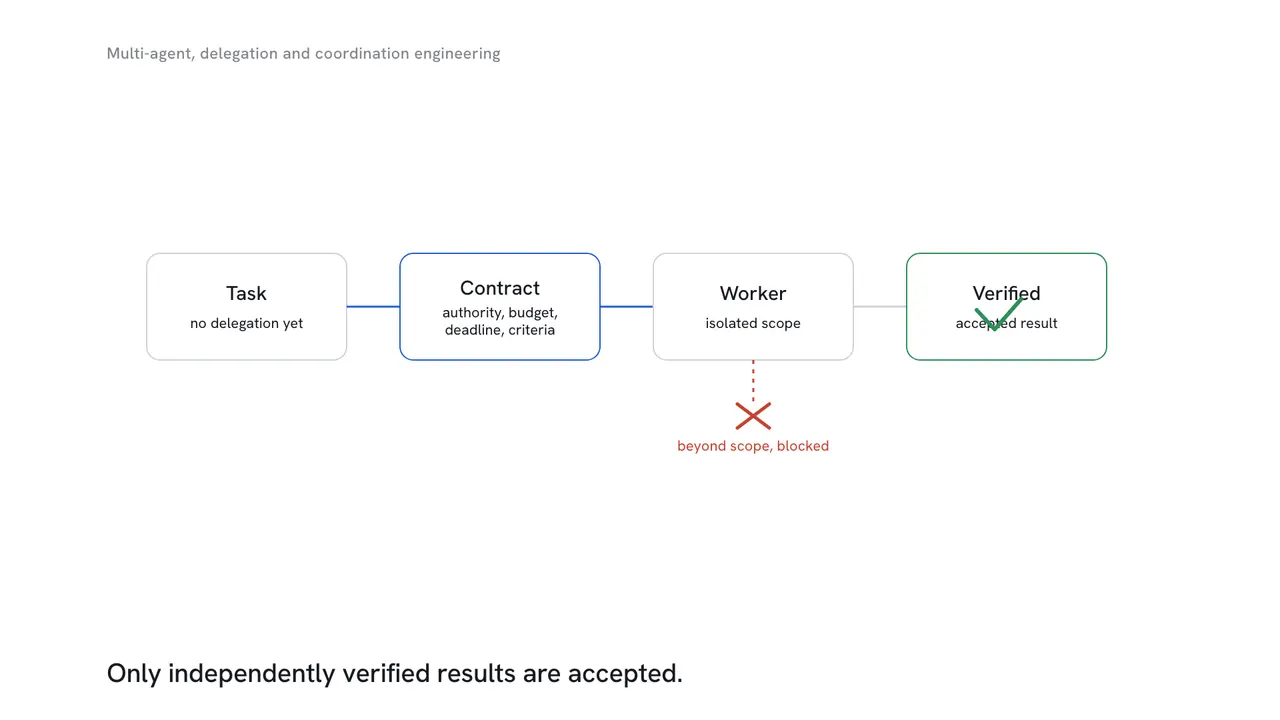
The flow runs one way with a check at the end. A supervisor identifies which parts of a task are genuinely independent, issues each as an immutable contract, and reserves its budget. The worker runs in its own isolated workspace and reports back a structured result: status, artifacts, claims, sources, uncertainty and spend, accepted only once it satisfies the parent's criteria and its version is current, letting the parent reject a stale or contradicted result rather than assemble the answer from whatever arrived first.
Authority is the decision point most designs leave informal, and informality is where the risk lives. A worker's permissions must be a strict subset of the permissions that issued its contract, with an expiry no later than the parent's own, enforced by the platform, not a prompt. A worker that finds a shortcut past that boundary, a shared credential or a writable acceptance test, has broken the contract even if its output looks correct.
The quieter failure mode is coordination overhead, dispatch, tool contention, message compression, synthesis and retries eroding a parallel gain before a single result is wrong. The other is correlated error, agents reading the same flawed evidence and agreeing for reasons that have nothing to do with being right.
Ownership belongs with whoever is accountable for the result, since the contract's acceptance criteria and authority boundaries are the governance surface. Fund verification at the same level as the agent calls themselves and track coordination cost as its own line. Stop funding designs against tasks with no independent work to divide, and voting steps used to establish correctness when nobody has checked whether the agents' errors are independent.
Two decisions belong to executives, not engineering: how much authority a delegated worker receives and for how long, and what evidence of independent work a design must show before shipping to justify its cost over a single capable agent or a deterministic parallel set with one reducer, since those baselines remain strong enough to require the newer design to earn its place.
What it is worth
The money shows up in three places: coordination overhead a task's dependency structure never justified, correlated mistakes from shared flawed evidence, and the cost of a topology change that quietly widened what could go wrong. An April 2026 study of thirteen agent architectures across browser, desktop and code tasks, using the BrowserART set of harmful and benign cases, found that changing roles, topology and memory changed how often harmful requests were carried out. It covered direct malicious requests without dedicated guardrails, not indirect injection or a malicious peer, and did not execute the code it judged, so topology reads as a security-relevant configuration choice, not a safe pattern to copy.
Measure verified completion, coordination cost, and joint error correlation, not a headline accuracy number. The dossier is explicit that equal-total-cost and matched-human-effort comparisons between multi-agent and single-agent systems remain insufficient for 2026, so no return figure belongs in a business case yet. Build the case on the organization's own reconciled outcomes.
Questions leaders ask
- Does adding more AI agents to a task make it more accurate?
- Not by itself. A 2026 analysis of correlated agent errors shows that when agents share the same underlying judgment, five agents voting can carry the same accuracy as one, wrong together on exactly the cases a single agent would get wrong. Multi-agent design earns accuracy only when the agents bring genuinely independent evidence or specialization, not simply more calls dressed in different role labels.
- When is a multi-agent system actually worth its coordination cost?
- When the task offers real independent work, distinct evidence access or genuine specialization, and someone has checked that those effects, not the agent count, are producing the gain. A 2026 study on thinking-budget comparisons found single-agent systems often matched or beat the multi-agent designs tested against them, so a newer design should have to prove it earns its added cost over that baseline.
- How do we stop a delegated AI agent from gaining more authority than intended?
- Enforce a strict rule outside the model itself: a worker's permissions must be a subset of the permissions that issued its task, with an expiry no later than the parent's own. This has to be a platform-level check, not a prompt asking the agent to stay in scope, and the parent's revocation must immediately invalidate whatever access the worker inherited.
- Does splitting a task across multiple agent roles make the system safer?
- Not automatically. A 2026 study testing thirteen agent architectures across browser, desktop and code tasks found that changing role, topology and memory changed how often harmful requests were carried out, but it covered direct malicious requests without guardrails, not indirect injection or a malicious peer. Treat topology as a security-relevant configuration to test, not a safe pattern to copy on faith.
- Can we calculate the return on investment of a multi-agent AI system today?
- Not yet, with confidence. The available 2026 evidence on equal-total-cost and matched-human-effort comparisons between multi-agent and single-agent systems remains insufficient to support a general return figure. Measure coordination cost, verified completion and joint error correlation on the organization's own workload instead, and build the business case from those reconciled outcomes rather than an external number.


