
The Residual-Risk Chain: How to Prove an AI System Is Safe
AI safety is not a benchmark score. The residual-risk chain ties every hazard to a tested control, an evaluation and an owner who can roll it back.
Yash Sharma5 min readResponsible AI and governance
Research area 36: Safety, robustness and behavioral-assurance engineering
In brief
- A high accuracy score does not prove an AI system is safe to deploy.
- The residual-risk chain ties every hazard to a tested control, an evaluation and an owner.
- Skipping retests after benign changes is now cheaper to avoid than to explain later.
Safety, robustness and behavioral-assurance engineering decides whether an AI system stays inside acceptable behavioral bounds once it leaves the demo and meets ordinary use, adversarial pressure and its own drift. Executives tend to treat this as a single pass or fail score. The 2026 evidence says otherwise: a system can score well on capability and still fail on consistency, and a change made for an entirely benign reason can move its safety either way without warning. This essay names the discipline that prevents that surprise the residual-risk chain.
What it is
Safety, robustness and behavioral-assurance engineering defines, measures and bounds how an AI system behaves across ordinary use, distribution shift and adversarial pressure, and treats what remains after every control as a risk someone owns, not a number that reaches zero.
Failure must be defined by observable behavior and consequence, not tone or guessed intent: harmful compliance means the system carried out a defined harmful request, excessive refusal means it blocked a legitimate one, and deception needs a stated information discrepancy and a behavioral test. Robustness is measured only against a declared perturbation set of paraphrases, languages, tool faults or adversarial moves, and holding up against that set says nothing about conditions outside it. No single layer of defense is sufficient alone, since layers can share the same underlying model or flawed evidence, so their combined effect must be measured together, not assumed.
The two assumptions leaders lean on most, a strong accuracy score and a safety-focused review cycle, both proved insufficient in the 2026 evidence. A study that evaluated 15 models across GAIA's 165 tasks and 26 airline tasks, running five repetitions per task and scoring twelve metrics, found accuracy gains do not reliably carry over into consistency, robustness or predictability, the properties that determine whether a system behaves the same way twice.
A second study fine-tuned six open models on 1,000 generated benign examples translated into eight languages. The safety effect was uneven: some adversarial-compliance categories rose fourfold while others fell, with no reliable link to capability. Most release processes retest safety only after a change labeled safety-related. A benign fine-tune needs the same retest.
The architecture
My model for this area is the residual-risk chain: four linked stages that carry a hazard from first identification through to an owned, time-boxed risk decision, with nothing allowed to drop out silently.
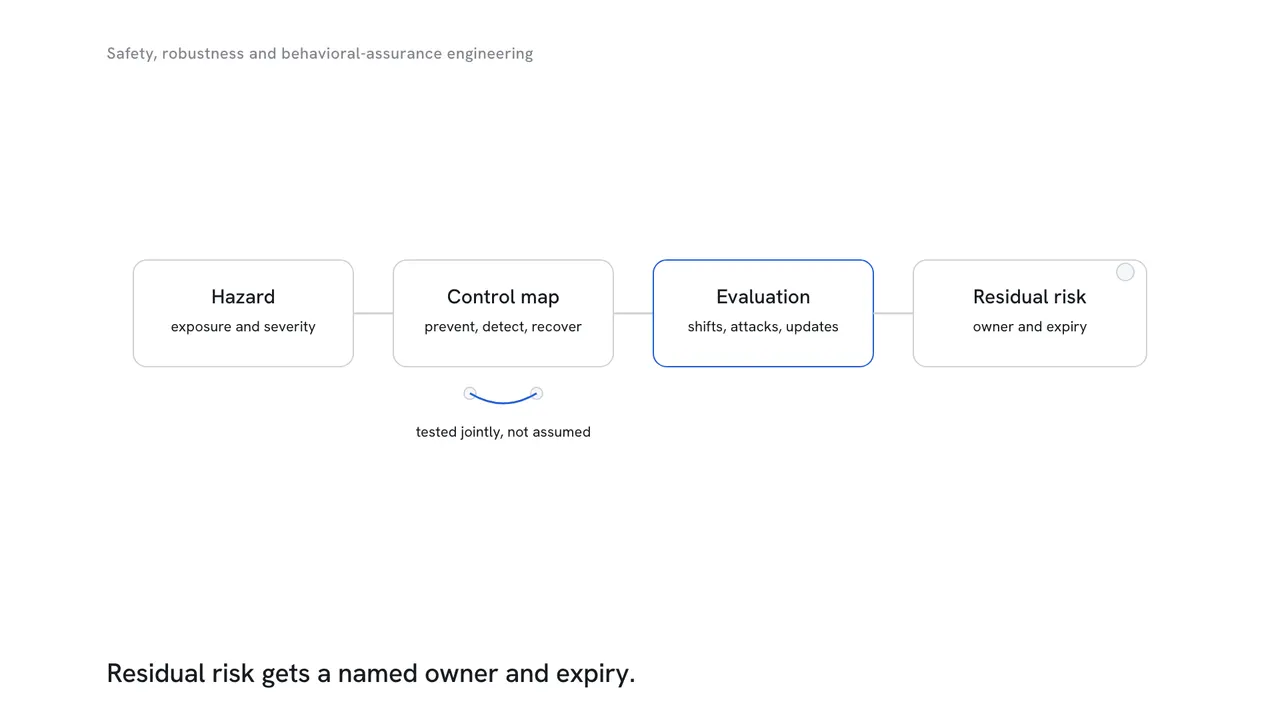
The chain starts with the hazard: a specific triggering condition, a countable exposure unit, a severity estimate and a named owner. It feeds a control map, which assigns preventive controls, detectors and a recovery path and records the independence assumptions behind them, since a preventive control and a detector sharing the same underlying model are one layer measured twice, not two. The arithmetic is unforgiving: if two defenses each miss 10 percent of attacks, their joint miss rate can fall anywhere between 0 and 10 percent, reaching the appealing multiplied figure of 1 percent only if the two are genuinely independent, which has to be tested, not assumed.
The control map feeds a safety evaluation, which runs the system across benign tasks, harmful tasks, distribution shifts and benign updates like the fine-tune above, recording realized effects against their own denominators rather than one blended score. A retrospective monitor is useful for learning what happened but is not a substitute for a pre-action constraint on an irreversible effect, since reviewing a trajectory 30 minutes after it ran cannot undo what it already did.
The chain ends at residual risk: whatever known failures and compensating controls remain once evaluation is done, assigned to a named owner with an expiration date and a rollback condition. A risk with no owner and no expiration is forgotten, and forgetting it is how a validated system drifts out of its tested envelope.
How to lead it
Ownership belongs to a named decision owner for each hazard category, not a review board that can discuss but not act. Fund joint evaluation of the full control stack: an untested combination has an unknown, not a measured, contribution to safety.
Measure a multidimensional reliability profile rather than one accuracy number, joint failure rates across the full stack rather than each layer's rate multiplied together, and refusal counts against their own legitimate-task denominator. Retest after every model, prompt, tool, memory or policy change, including changes labeled benign. Stop funding releases built on a single benchmark score, untested defense stacks, and vendor retrospective monitoring accepted as a verified detection rate.
Two decisions belong to an executive alone: how much residual risk to accept for a given hazard, and which capabilities warrant stronger containment before launch, reserved for actions with large irreversible consequences or broad access.
What it is worth
The money shows up in three places: incidents a genuinely tested control stack would have caught, over-refusal a poorly calibrated gate quietly imposes on legitimate work, and safety regressions discovered in production because a benign update was never retested. None of these show up on a single accuracy dashboard.
The 2026 evidence supports layered evaluation and exposes real regressions, including after benign fine-tuning, and treats retrospective vendor monitoring as useful for triage, not proof of prevention. It does not support zero risk, complete monitor recall, guaranteed harmlessness of every benign update, or additive protection from defenses never tested together. A credible business case reports what was actually measured and names who owns whatever risk is left.
Questions leaders ask
- Does a high accuracy score mean an AI system is safe to deploy?
- No. A 2026 study that evaluated 15 models across 165 GAIA tasks and 26 airline tasks, with five runs per task and twelve separate metrics, found that accuracy gains do not carry over into consistency, robustness or predictability. Treat those as separate measurements and inspect each before release.
- If we fine-tune a model only for a benign business purpose, do we still need to retest safety?
- Yes. A 2026 study fine-tuned six open models on 1,000 generated benign examples translated into eight languages and found the safety impact was uneven, with some adversarial-compliance categories increasing fourfold while others fell. A benign label does not predict safety effect, so retest after every fine-tune.
- Can we trust a vendor's own safety monitoring report as proof its AI agents are safe?
- Treat it as one input, not proof. OpenAI's 2026 account of monitoring internal coding agents describes reviewing trajectories roughly 30 minutes after completion, catching about 1,000 moderate cases among tens of millions. Catching known, escalated cases does not measure the false-negative rate, and retrospective review is not a barrier before an irreversible action.
- If two independent safeguards each catch 90 percent of attacks, does stacking them catch 99 percent?
- Only if they are genuinely independent, which is rare when they share a model, a prompt or a source of evidence. If each misses 10 percent, the joint miss rate can fall anywhere between 0 and 10 percent, reaching the multiplied 1 percent figure only under real independence. Measure the stack's joint failure rate directly.
- Does zero safety incidents during testing mean a system is safe at full production scale?
- Not by itself. Zero observed incidents across 100 independent, representative trials still leaves a one-sided 95 percent upper bound on the true incident rate of roughly 3 percent, material once a system runs at millions of exposures. Zero incidents is evidence about the tested sample, not proof the underlying risk is zero.


