
Governance Engineering: How to Prove an AI System Is Compliant
A written policy is not evidence. The assurance chain ties every AI requirement to an owner, a control and proof it still runs.
Yash Sharma5 min readResponsible AI and governance
Research area 39: Governance, compliance and auditability engineering
In brief
- A policy nobody enforces and cannot be traced to a deployed system is not governance.
- The assurance chain binds every requirement to an owner, a control, evidence and the exact deployment.
- EU Regulation 2026/1744 turns missed classification and stale evidence into calendar risk through 2028.
Governance, compliance and auditability engineering is the discipline of connecting an applicable requirement to a named accountable owner, an enforced control, current evidence and the exact system that evidence describes. Executives fund it as a single line item called governance, but a written policy nobody enforces and no one can trace to a deployed system is paperwork, not governance. The 2026 evidence gathered for this area shows a regulatory picture moving fast in specific places, and a documentation industry moving faster than the proof behind it.
What it is
Governance assigns decision rights and accountability for an AI system: who decided to build it, who can change it, who can stop it. Compliance is narrower, the obligations that actually apply given a jurisdiction, an operator's role and a use case. Auditability is narrower still: whether a decision can be reconstructed from evidence after the fact, not whether a policy describes how it should have been made.
Three principles hold the discipline together. Binding law, official guidance, voluntary standards, contractual commitments and internal policy are different kinds of obligation, and collapsing them into one list is the single most common governance mistake I see. Publication, adoption, entry into force and the date a provision applies are four different dates, and tracking only the first will misjudge deadlines. Accountability sits with a named person who can act, not a committee that can only discuss: a structure built to diffuse responsibility is also built so no one can stop an unsafe workflow in time.
Why it matters now
The stakes changed in 2026: jurisdictions moved from talking about agentic systems to writing rules for them. The European Union adopted Regulation (EU) 2026/1744, the Digital Omnibus on AI, on July 8, 2026, in force from July 27, with compliance dates staged into December 2026 and then 2027 and 2028: enacted law with a calendar attached, not a proposal in committee.
The cost is not hypothetical. A 2026 study of synthetic compliance monitoring found persuasive rationales can increase false acceptance rather than catch real violations, and a separate benchmark found predictable audit sampling can be exploited by an auditee who learns the pattern. Both are contained experiments, not proof of enterprise behavior, but both show the same failure: rigorous-looking compliance can still be gamed.
The architecture
The clearest way to build this is what I call the assurance chain: five links, requirement, owner, control, evidence and deployment, each binding to the next, so compliance traces from the rule that applies down to the exact running system it was checked against.
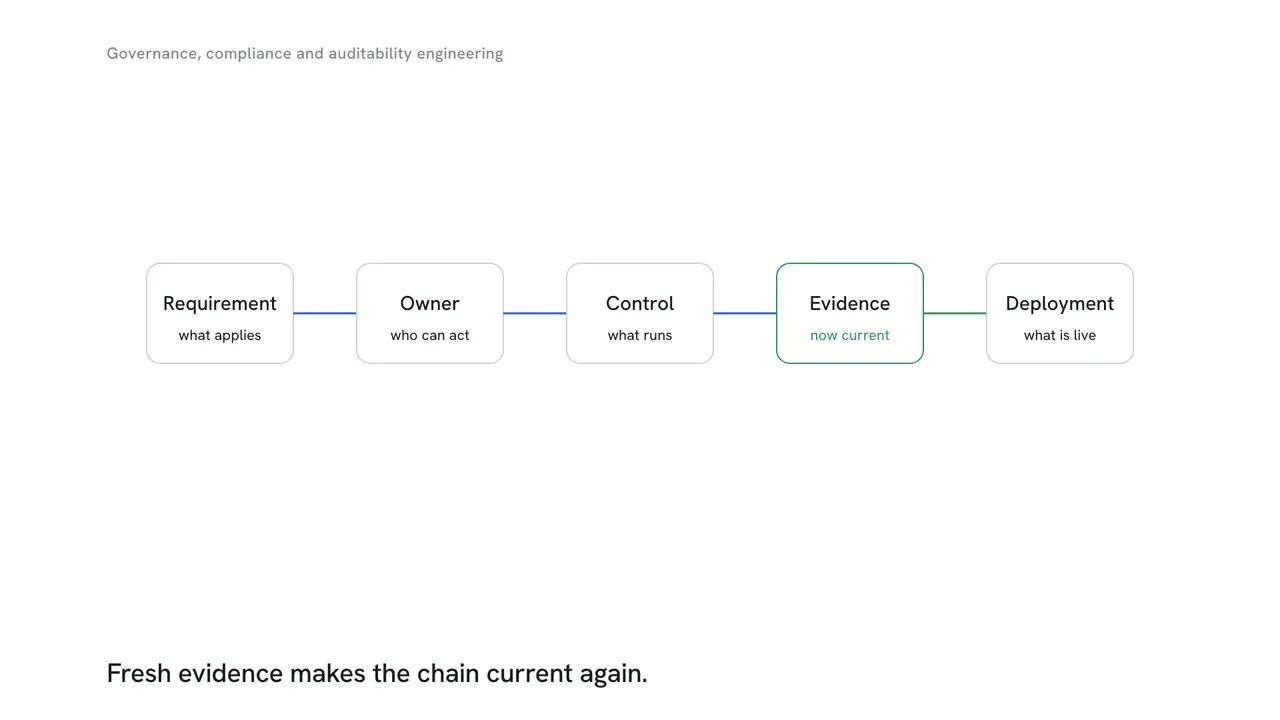
The requirement is tagged with its legal status, binding, guidance, voluntary, contractual or internal, and the jurisdiction, operator role and use case it applies to. The owner is a named business owner, technical owner, risk owner and release authority, recorded before anything is built. The control is the mechanism, technical or procedural, that satisfies the requirement. Evidence is where most programs quietly fail: it has to show the control ran and had the intended effect, a test result or a deletion record, not a document describing what the control is supposed to do. The deployment is the exact model, prompt, tool, policy and environment version the evidence was checked against, and it is where the chain breaks most often: a change to any of those can invalidate evidence that still looks current. Treat a stale link as broken, and reopen the chain whenever autonomy, data sensitivity or recipients change even without a model change.
A tamper evident log helps here, but a hash chain only proves no one has edited the middle of the sequence: an actor who controls the whole log can rewrite it end to end or truncate its tail. A working audit trail needs an independently anchored checkpoint outside the system it audits and a count of expected events.
How to lead it
Ownership belongs to a named person per use case, not a committee, which can set policy but should never be the only thing standing between a live system and a stop button. Fund three things first: an assurance chain implementation with automatic staleness checks, independent audit sampling kept separate from the audited team since predictable sampling can be gamed, and vendor diligence on data use and retention terms, with unresolved answers logged as open findings.
Measure outcomes, not paperwork: evidence coverage against current dependencies, time to reconstruct a decision, and the rate of findings marked unknown, since a rising unknown rate is information, not a failure to hide.
Three decisions belong to the executive alone: which frameworks the organization treats as its floor and why, what unresolved risk is acceptable before an irreversible action executes, and how quickly a reassessment must happen after a material change, before the next release, not the next incident.
What it is worth
The money and the risk show up at three points: engineering time spent maintaining documentation instead of enforcement, the cost of a missed classification or marking deadline once a binding provision's date arrives, and exposure when an irreversible action runs on stale or unknown evidence. The European Union's staged compliance dates, into December 2026 then 2027 and 2028, turn the first two into calendar risk, not an abstract concern.
Measure before and after on the assurance chain's own terms: share of requirements with valid, current evidence, time to reconstruct a decision, and rate of stale or unknown findings, at matched review cost. The 2026 evidence supports that documented frameworks give a shared vocabulary for controls, that written policy without enforcement is not evidence, and that audit sampling and compliance monitoring can both be gamed when predictable. It does not yet support an independent, organizational study proving any governance program reduces incidents or produces a stated return, and no such figure appears in the source evidence or belongs in this one.
Questions leaders ask
- What is the difference between governance, compliance and auditability?
- Governance assigns decision rights and accountability for an AI system, who decided to build it, who can change it, who can stop it. Compliance is the narrower set of obligations that actually apply, given a jurisdiction, an operator's role and a use case. Auditability is narrower still: whether a decision can be reconstructed from evidence after the fact, not whether a policy describes how it should have been made.
- Is the European Union's 2026 AI regulation only a proposal?
- No. Regulation (EU) 2026/1744, the Digital Omnibus on AI, was adopted on July 8, 2026 and entered into force on July 27, 2026, with compliance dates for specific provisions staged into December 2026 and then 2027 and 2028. Treating it as a still pending proposal understates its current legal force, though older EU law still shapes how any single deployment gets classified.
- Does a tamper evident hash chain prove an audit log was not altered?
- Not by itself. A hash chain reveals an edit only when an earlier or later commitment sits outside the log. An actor who controls the whole log can recompute the entire chain, and a truncated tail can still look like a valid prefix. The chain needs an independently anchored checkpoint and a count of expected events before it earns the description tamper evident.
- Should one committee own every AI governance decision?
- No. A structure built to spread accountability across many people is also a structure built so no single person can stop or roll back an unsafe workflow in time. Each use case needs a named business owner, technical owner, risk owner and release authority who can act alone in an emergency. Committees can set policy and review evidence, but the emergency stop belongs to a person, not a meeting.
- Does producing more governance documentation reduce AI incidents?
- The 2026 evidence does not support that claim either way. The frameworks and prototypes reviewed for this piece supply control vocabulary and audit trail designs, and separate studies found that predictable audit sampling can be gamed and that persuasive explanations can increase false acceptance in synthetic compliance tests. None of it is an independent organizational study proving that documentation alone reduces incidents.


