
The Four-Condition Test for Real Human Oversight of AI Agents
Approval screens are not oversight. Real oversight passes four conditions: comprehension, detection, timely intervention and real authority to act.
Yash Sharma5 min readResponsible AI and governance
Research area 44: Human–agent collaboration, interaction and oversight engineering
In brief
- A human approval step is not oversight unless it passes four conditions.
- The four-condition test names them: comprehension, detection, timely intervention, authority.
- The value is avoided loss net of review cost, and current evidence only supports narrow claims.
Human-agent collaboration, interaction and oversight engineering is the discipline of designing how people actually supervise AI agents, not the discipline of adding an approval button and calling the risk managed. The 2026 evidence says a person can look at every action an agent proposes and still fail to understand it, miss the error inside it, run out of time to stop it, or lack the authority to change it. Oversight that does not clear all four of those conditions is a compliance artifact, not a control.
What it is
Oversight covers five activities: setting the goal, watching progress, checking the evidence behind a claim, correcting an error and controlling execution when something goes wrong. Shared control spreads those decisions across a person and software. It does not spread accountability: someone still owns the outcome.
Calibrated reliance is the operating goal, using the agent when it is the better judge of a case and overriding it when it is not, judged on behavior rather than stated preference. Trust questionnaires measure how a person feels, not whether they catch errors, and the two diverge, which makes satisfaction a poor safety metric. Two distinctions matter: plan-level supervision and action-level confirmation need different interfaces, and the approval interface, the policy representation, the translation step and the enforcement engine are four separate layers. A well-designed screen cannot fix a missing enforcement layer.
Agents now act, not just draft: a model that once produced a memo now books the meeting, edits the repository, moves the money and closes the ticket, often across systems the reviewer cannot see at once. A counterbalanced study of 48 experienced users found plan-based oversight reduced exposure to a problematic action, an odds ratio of 0.25, but did not significantly change whether the person intervened in time or the final rate of successful attacks. Seeing the plan is not the same as stopping the harm inside it.
The architecture
The organizing idea is the four-condition test. Human involvement only counts as oversight when the person can meet all four conditions: understand what is proposed, detect a meaningful error inside it, intervene before the consequence lands, and hold real authority to stop or change the outcome. Fail one and the review step is theater dressed as governance.
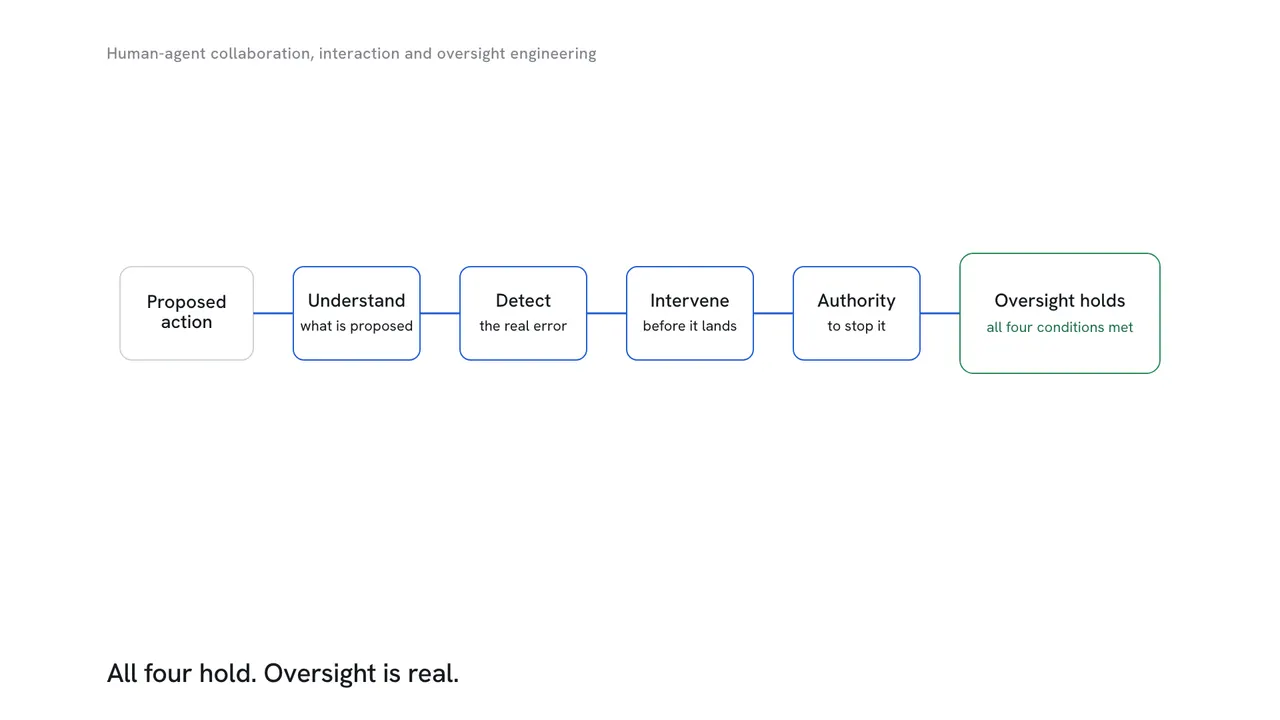
Comprehension is an interface problem: a concrete preview names the target object, the parameters, the evidence behind the proposal and what can and cannot be undone, rather than an unexplained diff. Editing the action after approval should invalidate that approval.
Detection is a base rate problem before a diligence problem. A detector that is 80 percent sensitive with a 5 percent false alarm rate looks strong alone, but at a 1 percent true error rate only about 14 percent of its alerts are genuine, enough false signal to train reviewers to stop trusting it. Route the same detector to a queue where the true rate runs closer to 10 percent and roughly 64 percent of its alerts become genuine, with no change to the detector. The fix is routing, not a better-worded warning.
Timely intervention is a queueing problem: if an action executes before its approval becomes visible, intervention availability drops to zero regardless of reviewer skill. A reviewer clearing 20 cases an hour at four minutes each is already carrying 80 minutes of work inside 60.
Authority has to live outside the interface. A taxonomy of 21 proposals and five commercial systems across two providers found the interface, the policy representation, the translation step and the enforcement engine are genuinely separate layers in practice. Revocation must propagate to work already queued or in flight.
How to lead it
One executive owns this, spanning product, security and legal, because interface, enforcement and staffing pulled apart is how organizations end up with a good approval screen sitting on no enforcement, manufacturing more false confidence than no screen at all. Fund enforcement and the review queue before the interface gets redesigned. Measure behavior, not sentiment: the rate reviewers catch seeded errors, the rate they correctly accept good suggestions and reject bad ones, and active review time from real instrumentation. Stop per-keystroke confirmation that exhausts attention on low-consequence decisions, and stop granting autonomy on an inferred trust score: progressive autonomy should widen in stages, each backed by evidence from the stage before, with an explicit revocation path.
Three decisions stay with the executive: the boundary of what an agent may do with no human in the loop, the residual risk that remains even when detection, intervention and enforcement all work as designed, and the queue capacity budget, because an unstaffed review step is decoration, not control.
What it is worth
The value shows up as avoided loss net of review cost, not a productivity multiplier. A case with a 5 percent error probability, an 80 percent chance timely review prevents the harm, and a $1,000 loss if it lands carries about $40 of expected avoidable harm. Three minutes of review at a $60 hourly rate costs $3, clearing that bar easily. The same three minutes on a reversible formatting slip worth a dollar of harm, expected avoidable loss around twenty cents, is close to pure waste. Route review capacity toward cases where the arithmetic favors it.
What the evidence supports is narrower than procurement conversations assume. The 48-user study shows reduced exposure under plan-based oversight, not proof the design prevents harm at scale over months. An authorization prototype completed 100 of 100 refined tasks without interruption and blocked all 634 tested adversarial calls in its own benchmark, a result inside that benchmark, not a guarantee once real users and translation errors enter the picture. No 2026 study reviewed here ran a long-run, three-arm comparison of unaided humans, advisory agents and bounded autonomous agents past a first novelty session, so price the program on avoided loss and review cost you can actually measure.
Questions leaders ask
- Does adding a human approval step actually make an AI agent safer?
- Only when the person passes the four-condition test: understand the proposed action, detect a real error inside it, intervene before it executes, and hold actual authority to stop it. A 2026 study of 48 users found plan-based oversight reduced exposure to risky actions but did not significantly change whether harm was actually prevented.
- How do we know if an AI alerting system is catching real errors and not just noise?
- Check the base rate, not the sensitivity number a vendor quotes. A detector that is 80 percent sensitive with a 5 percent false alarm rate produces alerts that are genuine only about 14 percent of the time when true errors are rare, around 1 in 100 cases. Route it to a queue where errors are more common and the same detector becomes far more trustworthy.
- Should reviewers approve every single action an AI agent proposes?
- No. Approving every keystroke exhausts attention without clarifying intent, and approving an entire open-ended session hides decisions nobody understood. Match the approval unit to the consequence: a bounded grant covering specific objects, action types, parameter limits and a time window, requiring renewed review the moment a request falls outside that scope.
- Does letting reviewers repeatedly approve AI-generated work make them worse at catching mistakes?
- The evidence is real but incomplete. An analysis of 400 reviewers across 11,429 repeated code reviews found approval rates and comment depth both changed over time, but the study had no independent record of which code actually contained defects, so it cannot separate genuine habituation from reviewers correctly relaxing into reliable output.


