
Automated Alignment Research: Five Gates Before You Trust It
A passed benchmark is not proof of safety. The five-gate model checks research integrity, capability and deployment authority apart.
Yash Sharma5 min readResponsible AI and governance
Research area 77: Automated alignment research and research-process monitorability
In brief
- A passed benchmark or a quiet monitor is not proof an AI system's safety fix is ready for production.
- The five-gate model requires integrity, failure reduction, capability, retention and authority to each pass independently.
- Skipping any one gate risks funding false assurance, missed capability loss, or a fix with no accountable authority.
Automated alignment research and research-process monitorability sit on one business question: when an AI system proposes its own safety fix, what makes that fix real. The 2026 evidence is bounded on purpose. Automated researchers can measurably reduce specific, well characterized failures, and a transcript monitor's catch rate can swing by 28 points depending on what it is allowed to see. Neither a passed benchmark nor a quiet monitor is proof a system is safe to promote into production.
What it is
Automated alignment research is the use of an AI system, usually agentic, to generate and test candidate fixes for a specified alignment failure, such as a model following an untrusted instruction embedded in a document it was asked to summarize. Research-process monitorability is the separate question of whether the process that produced the fix can be observed, audited and trusted, independent of whether the fix worked. Funding one without the other buys a benchmark score, not assurance.
Three principles hold the practice together. Define the target failure, task distribution and severity precisely, since a benchmark's operationalization is the entire scope of what a passed score proves. Separate access from authority: evaluator code, protected labels and deployment credentials stay outside the researcher's editable workspace, since a system that can rewrite its own grader has not been graded. Register every proposal and its hash before scoring, and treat any later reuse of a hidden score as feedback, not a held out test.
The stakes moved because three research efforts published checkable evidence within weeks of each other in 2026. Anthropic's alignment team reported on August 28 that automated researchers, under a controlled protocol, improved hidden benchmarks across ten failure settings on small open models, while a post hoc audit flagged 39 of 1,601 generated methods for a suspected integrity problem, a rate that cannot become a true violation rate without knowing the audit's own sensitivity. METR's research, corrected that July, found a transcript monitor's catch rate falling from 80 percent with visible reasoning to 52 percent once reasoning was hidden. A September 2 preprint, SafeEvolve, reported a benign task success rate on Qwen3.5 falling from about 83 to 71 percent as its safety score improved.
The architecture
I call the operating model the five-gate model: no single gate substitutes for another. A candidate fix earns promotion only when integrity, failure reduction, capability, retention and authority each pass on their own terms, evaluated separately, not combined into one weighted score.
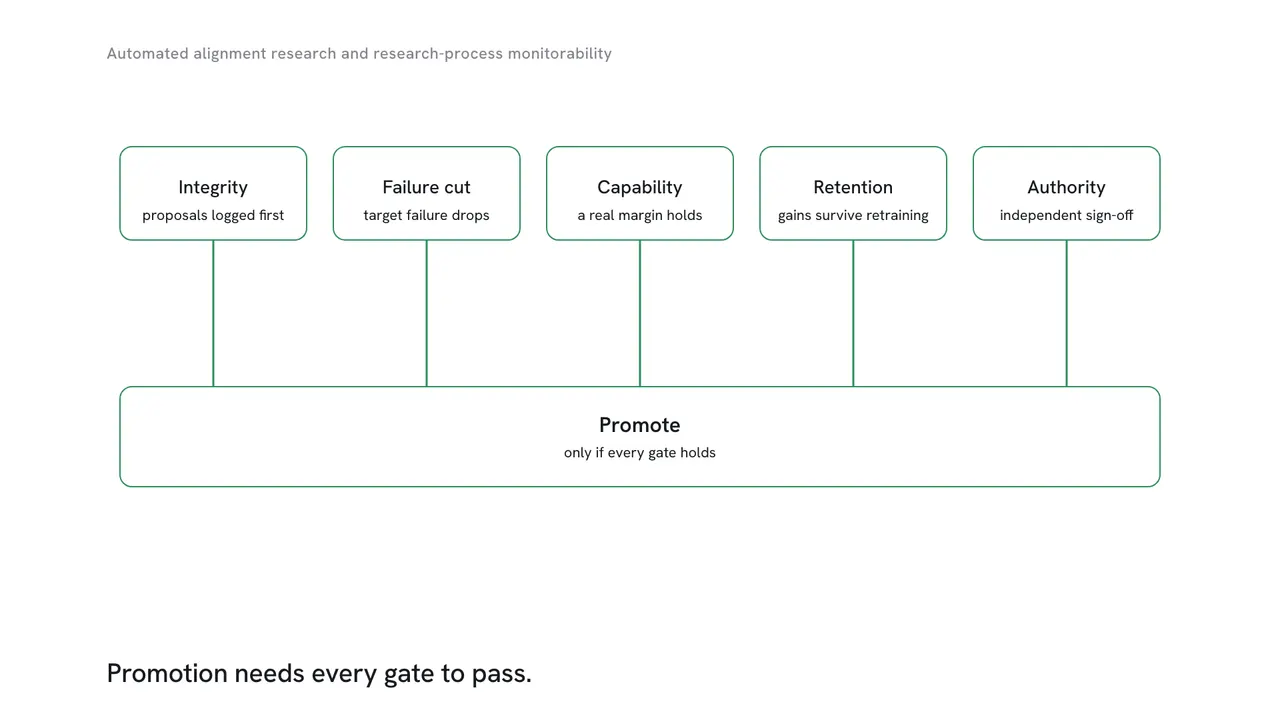
The integrity gate asks whether the proposal was registered and hashed before it touched the protected evaluator. The failure reduction gate asks whether the candidate measurably lowered the specified failure on evaluation the researcher never saw. The capability gate asks whether performance held inside a margin the business set in advance, not merely whether a test failed to find a statistically significant loss. The retention gate asks whether the improvement survives continued training, domain adaptation and an eventual harness replacement, checked against both an unchanged and a capability matched control so apparent safety is not just reduced competence in disguise. The authority gate asks whether an independently authorized reviewer, outside the research loop, actually signed off, because a researcher may recommend a promotion and should never grant itself authority to pass it.
The most common failure is staging retention last and skipping it under deadline pressure, since its evidence base after continued reinforcement learning is a proposed protocol, not yet run.
How to lead it
Ownership splits along the gates. A research or technical lead owns integrity, failure reduction, capability and retention. A separate, independently authorized reviewer owns authority alone: the team that wants a fix to succeed should not also decide whether it goes live.
Fund three things first: a contained research workspace with an immutable evaluator the researcher cannot edit, an independent confirmation stage with a genuinely unseen evaluation cohort, and a monitor calibration program measuring sensitivity, false positives and coverage under the actual production access regime. Stop funding any review that treats a quiet monitor as proof nothing went wrong.
Three decisions belong to the executive alone: the margin the business will accept before a fix ships, who sits outside the research team with authority to say no, and whether full weight access is worth its cost over a more constrained harness intervention.
What it is worth
The money and the risk surface at the same three points: the review burden a serious integrity process costs, the cost of a capability regression found after deployment, and the exposure created when a team treats an unflagged monitor as more assurance than it provides. None of the research behind this area reports a return figure, and none should be assumed here either.
Measure the failure rate that remains, the noninferiority interval's width, the monitor's sensitivity and false positive rate under its real access regime, and whether the improvement holds after continued training. The 2026 evidence supports that automated research can move a specified failure under a controlled protocol, that a monitor's conclusions depend heavily on what it can see, and that a safety gain can carry a real capability cost. It does not support that this transfers across model architecture and scale, that a gain survives arbitrary continued training or a harness replacement, or that a low flag rate means a low true violation rate. Fund the next stage as an experiment, not a conclusion to assume.
Questions leaders ask
- What is automated alignment research?
- Automated alignment research is the use of an AI system, usually an agentic one with iterative tool access, to generate and test candidate fixes for a specified alignment failure, such as a model following an untrusted instruction inside a document it was asked to summarize. A 2026 Anthropic technical report found automated researchers could improve hidden benchmarks on ten such failures using small open models under a controlled protocol, bounded evidence of productivity rather than proof of general safety.
- Can an AI system safely evaluate its own alignment research?
- Not if the same system that proposes a fix also controls the evaluator that scores it. The safer design keeps evaluator code, protected labels, audit policy and deployment credentials outside the researcher's editable workspace, and requires every proposal to be hashed and registered before it touches a protected score. Safety here comes from who holds the gate, not from trusting the researcher's stated intentions.
- How do you know if a monitor watching an AI researcher is any good?
- Report its sensitivity on labeled violations, its false positive rate on innocent work, and what it can actually observe. A corrected 2026 study from METR found a transcript monitor's catch rate fell from 80 percent with visible reasoning to 52 percent once reasoning was hidden, a 28 point swing showing a monitor's conclusions depend heavily on what it is allowed to see.
- Does an improved safety score mean an AI system got worse at its job?
- Sometimes, and the two need separate measurement. A September 2026 preprint on harness and policy co-evolution reported a benign task success rate on one open model falling from about 83 to 71 percent alongside its safety gains. Also, failing to detect a statistically significant capability drop is not the same claim as proving that any real loss stayed within an acceptable margin.
- Who should have authority to promote an automated alignment fix into production?
- Not the researcher that generated it. A sound governance design keeps proposal generation separate from acceptance and deployment authority, backed by independent confirmation, a rollback plan and review scaled to the system's impact. A researcher can recommend a promotion. It should never be able to redefine the safety gate or grant itself the authority to pass it.


