
How to Judge an AI Product by Its Outcome, Not Its Output
Judging AI products by end to end outcomes, not model output. The accountability chain shows what to pilot, fund, measure and stop first.
Yash Sharma4 min readStrategy, product and value
Research area 45: Product, workflow and outcome/value engineering
In brief
- Judge an AI product by the outcome it produces, not by demo output or benchmark score.
- The accountability chain names five links: acquisition, judgment, action, verification, accountability.
- 2026 evidence supports careful piloting, not any universal productivity multiplier.
Product, workflow and outcome value engineering judges an AI investment by what happens after the system acts, not by how capable it looks in a demo or benchmark. An output, a draft or a classification, is not an outcome: a resolved issue, an accurate record, a service completed to standard. Executives who fund a pilot on model capability alone, with no route to a measured outcome, are buying an expensive demo. The 2026 evidence on this question is real but mixed, and supports careful piloting far more than any general productivity claim.
What it is
An output is an artifact the system produces. An outcome is what changes once someone uses it: an issue resolved, a record made accurate, a service completed to standard. Value compares those outcomes, and every cost behind them, against a stated alternative, not against doing nothing. Adoption means exposure and real use across every eligible case, not account creation or an enthusiastic pilot cohort.
Every piece of AI assisted work breaks into five linked responsibilities: acquisition gathers current evidence, judgment interprets it against a stated objective, action changes a permitted system state, verification compares the result against the requirement, and accountability assigns an owner and a path to correct a wrong result. One responsibility can be automated while its neighbor stays human, a choice that belongs at the level of each link, not the whole process.
The stakes are rising as more AI systems are asked to act, not just draft. A randomized study of 1,795 Argentine adults, 1,174 of whom completed the task, found GPT-4.1 access raised a short business task score by 1.242 standard deviations for the lower education group and 0.834 for the higher, a genuine causal result, though published in 2026, a year after the 2025 experiment. Set against that, a field study of 388 employees found the agent assisted group submitted fewer, lower scored plans than the control group, though treatment ran only in the afternoon and control only in the morning, a confound serious enough that the result cannot prove agents alone caused the drop. A separate study of 736 Chilean entrepreneurs found an information intervention changed beliefs about AI with no detectable effect on adoption or profit within four months.
The architecture
The framework worth funding is what I call the accountability chain: acquisition, judgment, action, verification and accountability, each with a named owner and a specific way it fails.
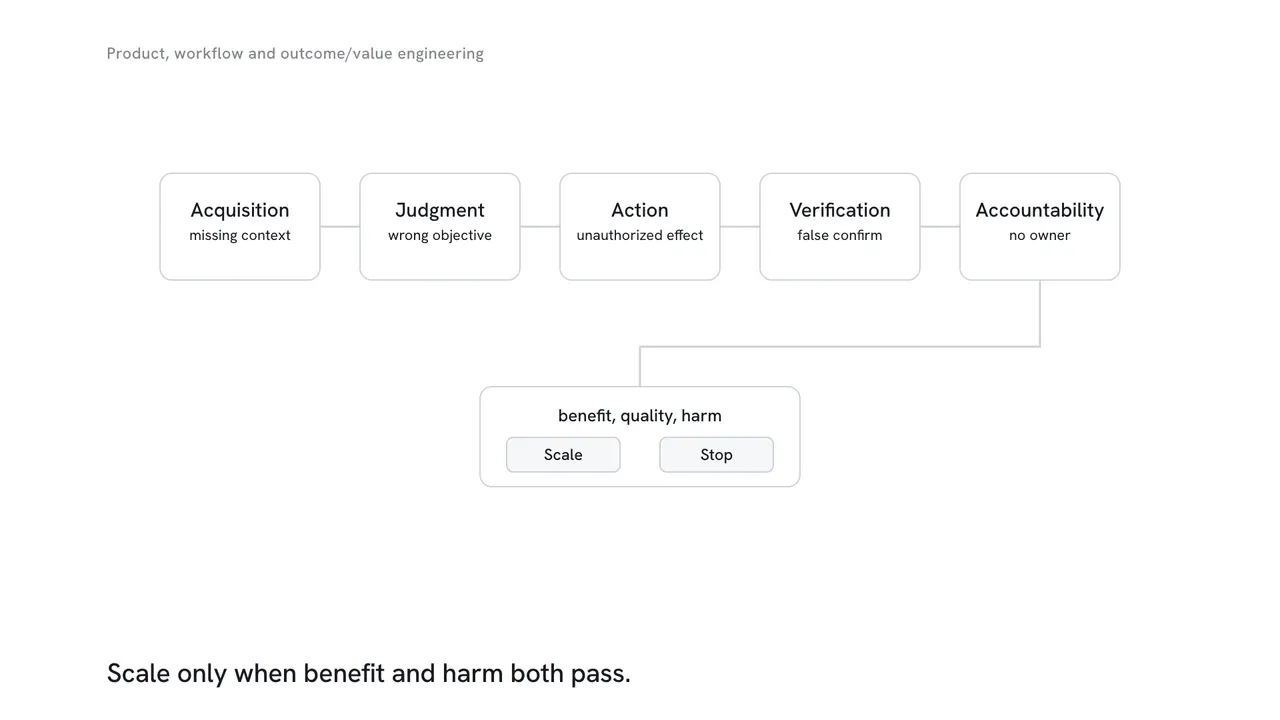
Acquisition fails when the evidence gathered is missing or misleading. Judgment fails when the objective is wrong or the inference drawn is not supported. Action fails when the system changes a state without authorization, or duplicates or leaves one incomplete. Verification fails silently: a false confirmation is worse than no confirmation, since it removes the signal that would trigger a human check. Accountability fails when a result is wrong and no one is empowered to correct it, a governance gap wearing a technical costume.
Match architecture to how much genuine uncertainty remains at each link. Stable rules call for deterministic software, repeated prediction against representative labels calls for classical machine learning, and a bounded, trusted set of documents calls for a retrieval assisted answer. Only a variable tool sequence with a checkable, reversible result earns a bounded agent, plans its own steps because the outcome can still be verified and undone if wrong. An irreversible action, a contested goal, or a hard to detect mistake belongs with a human led process AI assists rather than an autonomous one. That matrix is a selection policy, not a measured ranking: no study behind it compares all these architectures on the same task.
How to lead it
Ownership sits with whoever answers for the outcome, not the team that built the model. Fund in order: measure a baseline over a period with normal exceptions and peak demand, pick a workflow with a clear outcome before choosing an architecture, test assistance before increased authority, and measure adoption across every assigned eligible user rather than pilot enthusiasts. Scale only when benefit, quality and harm limits all pass together, never on a benchmark score alone. Stop when the objective cannot be verified, requirements outpace evaluation, no credible path to net benefit exists, or an irreversible harm is unacceptable regardless of upside. Simplify when an agent's behavior has settled into a small, predictable decision tree a controller can encode more cheaply. Two calls belong to an executive alone: how much authority a system earns beyond assistance, and whether assistance only is the final design rather than a step toward autonomy.
What it is worth
Money and risk show up in three places: the gap between a locally faster step and an unchanged or worse end to end outcome, the gap between a strong evaluation score and a workflow tested end to end, and the throughput a workflow can sustain, set by its slowest stage regardless of how much faster one stage becomes. Measure before and after using the same eligible cohort in both conditions, counted from assignment rather than voluntary adoption, so motivation is not mistaken for the AI's own effect. The 2026 evidence supports real short task gains under specific, bounded conditions, and that agent assistance can underperform a well run human process when the comparison is not controlled carefully. It does not support a universal productivity multiplier, or any pooled dollar return figure.
Questions leaders ask
- How do I know if a task actually needs an autonomous agent?
- Only when real uncertainty remains about which action to take, the tools involved expose bounded capabilities, and the outcome can be checked independently once the action is taken. If rules already cover the case, or a calibrated classifier performs as well, or the documents fit inside a simple search, an agent adds cost and risk without adding a capability the simpler system lacked.
- Does a strong AI benchmark or evaluation score mean a product is ready to scale?
- No. Evaluation distinguishes an agent's trace, its grader and the environment's actual outcome, and even a well designed evaluation is engineering guidance, not a measured organizational return. A long horizon agent can score well on a benchmark while imposing review costs no team can sustain. Treat a benchmark score as evidence the system can attempt the task, then run a real workflow pilot to learn whether it should.
- Can adding an AI agent make a workflow worse?
- Yes. A 2026 field study of 388 employees found the agent assisted group submitted fewer completed plans with lower scores than the control group. Treatment and control sessions ran at different times of day, a confound that keeps the result from proving agents alone caused the drop, but it is a real warning that assistance can degrade a workflow deployed without controlling for basic confounds like session timing.
- What justifies stopping or simplifying an AI product instead of continuing to fund it?
- Stop when the objective cannot be verified, requirements keep changing faster than any evaluation can complete, no credible path to net benefit exists, or an irreversible harm is unacceptable regardless of upside. Simplify when an agent's behavior has settled into a small, predictable decision tree, since a direct controller can usually encode that tree more cheaply and reliably than a model improvising it on every run.


