
The Novelty Gate: Testing AI Research Claims Before You Fund Them
Most AI research claims reaching leadership are relabeled prior art. The novelty gate tests mechanism, evidence and ownership before a claim gets a budget.
Yash Sharma5 min readStrategy, product and value
Research area 83: Frontier hypothesis laboratory and novelty challenge
In brief
- Most AI research pitches are existing mechanisms with a new name.
- The novelty gate tests nearest mechanism, a finite example and graded evidence before funding.
- It stops duplicated teams and training runs, at the cost of a small standing panel.
Most AI research claims reaching a leadership team are not new mechanisms. They are existing mechanisms wearing a new name, and funding them as new is how a research budget doubles without doubling what the company knows. A frontier hypothesis laboratory and novelty challenge is the standing discipline that tests a proposal against the nearest existing method, a small falsifiable example and a graded evidence standard before it becomes a funded workstream. The framework behind it, the novelty gate, makes that test repeatable rather than a matter of who tells the better story.
What it is
The novelty gate is a four-step test a proposed AI mechanism must pass before an organization commits engineering time to it, applied equally to a vendor pitch, an internal proposal or a widely cited paper.
Step one, the nearest-mechanism check, names the closest thing already being done and classifies what the proposal actually changes. A dossier built around this discipline found a heavily promoted idea for jointly adapting a model and its tool harness had eligible prior art in two papers published earlier the same year, one in June and a simpler recipe in August. The proposal was an increment, not an invention, and treating it as the latter would have funded a team duplicating existing work.
Step two, the finite test, is a small, concrete example the mechanism must survive: a robustness proposal for handling harness changes was tested against a two-scenario comparison where the model that wins on today's most common case loses once an unseen harness variant is weighted in.
Step three grades the evidence honestly, from independent corroboration down through bounded results to preliminary, first-party-only or disqualifying evidence. Step four is the decision: fund, merge into the team that already owns the nearest mechanism, or stop.
Why it matters now
A dossier built around this discipline searched twelve primary sources published across 2026, spanning six technique families. It found four candidates worth pursuing and confirmed all four already had a plausible existing owner. None justified a new team.
One source supplied a result worth sitting with: a hypernetwork designed to generate task-specific adapters on the fly, tested on a small instruction-tuned model across four tool-use benchmarks, produced the identical execution success rate whether enabled or disabled, a bounded finding the authors tied to one model size and recipe, not proof the whole technique family fails, but exactly what a pitch deck omits.
The architecture
The novelty gate runs a proposal through the same four stations every time, ending in one of two outcomes rather than a spectrum of maybes.
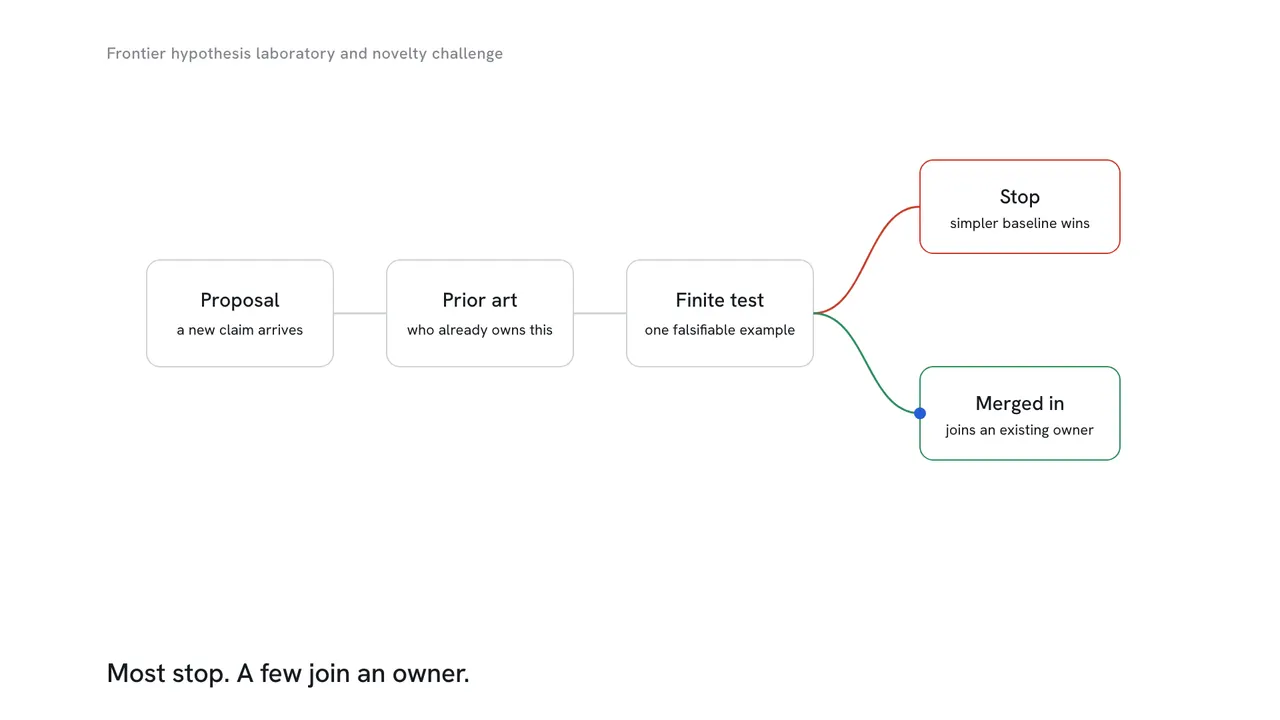
A proposal enters at the nearest-mechanism station: name what already exists that does something close, and who owns it. A proposal that cannot clear it is not disqualified but carries a flag to search harder before trusting what follows. Most proposals clear it, because most are extensions of something the station makes explicit.
The finite-test station, where a proposal earns a bigger budget, keeps the test small, checked by hand rather than in a full training run, and pairs it with an expected-failure control built to break the claim on purpose. A robustness mechanism gets fed a condition designed to be unhandleable, and the control checks that it reports failure rather than false confidence.
The evidence-grade station converts that result into a graded judgment, from independent corroboration down to preliminary, first-party-only evidence.
The fork is deliberately binary. A proposal a simpler baseline already matches stops, no matter how novel it sounds. A proposal that clears the bar merges into whichever team the nearest-mechanism station identified as owner. A new standalone team is the rare exception, reserved for a material gap that belongs to no one.
How to lead it
Ownership belongs with a small standing panel deliberately separate from the team proposing the idea, so the group asking for budget is not also grading its own evidence, the same separation the dossier insists on for a confirmation test: no information path between the data used to find a mechanism and the data used to confirm it.
What to fund is the finite test, not the full build: a convincing small-scale result earns a scoped pilot, not an open-ended team. What to measure is the gate's own throughput, how many proposals enter, pass the finite test, and get merged versus stopped.
Two decisions belong only at the executive level: approving a genuinely new standalone workstream, which should be rare and visible, and approving spend on internal access, model weights, training infrastructure or proprietary data a proposal needs to run its finite test, since that spend commits before the evidence grade exists. Everything else sits with the panel.
What it is worth
The dossier is explicit that none of its four surviving proposals has been built and measured yet. They remain hypotheses with stated go and no-go conditions, and the gate's value does not come from a return figure this framework can quote, because none exists yet, and inventing one would violate the discipline the gate is built on.
What the gate demonstrably prevents is measurable differently: the cost of a team built to duplicate something an existing team already half-owns, and the cost of a training run committed before a small worked example would have shown the mechanism losing under a different weighting of conditions. A gate that runs before the budget is set is cheaper than a postmortem that runs after.
Questions leaders ask
- What is a frontier hypothesis laboratory and novelty challenge?
- A standing discipline that tests every proposed AI research mechanism against the nearest existing method, a small falsifiable example and a graded evidence standard before it can become a funded workstream. Most proposals fail at the first step because they rename something already owned elsewhere.
- How is the novelty gate different from a normal research review?
- A normal review asks whether a proposal sounds promising. The novelty gate asks whether there is a nearest existing mechanism it has not beaten, provable with one small test before committing a team. It is a filter, not a critique panel.
- What happens to a proposal that fails the gate?
- It is stopped outright, or merged into whichever existing initiative already owns the nearest mechanism. In the dossier behind this framework, every surviving proposal was assigned to an existing owner. None earned a brand new team, and that outcome is normal.
- Who should run the novelty gate inside a company?
- A small standing panel separate from the team proposing the idea, so the group that wants the budget is not also the group grading the evidence. Its job is narrow: nearest mechanism, finite test, evidence grade, and a stop or fund decision.
- Why does the evidence grade matter more than the pitch?
- A compelling pitch and a graded result answer different questions. The dossier behind this framework found a widely pitched adapter mechanism produced the identical outcome as turning it off, a result only the evidence grade would have surfaced before a bigger commitment.


