
The Mechanism Ownership Map for AI Engineering Labels
A mechanism ownership map separates AI engineering labels like harness and loop from the work underneath, so spend and hiring track real mechanisms.
Yash Sharma5 min readStrategy, product and value
Research area 00: Taxonomy discovery, terminology validation and coverage architecture
In brief
- A mechanism ownership map separates AI engineering labels from the work underneath so spend tracks real mechanisms.
- The named framework is the mechanism ownership map: a registry, a lifecycle cross-check, a stress trace and a revision rule.
- It saves avoided cost, not proven new revenue, and current evidence does not show a more advanced harness improves performance.
Taxonomy discovery, terminology validation and coverage architecture maps what a vendor or research team calls a new AI capability onto the actual mechanism underneath it, so a leadership team funds real work, not a relabeled version of work it already owns. In 2026 the industry produced a wave of new names, harness engineering, loop engineering, skill engineering, for practices that often overlap heavily with existing responsibilities. The tool that stops a company funding the same mechanism twice, or leaving a new one unowned, is what I call the mechanism ownership map.
What it is
The map treats a label, whatever a vendor blog, conference talk or paper calls a piece of work this year, as different from a mechanism, the actual object being produced, changed or enforced: a compiled context with a data source, a runtime sandbox with a lifecycle. The registry keeps two columns: the stable mechanism and its owner, and every dated label attached to it.
Four principles hold it together. Allocate the mechanism, not the word, so loop engineering pins to a specific controller, not self-evident discipline status. Keep ownership and evidence depth on separate axes, so a name, an owner and one small study do not count as solved. Treat coverage as relative to mechanisms already discovered, since a registry can still miss an unnamed failure category. Split, merge or rename only when a concrete failure shows the boundary incoherent, never because a term became popular.
The stakes are budget and blind spots. An OpenAI engineering post on harness engineering published in February 2026, an Anthropic post on harness design published in March, and a June practitioner post that put loop engineering into wide circulation are first-person accounts of practice, a dated record of usage, not a measured result. A leader who assumes a fashionable label already covers a responsibility, or funds a second team to build the same thing under a new name, pays for the gap twice: in duplicated spend and an unowned failure.
The architecture
The mechanism ownership map has four parts.
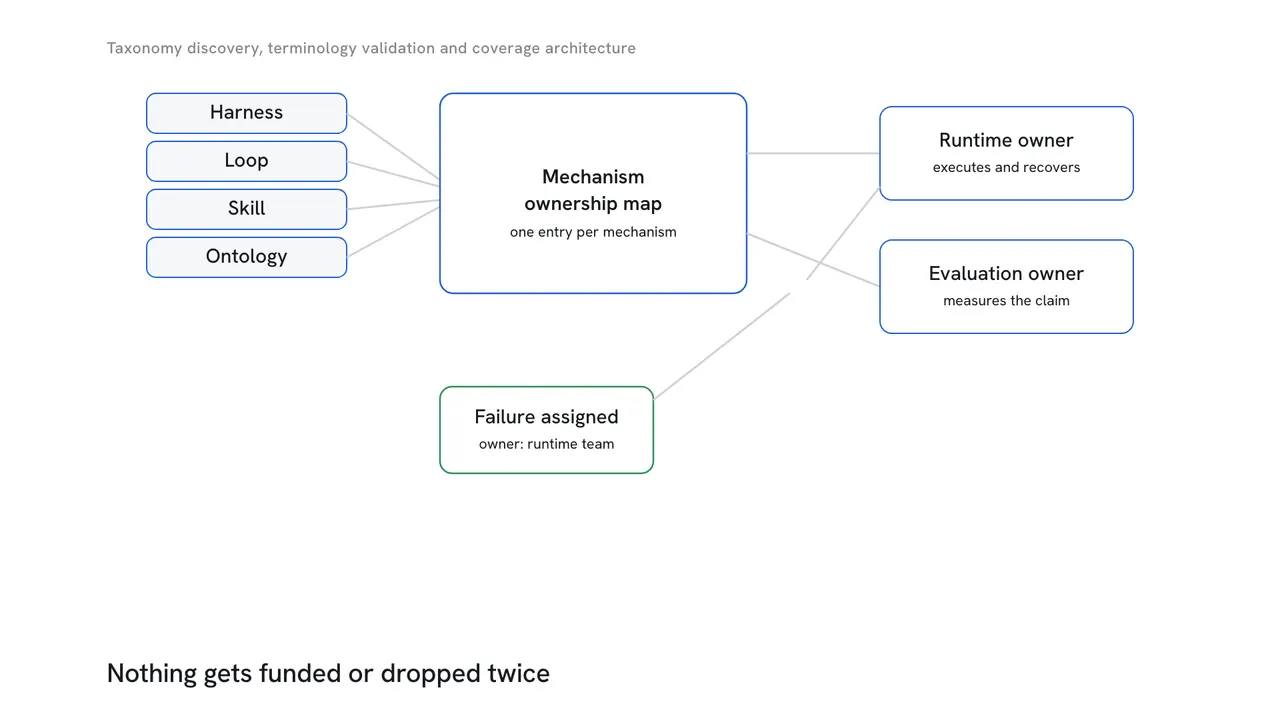
The registry is first: every mechanism gets a stable entry, current status (established component, emerging umbrella, organizational category, alias, or unsupported claim), primary owner, the artifact that owner produces, and its interfaces to other owners. Status changes as evidence accumulates. The entry does not.
The lifecycle cross-check is second: every mechanism is placed against its life stage, from data through training, inference, execution, validation, deployment and retirement. A row that cannot state its inputs, output artifact, owner, consumer and failure condition is not finished.
The stress trace is third: a coding agent, a multi-tenant workflow and a training pipeline are walked end to end, and every likely failure is assigned to the entry that should have prevented it. A coding agent that loses progress or falsely reports a task complete names the persistence and recovery entries, not the agent in the abstract. A failure with no accountable entry signals the registry needs a new row, not a louder label.
The revision rule is fourth: split a track only when it repeatedly holds two mechanisms with different artifacts and evaluation methods, merge only when two labels describe the same artifact and experiments, rename only when the label misleads a reader about what it does or how mature it is. Popularity changes nothing.
The clearest warning for how thin the evidence still is comes from a July 2026 paper, revised in August: across 89 tasks on a benchmark called TerminalBench 2.1, running the same prompt in parallel without harness evolution scored 72.3 on average, while letting the harness evolve scored 67.4, worse than prompting the model directly at 68.2. A held-out validation split narrowed that gap to 0.6 points, still small.
How to lead it
One accountable role, distinct from any specialist team, owns the map, settling integration disputes across it while leaving evidence judgment to the team that owns each track.
Fund the registry as a living artifact, not a one-time chart, prioritizing what action a system is authorized to take and where its effects could escape containment. Fund stress traces regularly, since a registry drifts as new tools and vendors enter the stack. Measure whether failures land on exactly one accountable entry, not adoption counts of a buzzword: only 217 of 256 heuristically flagged repositories actually held the loop engineering pattern once checked by hand.
Two decisions belong only to an executive: approving a split, merge or rename, since that changes headcount and reporting lines, and setting the smallest improvement worth shipping and the largest regression the business will tolerate, a statement of risk appetite, not a technical measurement.
What it is worth
The return shows up as avoided cost more often than added revenue: the second team not hired to rebuild a mechanism that already had an owner under a different name, and the failure caught in a stress trace instead of in production. Both are real money. Neither is a number the underlying dossier measures directly, and this essay will not invent one.
What the 2026 evidence does support is narrower: dated proof that harness and loop terminology are now in production use, the TerminalBench harness-evolution result above, and a documented method for testing whether a registry produces a single accountable owner for a given failure. The underlying audit is itself bounded: every one of its assigned research questions came back marked partial. What the evidence does not support is a claim that any of these labels names an established academic discipline, that adoption is universal, or that a more sophisticated harness reliably buys better task performance. Price that absence into every proposal that asks for a harness rebuild before checking whether the improvement was ever measured.
Questions leaders ask
- What is a mechanism ownership map?
- It is a registry that separates a mechanism, the actual artifact being built or changed, from the labels vendors and researchers attach to it in a given year. Every mechanism gets one accountable owner, a defined output, and the interfaces it depends on. The goal is that a rebrand of existing work never gets funded as if it were new, and a genuinely new responsibility never goes unowned.
- Is loop engineering an established discipline or a new name for existing work?
- The 2026 record treats it as an emerging umbrella term, not an established discipline. A June 2026 practitioner post put the term into circulation, and a later academic paper found the described pattern confirmed in only 217 of 256 repositories a heuristic scan had flagged. That supports dated usage of the term, not a consensus definition or proof of a new underlying mechanism.
- Does a more advanced harness reliably improve agent performance?
- Not according to the strongest evidence in the record. A 2026 benchmark study across 89 tasks found that letting an agent's harness evolve without tests scored 67.4 on average, worse than prompting the model directly at 68.2, while parallel sampling without any harness evolution scored 72.3. A leader funding harness work should treat that as a reason to measure the specific improvement, not assume one.
- Who inside a company should own this registry?
- One accountable role separate from any specialist team, because every specialist has an incentive to claim ambiguous territory as their own. That role owns integration disputes across the whole responsibility map and keeps evidence judgments with the team closest to each mechanism. Without that separation, ownership tends to get decided by whoever presented most recently, not by where the failure actually occurred.
- How complete is this taxonomy of AI engineering work?
- Deliberately bounded, not exhaustive. Every research question behind this map came back marked partial in its own audit, and the registry only reports complete ownership of the mechanisms it has already discovered, not of the field as a whole. A stress trace that turns up a failure with no accountable owner is the signal to expand the map, not a publication count or a popular new label.


