
The Boundary-First Decision Atlas for Enterprise AI Systems
Component wins in serving, routing or oversight do not make a better system. Judge every AI investment against a shared boundary-first decision atlas.
Yash Sharma5 min readStrategy, product and value
Research area 50: Cross-engineering synthesis, interfaces and decision atlas
In brief
- A component win in serving, routing or oversight is not a system win until checked against a shared boundary.
- The boundary-first decision atlas routes every claim through outcome, authority and total cost before it counts.
- Review and recovery labor, not the model bill, is where a cheaper architecture quietly costs more.
Cross-engineering synthesis reads serving, routing, deployment, cost, oversight, product, architecture, research and reliability engineering as one connected system, not nine scorecards. A win in one domain, a faster runtime, a cheaper router, a higher benchmark score, is not a business win until checked against the full boundary the task operates inside: what counts as done, who is authorized to act, and the true resource cost once review and recovery are included. Most AI programs are funded one component at a time, exactly where a gain in one domain quietly becomes a loss elsewhere.
What it is
Cross-engineering synthesis reconciles the specialist domains an enterprise AI program depends on against one shared set of interfaces before trusting any of their claims. It does not invent a single trust score, nor treat a repeated citation of the same study as independent confirmation.
Four principles carry it. Boundary before optimization: define the outcome, the authority a system may exercise, and the resource ceiling it must respect, before tuning anything inside it. Provenance travels with evidence: a fact's source, version and freshness must cross every interface with it. A proposal is not an authorization: a model may draft an action, but a separate, checkable step must confirm it is permitted first. Count everything actually spent, every failed call, every hour of human review and repair, not only the cost of the path that succeeded. A component that is faster, cheaper or better scoring still has to clear all four before it counts as a genuine improvement.
A March 2026 study of harness search, Meta-Harness, found that searching the executable harness around a model improved a classification task's average test accuracy to 48.6 against a 40.9 baseline while cutting context used from 50.8 thousand tokens to 11.4 thousand. Its authors note that matched proposal counts did not equalize total compute, human effort or deployment risk, the gap a whole-system view must close before the result becomes a production decision. The dossier illustrates that cost: an architecture spending twenty cents a case with a one percent review rate at three dollars a review costs twenty-three cents on average, while a cheaper twelve-cent architecture sending eight percent of cases to review costs thirty-six cents, a fifty-six percent rise in total variable cost despite a forty percent drop in modeled spend. At a hundred cases an hour and a six-minute average review, one reviewer clears about ten cases an hour, so those eight reviews already use eighty percent of that capacity before ordinary demand variation.
The architecture
I call the shared reference the boundary-first decision atlas: every domain's claim routes through the same gate before it can change what the system does. It has three parts: a task contract stating the outcome, owner and resource limits a piece of work must respect, a boundary gate checking any proposed change against that contract, and a routing step sending the task to the smallest architecture that can meet it, from a single model with an editable draft up through authorized retrieval, a durable controller with narrow tools, or a human-led workflow with preparation-only assistance.
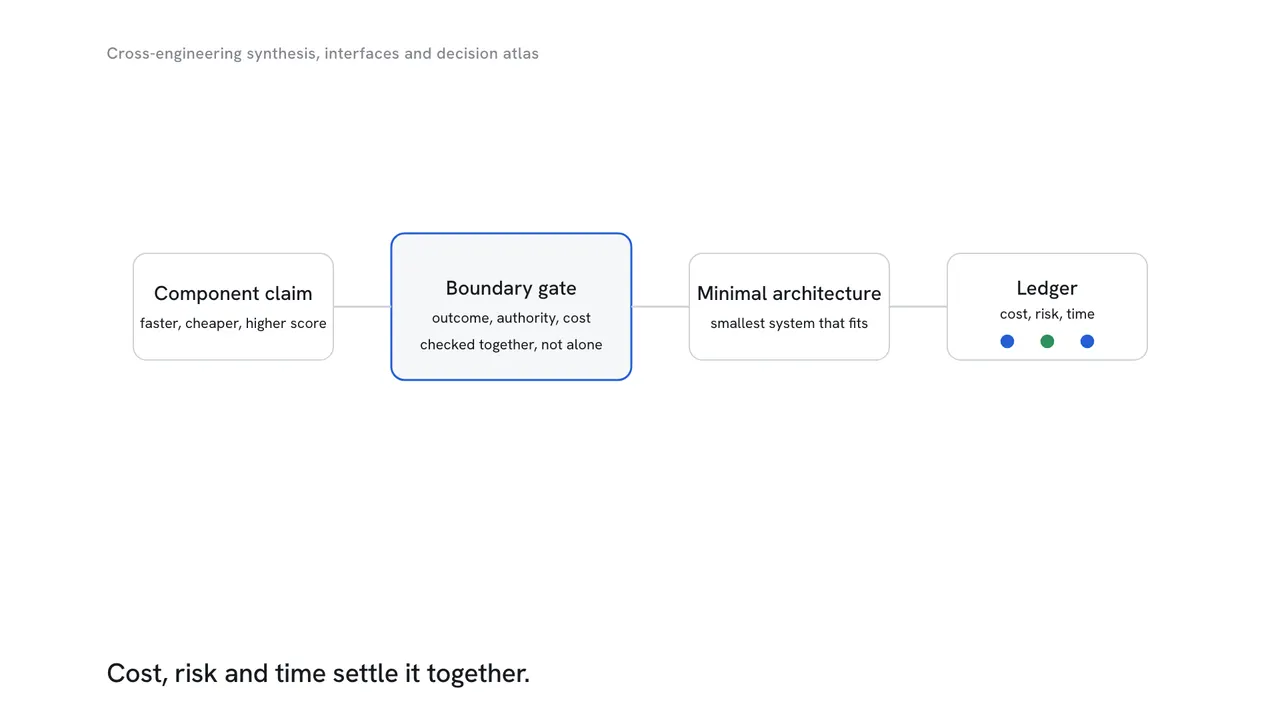
A component claim arrives first at the boundary gate rather than at production. The gate checks whether it meets the outcome definition, stays inside the task's authority, and compares favorably on total cost, including review and recovery, to the alternative. Only a claim clearing all three routes onward to the minimal architecture the task needs. A second gate sits inside routing: added complexity, another model, memory, a second agent, more autonomy, earns its place only when a matched comparison against the simpler version shows a benefit that survives the same checks and whose new failure modes can be named and contained.
The failure modes live at the seams the atlas guards. A gate checking quality but not authority lets a fluent draft get executed as if already approved. A gate checking authority but not total cost lets a cheaper model create a review queue expensive enough to erase its own savings. Added capability without a matched ablation lets a system accumulate correlated error risk nobody owns.
One architecture owner should hold the atlas as a living reference, reviewed at each release, with a named owner for each part of the boundary: outcome, authority, provenance, resource ceilings, recovery. Fund a capability registry recording what each component promises, an effect ledger tracking whether an outside action is pending, committed, failed or unknown, and a protected evaluation holdout no optimizer ever sees. Measure verified outcome, total cost including review labor, and tail completion time, not the average.
Two decisions belong only to an executive: which constraints are hard authorization boundaries that can never be traded for a higher quality score, since an optimizer left to its own objective will make that trade if nobody stops it, and the fallback policy, since a backup route must meet the primary's authority bar or the system must degrade to a safer mode.
What it is worth
Money shows up first in review and recovery labor, not the model invoice: a route forty percent cheaper on the bill can still raise total variable cost once its higher review rate is counted, and a reviewer capacity comfortable on average can fail under a routine demand burst. Risk shows up in how often the effect ledger records an outcome as unknown rather than a clean success or failure, since that predicts a duplicated charge or a lost update. Time shows up in tail completion, cases stuck between a model, a reviewer and a retry, more than average response time.
No study in the dossier's 2026 corpus compares a minimal architecture against an elaborate one under equal task access, compute and engineering effort, so no single return figure for the atlas is supported across industries today. Independent reproductions of the component results also remain scarce. Measure the three dimensions above before and after any real change, and treat that measured difference, not a borrowed industry figure, as the return.
Questions leaders ask
- What is cross-engineering synthesis, in plain terms?
- It is the discipline of reading serving, routing, deployment, cost, oversight, product, architecture, research and reliability engineering as one connected system rather than nine separate scorecards. A win in any one domain is judged against total cost, authority and verified outcome before it is allowed to count as progress.
- What is the boundary-first decision atlas?
- A shared reference that names the outcome, the authority and the resource ceiling a task must respect, routes the task to the smallest architecture that can meet them, and only adds retrieval, memory, another model or more autonomy after a matched comparison shows the addition earns its cost and its new failure modes can be contained.
- Does the Meta-Harness result mean I should let an optimizer rewrite my production system?
- No. The March 2026 study shows harness search can improve selected held-out tasks against its tested baselines, with a large context reduction on a classification benchmark. Equal proposal counts in the study did not equalize total compute, human effort or deployment risk, so the result licenses testing harness changes, not handing an unrestricted optimizer production control.
- How do I know when to add retrieval, memory or a second agent?
- Only after a matched ablation, same models, data and tools, adds the one component under test and measures verified outcome, total cost and maintenance against the version without it. If the difference does not clear what the addition costs to build, run and keep verified, the minimal version stays. This is the atlas's own stop condition, not a one-time architecture review.
- What does the current evidence not yet tell us?
- It does not yet support a single return figure for any architecture across industries. No study in the 2026 corpus behind this atlas compares a minimal and an elaborate system under equal task access, equal compute and equal engineering effort, and independent reproductions of the individual component results remain scarce.


