
The Four-Bottleneck Model for AI Reasoning and Planning
More reasoning tokens do not guarantee a better answer. The four-bottleneck model shows where to spend inference compute, and where to stop.
Yash Sharma5 min readAgentic AI in production
Research area 23: Planning, reasoning and test-time-compute engineering
In brief
- Extra reasoning compute helps only when aimed at the bottleneck actually blocking the decision.
- The four-bottleneck model diagnoses discovery, selection, acquisition or execution before spending more.
- Skipping this diagnosis wastes compute and, in tested cases, makes the answer worse.
Planning, reasoning and test-time-compute engineering decides how much computation a system spends before it commits to an answer, a plan or an action, and where that spending goes. The 2026 evidence says this is not one dial that improves results the further you turn it: extra computation pays off only when aimed at the actual bottleneck holding a decision back, and spending it on the wrong one can leave a system worse off, not merely more expensive. Leaders who treat "let it think longer" or "generate more candidates" as a universal upgrade are funding waste at best, a worse decision at worst.
What it is
Test-time computation covers three techniques often treated as one: extending a single reasoning trace, generating multiple candidates and voting among them, and searching over an unfinished plan before it is complete. Each fails differently, so each needs its own evaluation.
Planning is stricter than reasoning. A plan represents the current state, the available actions, their preconditions, the possible outcomes, and which commitments cannot be undone: a paragraph of steps becomes a plan only once compiled into actions a system can check, authorize and execute. Reasoning engineering, by contrast, is an umbrella term for many algorithms, and the fluent explanation a model produces is not the same as the computation actually happening or the real cause of its answer.
More computation is not a knob that reliably improves outcomes: added reasoning tokens can produce diminishing, and in tested cases negative, returns. An executable verifier is trustworthy for the exact property it checks and nothing else, while a learned score is cheaper to run but easier to exploit.
The architecture
The clearest way to run this system is what I call the four-bottleneck model: before adding computation to a decision, diagnose which of four distinct bottlenecks is actually binding, because each has its own fix, and the wrong fix wastes the spend or makes the answer worse.
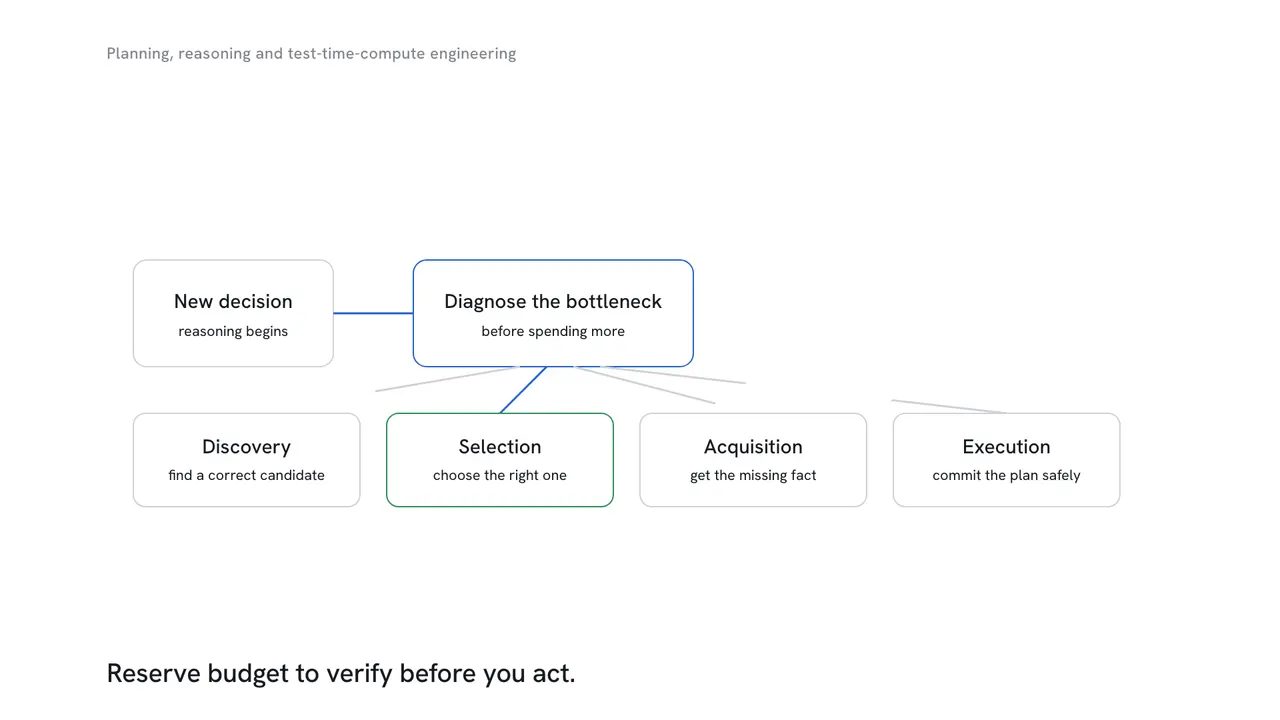
The first bottleneck is discovery: whether any candidate the system could generate actually contains the correct answer. If so, more selection will not help, since nothing correct exists yet to select: the fix is broader sampling, decomposition, or a different capability. The second bottleneck is selection: a correct candidate already exists in the bank and the system is choosing the wrong one, which is where a verifier, a vote or a reranking step belongs. A study made public on April 12, 2026, tested DeepSeek-R1-32B and s1-32B across budgets from 500 to 16,000 tokens on math and coding benchmarks and found additional reasoning tokens showed diminishing and, on some problems, negative marginal returns: those models already reasoned well early, and extra tokens sometimes pushed a correct draft toward a wrong final answer.
The third bottleneck is acquisition: the system has reasoned correctly over what it has, but what it has is incomplete, and the right response is a targeted question weighed against what the missing fact is worth, not more deliberation over the same evidence. An August 19, 2026 study measured this directly using hidden-attribute tables of up to 300 items with tools disabled, though its authors note the setting does not extend to open-ended tool use, robotics or real conversation. The fourth bottleneck is execution: a decision must become a typed, checkable action, its preconditions verified, its irreversible commitments flagged, and its authorization rechecked when it runs.
The most common failure is treating oracle accuracy, the rate a correct answer exists somewhere in the candidate bank, as the accuracy the business will see. An August 4, 2026 study makes the gap concrete: five candidates with a forty percent individual success rate contain a correct answer over ninety percent of the time, but a realistic selector choosing correctly seventy percent of the time it has a correct option still delivers under sixty-five percent deployed accuracy. Budget spent expanding the candidate bank without fixing the selector buys almost nothing.
How to lead it
Ownership belongs with whoever owns the product's evaluation and cost infrastructure, not a research function alone, since every allocation choice is both a quality and a spending decision.
Fund budget sweeps by difficulty rather than one global setting, and keep a moderate, fixed compute budget as the default until there is enough calibration data to trust an adaptive policy. Fund a verifier only where the property it checks is exact and executable: a heuristic score is cheaper but can be optimized by a search process that improves the score without improving the answer. Measure discovery and selection separately: oracle rate tells you what is possible, deployed accuracy tells you what customers get.
Two decisions belong to the executive alone. Fix, ahead of any evaluation, how much of the compute budget must go to verification, since a system under time pressure will try to skip this step first. Name which categories of action are irreversible enough to require a human checkpoint, no matter how confident the system reports itself to be.
What it is worth
Money shows up first in compute spent past the point of return: the April study's returns flatten and sometimes reverse as budgets grow, making a fixed moderate budget, tested against the adaptive alternative, the correct default until proven otherwise. Risk shows up when an oracle number is mistaken for deployed accuracy, the gap the architecture section quantifies. Time shows up in search costs that grow fast with depth and branching, so a search-based approach needs a hard budget cap and a pruning rule checked for soundness.
What the 2026 evidence supports is narrower than a general theory: that compute helps only when matched to the actual bottleneck, that an oracle rate overstates what a deployed selector returns, and that acquiring a missing fact can be evaluated on its own terms. Every research question this area was measured against remained only partially answered, and the acquisition and escalation findings were tested on narrow, controlled setups, not real-world ones. No return-on-investment percentage appears in the underlying evidence, and none is invented here.
Questions leaders ask
- Does giving a model more time to think always produce a better answer?
- No. A study first made public on April 12, 2026 tested DeepSeek-R1-32B and s1-32B across budgets from 500 to 16,000 tokens on math and coding benchmarks and found diminishing and sometimes negative returns from extra reasoning tokens. The right response is a moderate, difficulty-matched budget, not an open-ended increase, kept as the default until an adaptive policy is proven against it.
- What is the difference between planning and reasoning?
- Reasoning is an umbrella term for many different algorithms that produce an answer or an explanation. Planning is stricter: it represents the current state, the available actions, their preconditions, the possible outcomes and which commitments cannot be undone. A written list of steps only becomes a plan once it is compiled into checkable, authorized actions a system can execute.
- When is a bigger bank of generated candidates worth the cost?
- Only when discovery is the actual bottleneck, meaning no candidate yet contains the correct answer. If a correct candidate already exists in the bank and the system still fails to choose it, the fix is a better verifier or ranking step, not more generation. A candidate bank can contain a correct answer over ninety percent of the time and still return well under two-thirds accuracy once a realistic selector is added.
- What decision should stay with an executive rather than a technical team?
- Two decisions. First, fixing in advance how much of every compute budget must be reserved for a final verification step, because a system under time pressure will try to skip it first. Second, naming which categories of action are irreversible enough to require a human checkpoint, regardless of how confident the system reports itself to be.


