
Multimodal AI Needs an Evidence Ledger, Not Just Bigger Models
Multimodal AI succeeds by preserving where each fact came from. The evidence ledger framework for document, voice and video pipelines leaders can trust.
Yash Sharma5 min readAgentic AI in production
Research area 28: Multimodal, document, voice and real-time interaction engineering
In brief
- Multimodal AI succeeds by preserving where each fact came from, not by scoring accuracy alone.
- The evidence ledger tracks capture, track, reconcile and commit so revisions and commitments never blur.
- Skipping the track and reconcile stages is what turns a quiet failure into a costly one.
Multimodal, document, voice and real-time interaction engineering turns documents, speech, video and live conversation into decisions an enterprise can act on, without losing track of where each fact came from or whether an action already happened. The most common failure is treating a bounding box, a timestamp or a stopped microphone as proof something is correct, complete or undone. Before trusting any accuracy score, ask whether the system can show its source, its revision and what it has already committed, kept separate.
What it is
This area covers four kinds of work marketed as one capability but that fail differently: document extraction (OCR, layout parsing), speech pipelines (recognition, diarization), video understanding (frame selection), and real-time conversation (full duplex audio, interruption handling).
Four principles hold it together. A bounding box says where a value was read, not whether it was read correctly, and a timestamp says when a frame was sampled, not whether the model reasoned about it correctly. Full duplex, a voice system's ability to listen and speak at once, is an audio capability, not a guarantee that interruption handling is safe. Value extraction, completeness and source grounding are three separate checks, not one blended score. Preserving a raw value beside its normalized one is what lets a person catch an extraction error the model cannot see.
Why it matters now
2026 produced the first benchmarks testing these four subareas separately, and the early results say the easy assumptions do not hold. A July 2026 evaluation from LlamaIndex, ExtractBench, tested fourteen extraction systems against 370 documents and 4,869 pages and found schema-compliant output can hide missing rows or the wrong unit.
An April 2026 study, Full-Duplex-Bench-v3, recorded 100 sessions and found turn-taking varies by pipeline configuration, but mocked its tool APIs at zero latency, excluding the delay a real payment or booking service adds. A June 2026 study, IHBench, ran 428 interruptions across 45 conversations and found recovering intended conversation is a different metric from how fast audio stops. An August 2026 study of 2,190 videos, The Low-Frequency Trap, found a system can count events correctly while getting their sequence wrong, and denser sampling alone does not fix that.
The architecture
The clearest design here is what I call the evidence ledger: a pipeline that keeps every perceived fact bound to where it came from, and never lets a committed decision get ahead of what the business has authorized, in four stages: capture, track, reconcile and commit.
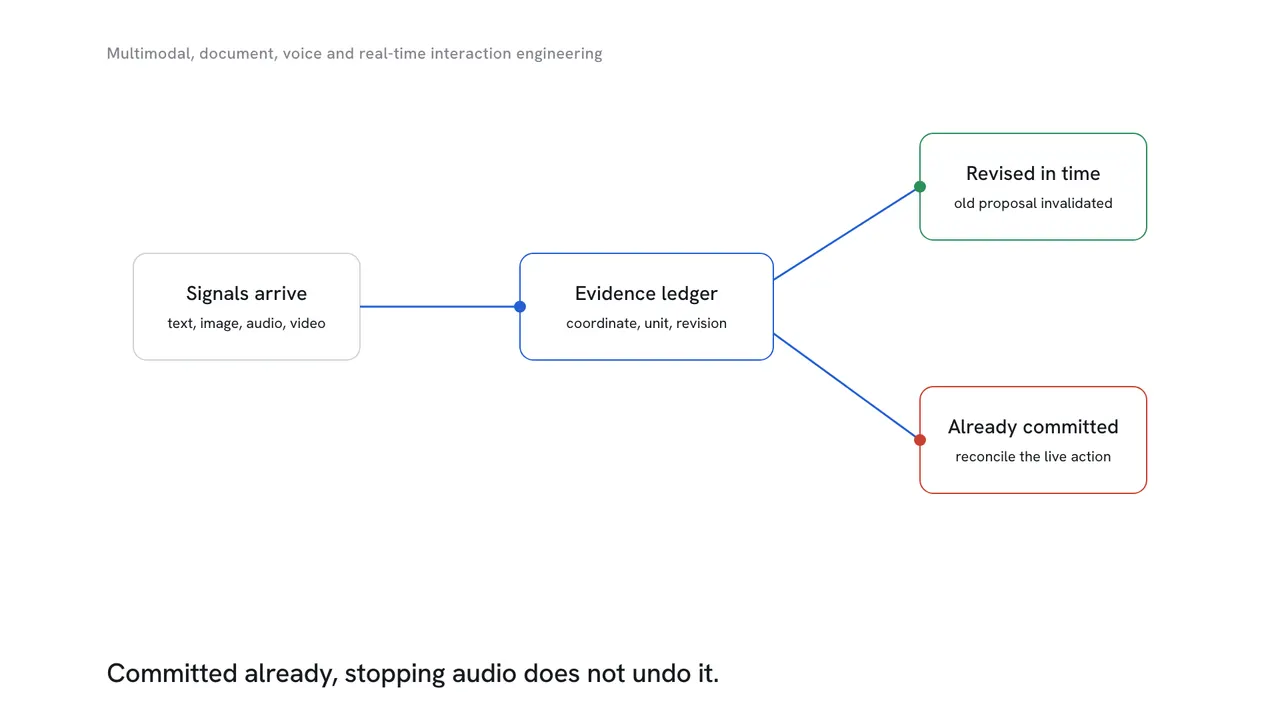
Capture assigns every incoming signal a source hash, a page or timestamp, a bounding box or speaker identity, and a unit. Track keeps a revision number and a commit watermark on every candidate value, so a changed intent invalidates the dependent proposal instead of carrying it forward. Reconcile is where most pipelines quietly fail: stopping audible output and undoing an external action are two different operations, since a dispatched tool call does not roll back because the microphone goes quiet, so the ledger records whether it already committed and routes it to an authorized correction path if it did. Commit is the only stage allowed to turn a candidate into a stated fact, once the current authority signs off, after which the answer carries its source and timing reference.
How to lead it
Ownership belongs with whoever is accountable for the decision the pipeline feeds, not a shared AI platform backlog, with one written contract for what counts as a source, a revision and a commit. Fund the track and reconcile stages before new capability: most vendor pipelines do capture and commit, and almost none do the revision bookkeeping or the audio-versus-effect distinction well. My rule: no voice or document AI product gets a broader rollout budget until it shows, live, what happens when a user revises a request after a tool call has fired.
Two decisions belong to an executive alone: how much authority an agent has to keep a committed action after an interruption before it must halt and route to a human, and what accent, language, disability and assistive-technology coverage must be validated before launch, since the 2026 evidence base is explicitly insufficient to extrapolate from.
What it is worth
Money shows up in three places: inference and media cost spent on signals that never changed the answer, correction labor when a schema-compliant but wrong extraction reaches a downstream decision, and the cost of keeping original evidence beside structured output. Risk shows up as cross-modal instructions hidden in an image or clip crossing from data into command, a stopped voice masking a still-live committed action, and accessibility gaps that silently fail the users least likely to report the failure.
Measure before and after with matched budgets and equal token, dollar and latency comparisons, clustering results by document, speaker or conversation rather than counting every field as an independent trial. A system reporting zero failures in a small trial still carries real risk: thirty trials with no failures leaves an upper failure-risk bound near one in ten, not zero.
The 2026 evidence reviewed here supports that native, modular and hybrid pipelines carry genuinely different trade-offs in traceability, latency and correction cost. It does not yet support a matched total-cost comparison between them, a settled accuracy ranking for real-time voice under real delays, or a proven protection rate against cross-modal attacks. No return figure or percentage improvement appears in this evidence, and none should be assumed.
Questions leaders ask
- Should we replace our OCR and ASR pipeline with one native multimodal model?
- Not on the current evidence alone. Native models can reason jointly over layout and content, but the 2026 research reviewed here has no matched total-cost comparison between native, modular and hybrid pipelines. My rule is to keep the original document or recording alongside whatever structured output you extract, so the decision stays reversible while better evidence accumulates.
- If our voice agent stops talking mid-sentence, is the mistaken action canceled too?
- Not necessarily. Stopping audible output and undoing an external action are two different operations. If a tool call to book, pay or send already committed before the interruption was detected, silencing the voice does not reverse it. The system needs to check whether the action fired and route it to an authorized correction path if it did.
- How much should we trust published benchmark numbers for real-time voice agents?
- Treat them as directional, not as a service-level guarantee. The most cited 2026 full-duplex benchmark mocked its tool APIs at zero latency, so its timing results exclude the delay your actual payment, booking or calendar system will add. Rerun the timing tests against your own services before setting a customer-facing latency target.
- Does sampling more video frames fix event understanding?
- No. A controlled 2026 study of 2,190 videos found that a system can count events correctly while getting their sequence and timing wrong, and denser sampling alone does not close that gap. Ask any video AI vendor to show event-trace accuracy on frames it was not told were important in advance, not just an event count.
- What should we do about accent, disability and language coverage before launch?
- Treat it as an open validation gap, not a solved problem. The 2026 evidence on accessibility and accent coverage for voice and document AI is explicitly insufficient to extrapolate from. Commission your own testing with the accents, languages and assistive technologies your actual users bring before a broad rollout, and set that as a launch gate an executive owns.


