
Knowledge Graphs and Ontologies: What They Are Worth Funding
Knowledge graphs and ontologies improve auditability far more reliably than they improve correctness, so test the two separately before you fund one.
Yash Sharma5 min readContext, retrieval and memory
Research area 05: Ontology, knowledge-graph and neuro-symbolic semantics engineering
In brief
- More structure often makes answers tidier, not more correct, so test each outcome separately.
- The truth gate checks every claim's consistency and its truth before calling it a fact.
- Ontologies pay off in audit traceability, not raw correctness, per the 2026 evidence.
Ontology, knowledge-graph and neuro-symbolic semantics engineering decides what a system is allowed to call a fact and how it has to prove that fact. The real question is not whether to add a knowledge graph, but whether your decisions need that much structure and whether you check an answer's truth separately from its consistency: in two of the three controlled 2026 studies behind this essay, more structure made answers less correct even as it made them tidier.
What it is
An ontology is a set of concepts, relationships and explicit logical axioms, strong enough that a reasoner can check consistency and draw permitted conclusions. A knowledge graph is looser, entities and edges built for traversal without full logical commitment, and a taxonomy is looser still. Neuro-symbolic systems combine a learned model with one of these structures, though the dossier is blunt that many systems calling themselves neuro-symbolic are really a language model retrieving a symbolic definition into its prompt, a legitimate technique but not proof-carrying inference.
Structure is a tool matched to specific decisions, not a default upgrade: a relational table already answers exact-key questions better than any graph, and richer semantics creates a maintenance obligation earned, not assumed. Consistency and truth are different targets, since a system can make every extracted triple conform to a schema while getting more answers wrong. Every extracted claim needs its source span, valid time, polarity and extraction version before it counts as more than a proposal, and the people who validate an ontology's content must be independent of the model that built it.
The controlled 2026 evidence is unkind to the reflex purchase of a knowledge graph for better answers. Loconte, Hospedales and Cornelio (May 2026) raised structural consistency through a post-extraction correction step, then measured answer quality on HotpotQA using Qwen: consistency rose, F1 fell from 58.6 to 56.4. Lunyakin's ontology-driven finance framework (August 2026), tested on 145 FinanceBench questions, raised citation-traceability F1 from .463 to .515, a real audit gain, but correctness barely moved, .110 against a BM25 baseline's .117, a confidence interval touching zero. Labre's ontology-guided retriever on 500 MATH problems looks stronger but weakens on inspection: one of three small models degraded under normal decoding, and the headline number used an oracle picking from five attempts against ground truth, on a subset thresholding had shrunk to 75. None of the three studies is large, replicated, or free of confounds, and the dossier grades them B, C and B: a caution against a reflex, not a verdict.
The architecture
I call the operating model the truth gate: every extracted claim must pass two separate checks before it can be called a fact, and neither substitutes for the other.
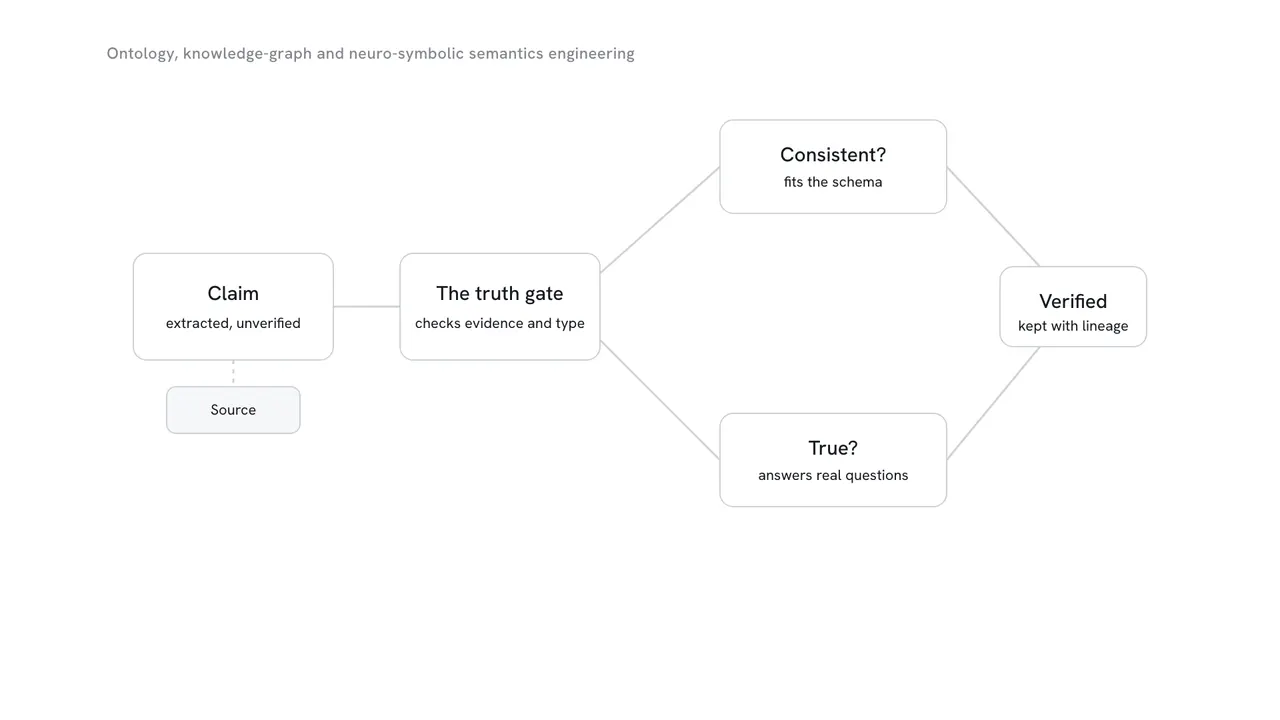
A claim enters as a proposal, not a fact. It must bind to an exact source span, a valid time window, its units and polarity such as "not," "formerly," or "approximately," and an extraction version, or it is quarantined rather than silently dropped. The gate then splits it onto two independent paths. Consistency asks whether the claim fits the chosen schema: right types, no contradiction, no identity collision between two names describing one entity or one name describing two. Truth asks whether the claim produces correct decisions on competency questions domain experts wrote before seeing the ontology, tested against a baseline fed identical evidence. A claim that passes consistency but fails truth is a well-formed error, the failure mode both cited studies describe.
Only a claim that clears both paths is promoted to verified, carrying a provenance graph linking every fact back to its evidence. Withdraw a source, wrong, retracted or expired, and every fact that depended on it with no independent support is invalidated automatically. An ontology that cannot run this cascading withdrawal is not auditable.
Ownership sits jointly with data and knowledge engineering and the domain leader whose decisions the structure serves, never one team alone: the model that proposed the ontology should never write its own competency questions or certify its own consistency. Fund provenance by construction, competency questions written before anyone sees the generated ontology, a standing ablation against a schema-only baseline, and source-withdrawal as production infrastructure. Measure precision, qualifier retention, source support, and cost per validated completed task, not cost per claim ingested, and stop funding a graph as a default AI-quality line item with no competing baseline. Two decisions belong only to an executive: the smallest improvement worth having and the largest regression tolerated, set before anyone sees the holdout results, and the governance for rollback when a migration fails.
What it is worth
The financial case for structure is strongest around traceability and audit, not raw correctness. The finance study's traceability gain, .463 to .515 with a confidence interval clearly above zero, shows up as fewer audit findings and faster regulator conversations, real value honestly labeled an audit benefit. What the evidence does not support is booking a correctness improvement just because a graph went in: correctness moved by a confidence interval touching zero in the finance study and fell outright, 58.6 to 56.4, in the correction study. Price the full lifecycle, development, human review, migration tooling, and revalidating dependents when a source is withdrawn, against cost per validated completed task, not cost per claim stored. An oracle-selected headline number, or a consistency score with no truth check behind it, does not belong in front of a board as an accuracy result.
Questions leaders ask
- What is the difference between an ontology and a knowledge graph?
- An ontology adds explicit logical axioms and lets a reasoner check consistency and draw permitted conclusions. A knowledge graph is usually looser, entities and edges built for traversal without a full logical commitment. Pick the ontology only when your decisions genuinely need entailment, not because the name sounds more advanced.
- Does adding a knowledge graph make an AI system's answers more accurate?
- Not automatically, and the controlled 2026 evidence behind this essay says the opposite in two of three comparisons. One ontology correction step raised structural consistency while a benchmark's answer quality fell, and a finance system's ontology improved citation traceability without moving correctness. Test both outcomes separately, through something like the truth gate, before assuming the gain.
- When is a plain schema or database better than an ontology?
- Whenever the questions you need answered are exact-key lookups, transactions or joins that a relational table already handles, or when questions mostly need a source passage rather than a logical inference. Reach for an ontology only when automated reasoning or vocabulary interoperability across systems is genuinely required and someone can maintain it.
- How do you stop an AI system from turning a guess into a fact?
- Require every extracted claim to bind to an exact source span, valid time, units and polarity before it counts as anything more than a proposal, and route ambiguous or conflicting claims to human review instead of letting the system resolve them on its own. That evidence binding is the front door of the truth gate.
- Who should own ontology and knowledge graph decisions inside a company?
- Data and knowledge engineering and the domain leader whose decisions the structure serves, jointly, never one team alone. Domain experts should write competency questions and counterexamples before they see the generated ontology, and the system that proposed the ontology should never also certify its own consistency.


