
Retrieval and RAG: How AI Systems Ground Answers in Evidence
Retrieval finds relevant material. It does not prove an answer is supported. The evidence chain shows the four checks that separate the two.
Yash Sharma5 min readContext, retrieval and memory
Research area 07: Retrieval, search, RAG and evidence-grounding engineering
In brief
- Retrieval finds relevant material but does not prove an answer is grounded in evidence.
- The evidence chain checks ingestion fidelity, completeness, attribution and current authorization before trusting an answer.
- Skipping these checks costs money twice, in unproven infrastructure and in wrong decisions built on incomplete evidence.
Retrieval, search, RAG and evidence-grounding engineering decides whether an AI system answers from evidence or merely near it. A retrieved passage can be relevant and still omit the clause a decision turns on, and a citation can point at a source that never supports the claim beside it. Leaders who measure retrieval by relevance alone pay for confident wrong answers.
What it is
Retrieval, search, RAG and evidence-grounding engineering finds material for a model to answer from, then separately proves the answer is supported by what was found. RAG, the common architecture, searches a corpus and hands the results to a model to write an answer. Retrieval is evidence acquisition, not a certificate of grounded generation.
Ingestion decides what survives from a source, including table structure, headers, units and version, before retrieval ever runs. Candidate retrieval, lexical, dense, hybrid or adaptive, decides what the system considers. Evidence completeness asks whether the specific facts a decision requires are present, not whether the material is topically related. Attribution checks, claim by claim, whether a citation actually supports the assertion beside it. A final decision layer knows when to answer, ask a clarifying question, route to structured lookup, or state the evidence is not there.
Treating these as one blended score is the most expensive mistake here: a system can score well on relevance and still deliver a wrong answer, because the missing fact was never counted as missing.
Why it matters now
Enterprises are wiring retrieval into decisions with real consequences faster than the architecture comparisons can settle. A benchmark posted on arXiv in June 2026, revised in July, built a corpus of 378 documents and 8,442 passages with 116 test queries, and found hybrid retrieval only marginally ahead of a plain lexical baseline, a gap a paired significance test could not distinguish from chance. The evidence does not support a universal ranking of retrieval architectures: prove a cheap baseline insufficient before paying for a complex one.
The architecture
The clearest way to run this discipline is what I call the evidence chain: four gates a claim must pass, checked separately, before an answer reaches a reader.
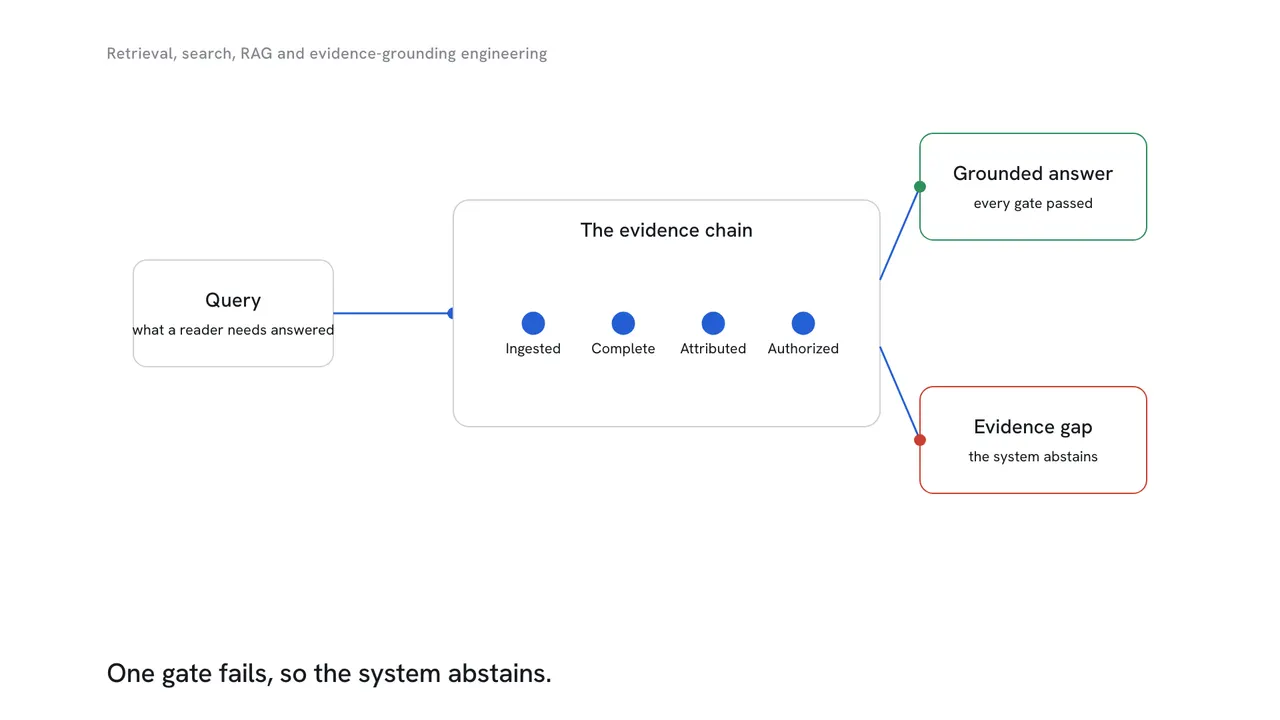
The first gate is ingestion fidelity: a table row that loses its header, or a passage that loses its source version, can retrieve perfectly and still be wrong read alone. The second gate is completeness, the one most systems skip: of a hundred relevant passages, a system may retrieve ninety and still miss the one that states a policy's binding exception. Recall reads ninety percent, completeness reads zero, and the generator writes a fluent, wrong, confidently cited answer.
The third gate is attribution, checked per claim. Citation coverage, the share of claims with adequate support, and citation precision, the share of citations that actually support their claim, are different denominators: a system can score well on one while failing the other. The fourth gate is current authorization, permission and freshness checked at retrieval, not inherited from indexing. A document whose access was revoked can remain live in embeddings and cached summaries long after the source forgot it.
Security failures live inside this same chain. A study posted in June 2026 varied 432 retrieval, chunking and model configurations against 100 curated question pairs and found resistance to a poisoned passage depended heavily on how the attack was built, with tested attacks concentrated on lexical overlap. A separate evaluation agent, published in August 2026, detected suspicious passages with 91 percent accuracy on one benchmark but transferred more weakly to a different one: detection is not proof it was unused. Retrieved text has to stay data the system evaluates, never an instruction it follows.
How to lead it
Ownership belongs with whoever is accountable for the decision the evidence feeds, from one shared evidence store rather than a search feature bolted onto each application. Fund the cheap, exact path first: structured lookup and a plain lexical index already handle exact names, identifiers and policy versions well. Fund dense or hybrid retrieval only against a measured gap those cannot close.
Measure evidence completeness and claim level attribution precision separately from relevance, and log every abstention so success does not hide the work that failed quietly.
Two decisions belong to the executive alone: setting in advance how the system behaves when evidence is incomplete, abstain, ask, or route to structured lookup, a risk tolerance choice, not a modeling default, and deletion and permission governance, what revoked has to mean across embeddings, caches and summaries, with the chain proving a document is gone everywhere.
What it is worth
The financial case shows up in three places: infrastructure funded for sophistication a fair budget comparison cannot justify, wrong decisions traced to evidence retrieved but not complete, and exposure from a revoked document still surfacing through a cache or old summary. Measure before and after with the same yardstick, evidence completeness, citation coverage and precision, and abstention rate, at matched budget, never a headline relevance score alone.
The evidence supports building this as separately measured gates and treating any claimed grounding improvement as unproven until independently checked citations confirm it. It does not support a universal ranking of retrieval architectures, a settled comparison of long context against iterative search at equal cost, or a poisoning defense proven safe beyond the attack template it was tested against. No dollar figure or return percentage appears in the source evidence.
Questions leaders ask
- What is the evidence chain, and why is relevance not enough on its own?
- The evidence chain is four separate checks a claim has to pass before an answer is trusted: ingestion fidelity, evidence completeness, claim level attribution and current authorization. Relevance only shows that a passage is topically related to a query, not that the decisive fact is present or that a citation actually supports the claim beside it. A system can score well on relevance and still hand a reader a confident, wrongly supported answer.
- Does a more sophisticated retrieval architecture always beat a simple one?
- Not on the evidence available. A 2026 benchmark comparing hybrid retrieval against a plain lexical baseline on a specialized corpus found only a marginal difference that a paired significance test could not distinguish from chance, and the tuning already used the benchmark's own answerable queries. Prove that structured lookup or lexical search is insufficient before funding a more complex architecture, and compare every option under the same source access and budget.
- How real is the risk of a poisoned retrieval index?
- It is real but conditional, not a fixed number that transfers across systems. A 2026 study found that resistance to a poisoned passage depended heavily on how the attack was built, with the tested attacks concentrated on lexical overlap. A separate detector caught suspicious passages with 91 percent accuracy on one benchmark but transferred more weakly to another, and catching a passage before generation does not prove the model never used it.
- When should a system refuse to answer instead of retrieving more?
- When the decisive evidence a decision requires is absent, conflicting or inaccessible, and another search is unlikely to change that. The right test weighs the cost of an error against the expected value of one more search, not a fixed count of retrieved passages. An honest evidence gap, stated plainly, is worth more to a business than a fluent answer built over missing support.
- Can a larger context window replace retrieval investment?
- Sometimes, but not as a general rule. A large context window can avoid a retrieval selection mistake when the needed evidence fits inside it and the model actually uses what it was given, though it can also add distractors, stale versions and real cost. Retrieval keeps exposure narrow and supports access control, but evidence it never returns stays unrecoverable regardless of window size.


