
Epistemic Trust Engineering: Why AI Needs a Time-Aware Evidence Core
AI agents need typed claims, four time clocks and a commit gate that separates belief from fact. The evidence core framework and what to build first.
Yash Sharma5 min readContext, retrieval and memory
Research area 70: Epistemic trust, contradiction and temporal-state engineering
In brief
- AI agents need typed claims and four time clocks to separate belief from committed fact.
- The framework is the evidence core, the component that checks origin and time before any claim counts.
- It costs a wrong decision, a stale cache or a correction that never cascades to ignore.
Epistemic trust, contradiction and temporal-state engineering is the discipline of teaching an AI system to tell what it has been told from what it can prove from what it has committed to as fact. Most production failures in agentic systems are trust failures, not reasoning failures: a system counts three copies of one rumor as three witnesses, serves a cached answer after the claim underneath it expired, or cannot say which of two contradictory statements should win. An executive who wants agents making real decisions has to fund that plumbing.
What it is
This area treats an AI system's knowledge as five distinct kinds of object, not one blob of retrieved text: an observation records something that happened, a source assertion records only that a source said something and stays true even if false, a derived proposition follows from premises under a stated rule, a decision selects an action under uncertainty, and a committed fact is an authoritative record that can still be corrected later. Collapsing these into one memory is the field's most expensive design mistake: a system that cannot tell a rumor from a record will eventually act on the rumor.
Four clocks give those objects meaning: when a source asserted a claim, when the event happened, the interval it is valid for, and when the system retrieved it. A limit capped at five through August and lowered to three from September is not a contradiction, it is two correct statements with different valid intervals. Authority to read evidence is separate from authority to write it, and revision must stay reversible, with prior state and reason for any change kept on file.
Why it matters now
Agentic systems increasingly let agreement stand in for verification, and early 2026 research says that substitution is dangerous. Anthropic's August 2026 report on multiagent systems finds that shared models and open discussion do not create independent checks on each other, they create conformity, with private evidence having to overcome an initially attractive majority answer. Ten web pages repeating one measurement are one origin, not ten independent observations, and an August 2026 arXiv study found that asking a model what year it is can shift its stated answer far more than the year implicit in its other behavior.
The architecture
The operating model I use is the evidence core: a small, stable component that owns claim types, clocks, dependency graphs, permissions and revision history, sitting behind every retrieval system, similarity search and language model in the stack, which stay replaceable adapters around it, never the source of truth themselves.
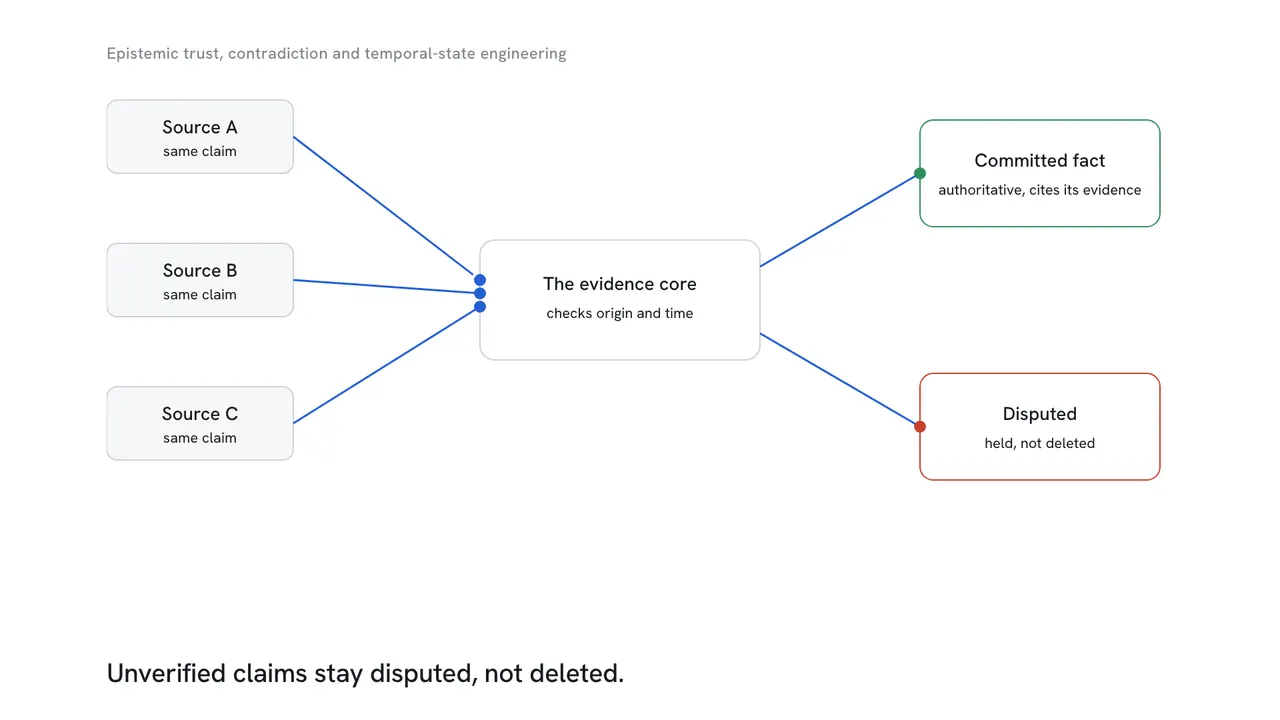
A new claim enters as an unverified observation tagged with its four clocks and tenant scope. The core first checks dependence, whether it shares an origin, citation chain, dataset or model family with claims already on file: five copies of one measurement get recorded as one data point with five citations, not five votes. Only then does it check for conflict, first aligning entity, definition, scope and valid time, since most apparent contradictions dissolve once two statements turn out to describe different times or things. What survives is classified as a genuine contradiction, a supersession, a difference in measurement conditions, or an unresolved ambiguity. A similarity model can triage which case applies but does not decide alone: an August 2026 arXiv audit found embedding-cosine gates report high similarity between statements that reverse each other's meaning.
A claim becomes a committed fact only when it passes a commit rule checking authority, time validity and permission together, never any one alone. If it fails, the core keeps it visible as a recorded dispute rather than discarding it, since dropping unsupported claims loses the ability to explain a decision later.
How to lead it
Ownership belongs with whoever is accountable for the decisions the evidence feeds, working with a data or platform function that owns the evidence core, not whichever team built the first retrieval pipeline. Treat commit authority as a permission granted deliberately, tenant by tenant and purpose by purpose, never a default free with read access. Fund typed claims, the four clocks, a dependency graph and the commit gate first, and treat similarity models as triage tools, never the sole basis for a decision.
Two calls sit with the executive alone: setting the commit threshold, how much authority and corroboration a claim needs before it becomes fact the business acts on, and deciding which tenants and purposes may write into the shared evidence core, since a retrieved document should never grant itself more authority than the person who read it.
What it is worth
The exposure shows up in three places: a wrong decision made on evidence that looked corroborated but was one source counted several times, a stale cached answer served after its claims expired, and a correction that fails to cascade, leaving a downstream record acting on a fact already withdrawn. Measure before and after against matched baselines, a cosine-only cache, an entailment-assisted triage layer, and a provenance and time-aware core, under the same query costs, tracking contradiction recall, false reversals, calibration and revision latency.
The 2026 evidence supports building around dependence checks, four clocks and a commit gate rather than agreement or similarity alone. It does not support a universal confidence threshold, a proof any one entailment model solves the problem, or a dollar return figure. The research is explicit its own coverage is partial and several conclusions remain open, a reason to build the typed core now and treat every scoring model bolted onto it as replaceable.
Questions leaders ask
- What is epistemic trust, contradiction and temporal-state engineering?
- It is the discipline of giving an AI system typed knowledge, an observation, a source assertion, a derived proposition, a decision and a committed fact, kept distinct rather than blended into one memory. Each object carries four clocks: when it was asserted, when it happened, when it is valid, and when it was retrieved.
- Why can't an AI system just trust whatever sources agree on?
- Because agreement often shares one origin rather than confirming it independently. Anthropic's August 2026 report on multiagent systems found that shared models and open discussion make agents converge on a majority answer even when private evidence points elsewhere, which is conformity, not confirmation. Ten sources repeating one measurement count as one data point, not ten independent votes.
- How should a system handle two claims that seem to contradict each other?
- First align what each claim is actually about: the same entity, definition, scope and valid time interval. Many apparent contradictions dissolve once that alignment is done, because the claims describe different periods or things. What remains is classified as a genuine contradiction, a supersession, a difference in measurement conditions, or an unresolved ambiguity.
- Can an AI model be trusted to know what year it is?
- Not reliably from its own training alone. An August 2026 arXiv study found a model's declarative answer to a direct question about the current year can diverge sharply from the year implied by its other, associative behavior. The safer pattern is to inject the environment's authoritative timestamp and independently verify any time-sensitive claim, rather than trusting the model's own inference.
- What decision about evidence and trust should stay with an executive?
- Two decisions. First, the commit threshold, how much authority and independent corroboration a claim needs, for each class of decision, before it becomes a fact the business acts on. Second, who is authorized to write into the shared evidence core, by tenant and purpose, since a retrieved document should never grant itself more authority than the person who read it.


