
Context Engineering: How AI Systems Decide What They See
Context engineering decides what a model sees before it answers. The context compiler framework, why bigger windows are not the fix, and what to fund.
Yash Sharma5 min readContext, retrieval and memory
Research area 02: Context engineering and context compilation
In brief
- Context engineering decides exactly what a model sees for each call, not how large its window is.
- The context compiler checks authority and evidence budget in stages before anything reaches the model.
- No dollar figure exists yet, but the framework tells you what to fund and what to reject.
Context engineering is the discipline of deciding, for every call a model makes, exactly what information it is allowed to see. The question that matters is not how large the window is, but whether the one fact a decision depends on reached the prompt, correctly labeled, with its source and limits intact. Leaders who treat this as a plumbing detail inherit two failure modes: a model that answers confidently over missing evidence, and a pipeline that becomes an attack surface once retrieved text behaves like an instruction.
What it is
Context engineering is the ongoing work of assembling what a model receives for one decision: instructions, a user's corrections, task state, tools, retrieved evidence, and prior artifacts. Context compilation is the build step that turns that inventory into the input a model reads, versioned, reproducible, inspectable after the fact.
A raw token count treats this as interchangeable text, and it is not. Four principles follow. Every item entering context needs an owner, an authority level, a timestamp and a validity window, not just content. Committed state, what the system has verified, differs from evidence, what a source claims, and must never be silently promoted from one to the other. Compression is a real operation with real loss, not a free resize. When evidence cannot support a decision, say so rather than answering fluently over the gap.
Why it matters now
Production systems increasingly compile context automatically, so a mistake at this layer produces a wrong decision that looks like a right one. Work through 2026 pulls the field three ways. A study posted January 2026, revised February, trained the choice of skills and file or code context across five task domains, reporting gains in several, though test sizes ran as small as one hundred cases on one benchmark, and versions with the learned layer removed beat the full system on some tasks. A second line, May 2026, proposes writing commitments in a typed, source-linked notation so compression cannot silently drop them, tested on only five author-written cases. A third, June 2026, trains a compact encoder and large decoder together in a shared latent space, requiring a matched model pair most enterprises cannot attach to a closed model API.
The term context rot has spread faster than the evidence. Length, position, contradiction and distractor density behave as separate variables in the 2026 record, and falling accuracy as more material is added can reflect a shrinking token budget or a changed task mix rather than length itself.
The architecture
The clearest 2026 design here is what I call the context compiler: a pipeline that turns raw sources into a versioned context artifact through checked stages, not one opaque prompt-assembly step.
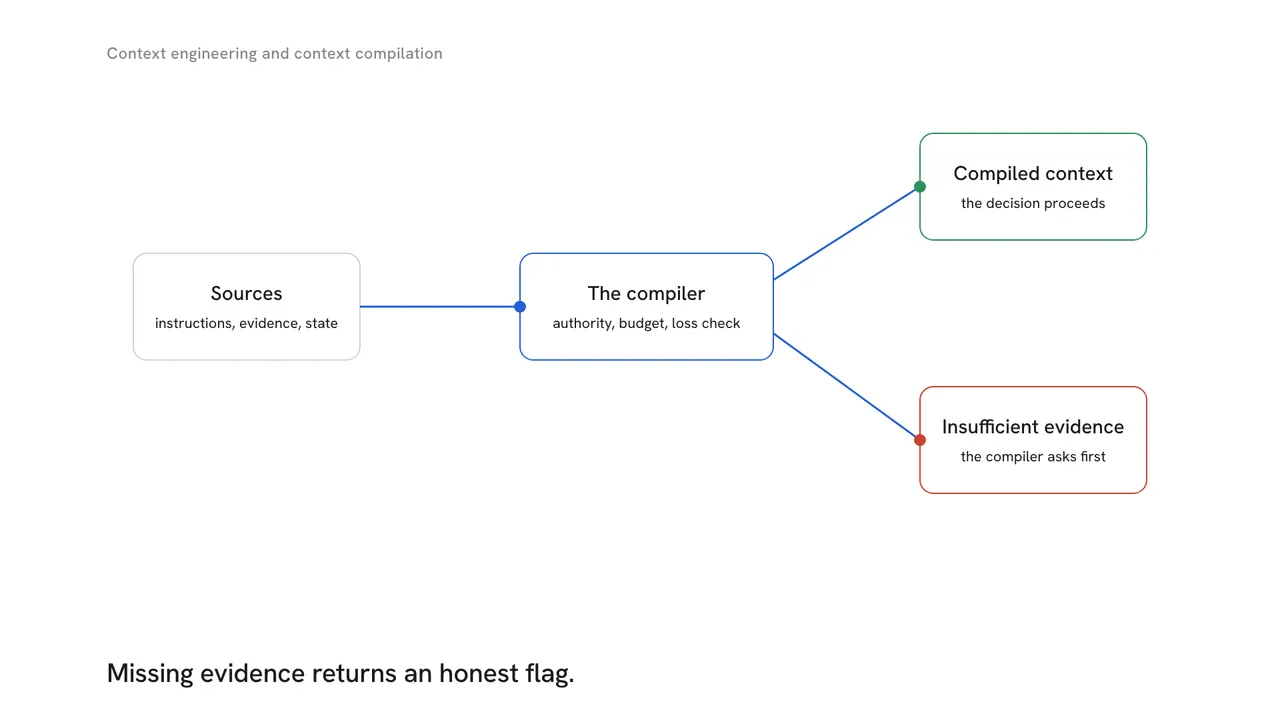
Four stages. First, inventory and authority resolution: load only source versions a caller is authorized to see, resolving conflicts by authority and recency, not by whichever text loaded last. Second, check mandatory evidence against the available budget before anything is selected, stopping to ask for more room rather than quietly trimming what the decision needs. Third, select remaining candidates with dependencies intact, then compress only material that can be safely reconstructed later, comparing critical facts before and after compression. Fourth, output a context artifact carrying its compiler version, source versions, budget, and a list of anything unresolved.
The common failure skips straight to output, pouring retrieved and remembered material into one prompt with no checks between.
How to lead it
Ownership belongs with whoever is accountable for the decision the context feeds, not a centralized platform team, under one shared contract.
Fund the deterministic path first: a fixed manifest, retrieval and structured state are inspectable, reproducible, cheap to audit, and cover most workflows. Fund a learned policy only for repeated tasks with real holdout data, measured against that baseline.
Measure critical-fact retention, not average answer quality, since compression can raise average score while quietly dropping the fact a decision depended on. Track cost per completed, checked task rather than per token processed, and stop funding relevance measures built on query-document similarity, which measures likeness, not completeness.
Two decisions belong to the executive alone: setting the smallest improvement worth shipping and the largest regression the business will tolerate, before anyone sees results, and governing any learned policy by freezing it before external evaluation, restricting it to sandboxed edits, and testing it on a different model and task mix.
What it is worth
The financial case shows up in three places: inference spent on material that never influenced the answer, downstream errors from a fact that was available but never reached the model, and exposure when a system shares more of a document with a provider than required. The risk case shows up as cross-tenant leakage from careless authority resolution, and as an attack surface once compiled context carries retrieved text a downstream system treats as executable.
Measure before and after with the same yardstick: critical-fact retention, citation fidelity, completed-task rate and stale-fact use, at matched total cost. The 2026 evidence supports that context strategies can be tuned for a specific task and that typed, source-linked commitment notation is a hypothesis worth testing. It does not yet support a universal ranking of fixed packing, retrieval, summaries and learned policies, a calibrated definition of context rot, or a drop-in latent compressor behind a closed model API. No dollar figure or return percentage appears in the source evidence.
Questions leaders ask
- What is context engineering, in practical terms?
- It is the decision, made fresh for every model call, about exactly what information that call is allowed to see. The practical test is whether you can show why each item was included, who had the authority to assert it, when it was true, and what was deliberately left out. A large context window does not answer that test.
- Is context rot a proven, measurable phenomenon?
- Not yet as a single calibrated law. Length, position, contradiction and distractor density behave as separate variables in the 2026 evidence, and falling accuracy as more material is added can also reflect a shrinking token budget or a changed task mix rather than length itself. Ask anyone using the term to show a test that varies one factor at a time.
- Should we build a fixed context pipeline or a learned one?
- Start with a fixed, deterministic compiler. It is inspectable, reproducible, and its failure surface is easy to audit, and it already covers most stable workflows. Fund a learned context policy only for repeated tasks with real holdout data, and only once you can measure its added cost against that fixed baseline.
- Does compressing context to save tokens create real risk?
- Yes, when compression is treated as a free resize instead of a lossy operation. The right test compares the critical facts present before and after compression, not average answer quality, because a system can score better on average while silently dropping the one fact a decision depended on. Reject any compressor that cannot show that comparison.
- What decision should stay with an executive rather than a technical team?
- Setting, in advance, the smallest improvement worth shipping and the largest regression the business will accept from a new context strategy. That is a risk tolerance call, not a statistical default, and it has to be fixed before anyone looks at the final evaluation results.


