
Why a Small AI Circuit Is Not Proof You Understand It
A concentrated AI circuit is not automatically an explanation of the model. Four checks separate a real interpretability claim from an engineered story.
Yash Sharma5 min readData, adaptation and alignment
Research area 78: Interpretability-by-construction and circuit-concentrating training
In brief
- A small AI circuit is not automatically proof you understand or have secured the model.
- The circuit-claim ledger checks four gates: modification, boundary, causal and cost.
- Treating an engineered circuit as discovered assurance produces audits and certifications that do not hold up.
Interpretability-by-construction and circuit-concentrating training covers methods that train or select a model so a chosen behavior runs through a small, inspectable pathway instead of the whole network. A small circuit is not automatically a true explanation of the model, a safer model, or a faster one. Treating those three claims as one turns a useful technique into a compliance liability.
What it is
Five approaches get grouped under this label, answering different questions. Posthoc circuit discovery studies an unchanged model and finds which parts causally drive a behavior. Sparse representation learning re-expresses the model's internal features. Architectural bottleneck training restricts information flow before training starts. Circuit condensation retrains a model, typically with small adapters and gates, so a behavior depends on a smaller graph. Architecture-constrained transparency picks a computational family narrow by design.
They optimize different properties, and strength on one says nothing about the others: localization, sufficiency, necessity, readability and predictability under intervention. A low sparsity score demonstrates none of the other four by default.
Posthoc discovery leaves the model unchanged. Condensation and bottleneck training do not: their explanation covers the model you now have, not the one you started with, and the two are not the same asset for audit or certification.
Why it matters now
Interpretability claims are moving from research curiosity to procurement criteria, and the methods for manufacturing an answer that looks like one are advancing faster than the discipline for checking it. Two studies published weeks apart in August 2026 show both sides. One on circuit condensation trained a model with lightweight adapters and gates so a behavior ran through a smaller graph, tested across four tasks, eight models and three seeds with sealed evaluation examples the search never saw. A study of Muon-trained transformers on modular-arithmetic tasks found a model can keep the same internal spectral structure while completely losing the ability to generalize, because the fault sat at the interface between representation and readout, not the representation itself.
Accepting a readable circuit as proof of safety, without asking whether the model was modified or the boundary hides upstream work, is buying a story rather than a guarantee.
The architecture
I use one checklist for every interpretability claim that reaches my desk, the circuit-claim ledger. It has four gates, and a claim has to clear all four before I treat it as assurance rather than a hypothesis.
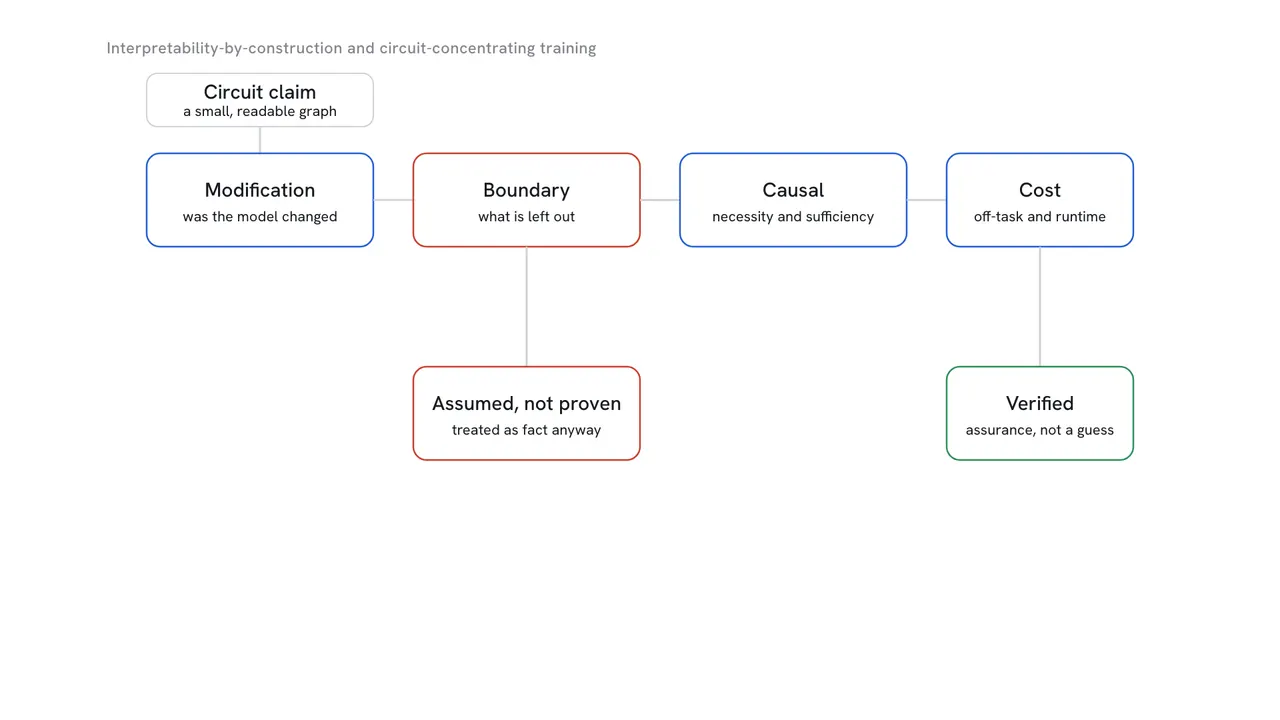
The modification gate asks whether the model was retrained or only observed. Posthoc discovery leaves the model untouched, so its explanation is a claim about the system in production. Condensation and bottleneck training change the model, so a team must show, with matched interventions on both versions, that the same dependency existed before the change.
The boundary gate matters because every circuit diagram is drawn against a declared accounting boundary, and what sits outside it is the real risk: upstream processing, residual pathways, adapters and bypass routes a small displayed subgraph never counts.
The causal gate requires real controls, not one sparsity number. Redundant pathways can each look unnecessary alone while the behavior depends on having at least one, and components that matter jointly can look irrelevant tested alone. A defensible test compares the circuit against equal-size random masks and holds out sealed examples the search never saw.
The cost gate matters because a smaller graph does not itself mean a cheaper or faster model, since graph size excludes the adapters and bypass work that made the concentration possible. The only honest cost figures are off-task accuracy, robustness under shift, and measured latency and memory.
How to lead it
Ownership sits jointly with research, which runs the interventions, and risk, which decides what assurance a use case requires. Fund this against specific, named behaviors, a fraud check, a triage step, a credit decision, not a general initiative. My rule: a model retrained to concentrate a behavior is a new model version, back through full evaluation rather than riding on the original model's track record.
The decision only an executive can make is where on the assurance ladder a use case sits. A low-stakes, high-volume case can rely on a posthoc explanation of the model already in production. A case with an audit trail a regulator will examine deserves a transparent small model or a typed, deterministic component around the opaque model, not an engineered circuit presented as a discovery about the original system.
What it is worth
The value shows up as faster, defensible audits for the behaviors you certify, fewer surprise regressions when a production model gets patched, and a basis for deciding whether an opaque model is acceptable. Skipping it costs the opposite: a certification built on an engineered rather than discovered circuit, or a procurement decision made against a compression number nobody verified.
Be direct with vendors and your own teams. The most cited condensation result carries a quantitative headline its own source materials do not agree on, unreconciled at the byte level, so budget no savings against it. What the evidence does support, in controlled settings, is that necessity, sufficiency and basis sparsity are logically separate properties, and that a model can keep a readable feature while failing a task because the fault sits at the readout, not the representation. It does not yet support a general claim that frontier models can be made transparent, or that a smaller circuit reliably means a cheaper one.
Questions leaders ask
- Does a small, readable circuit prove we understand our model?
- No. It proves only the property the method was built to optimize, usually localization or sparsity, and nothing else by default. Necessity, sufficiency, readability and predictability are separate properties that need their own tests. Treat a circuit diagram as a hypothesis about the model until those tests are run, not as a finished explanation.
- If retraining shrinks a risky behavior into a small circuit, is the model now safer to deploy?
- Not automatically. Concentrating a behavior into a smaller graph changes the model, so the resulting explanation covers the new, adapted version rather than the one you originally evaluated. My rule is to treat a concentrated model as a new model version and put it back through full capability and safety evaluation before it goes near production.
- Can we get this kind of assurance by testing a vendor's model through its API alone?
- No. API access supports behavioral testing and external checks built around the model, not internal activations or the ability to intervene on them, which a real circuit claim requires. Getting past behavioral testing to an actual circuit claim needs open-weight access or direct training access to the model.
- We turned a component off and nothing changed. Doesn't that prove it is unnecessary?
- Not on its own. Two components can each look individually unnecessary while the behavior still depends on having at least one of them, because the other quietly covers for it. A single-component test can also miss cases where two components only matter together. Test components in groups against random equal-size removals before concluding anything is unnecessary.
- Should we wait for a fully transparent large language model before using any of this?
- No. For the specific, high-stakes decisions that need a clear audit trail today, a transparent small model, a typed deterministic component, or a verifier placed around the opaque model already gives a clearer assurance boundary, even with narrower capability. Use the least complex system that actually meets the task and the risk involved.


