
Multiscale Credit Assignment: The Credit Integrity Test
Process rewards can look precise while crediting the wrong step. The credit integrity test checks invariance, causation and provenance before trust.
Yash Sharma5 min readData, adaptation and alignment
Research area 56: Multiscale credit assignment and process-reward engineering
In brief
- A denser reward can look precise while crediting the wrong step, training an agent to please its grader.
- The credit integrity test checks any reward candidate for invariance, causation and provenance before it trains a policy.
- Teacher and verifier costs rarely appear in the training budget until a false localization has already shaped the policy.
Multiscale credit assignment and process-reward engineering decides which of an agent's many intermediate actions, tokens, or tool calls deserves the reward or blame when a long task finally succeeds or fails. No single scoring method answers this safely: a step rewarded because it looks locally responsible, without testing whether repairing it changes the outcome, can train an agent to please its grader rather than finish the task. An executive funding a process-reward program is buying a claim about cause and effect, and that claim has to be tested before it is trusted, not assumed from a rising score.
What it is
This area turns one sparse terminal signal, whether a task finally succeeded, into denser feedback spread across the steps that led there. A team first has to pick the unit credit is assigned to: a token, a tool call, a semantic decision, or a trajectory segment. A single tool call can hold hundreds of tokens but represent one state change, so scoring per token rather than per event silently changes what is measured.
An action-independent baseline, a shaping reward, and a teacher-localized reward are three different mathematical objects with three different effects on what the agent ends up optimizing. Provenance matters as much as size: without an identifier tying each term to the real event it scores, one genuine success can be paid three times over, as a local step, a milestone, and a terminal reward.
Why it matters now
More production agents now run long, tool-using trajectories where the final outcome alone arrives too rarely to train efficiently, and three 2026 studies show the appeal and the limits of the obvious fixes. Learning from Environmental Feedback (August 2026) derives short- and medium-horizon weights from an agent's environment in ALFWorld and WebShop, a real technique that is not automatically an unbiased or policy-preserving reward. Rubric-to-Code Credit Assignment (posted August 28, revised August 31) maps rubric requirements through code dependencies to generated spans, and its reported gains do not by themselves show the spans caused the improvement. Cliff (posted September 2) has a teacher model identify an agent's first mistake, and the dossier says its localization accuracy, including whether it wrongly penalizes a reversible step, still needs direct assessment. All three are grade C evidence, author-reported, not independently replicated.
The architecture
The operating model I use is the credit integrity test: before any reward candidate trains a policy, it has to clear three checks, invariance, causation, and provenance, and any candidate that fails one has that failure declared, not hidden inside a rising number.
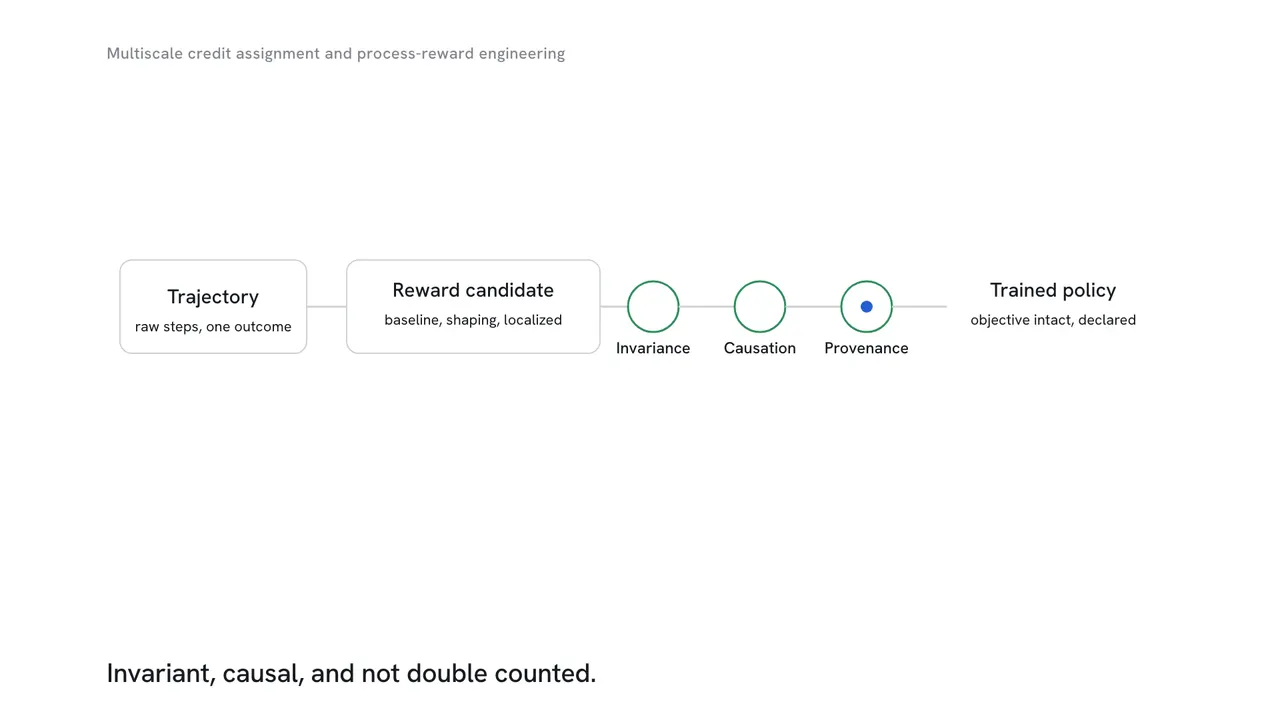
The invariance check asks whether the candidate changes the training objective at all. A baseline that depends only on the state, never the action taken, cancels out of the expected training update, reducing noise without moving the goal. A shaping reward built from a potential pinned to zero at the ending state sums, across a trajectory, to the same total the original objective would have paid. A reward that depends on which action was chosen generally fails this check.
The causation check applies once a reward claims to localize responsibility, a rubric pointing at one function, a teacher naming one first mistake. That claim is a hypothesis until it survives an intervention: repair, replace, or delete the nominated step while holding the rest of the trajectory fixed, and confirm the outcome changes more than under the same treatment applied to a matched, random step.
The provenance check closes the loop across timescales: every reward term needs an identifier tied to the event it scores, so a local completion, a milestone, and a terminal success cannot double-pay for the same event. A candidate that fails silently is the failure this architecture exists to catch: reward and process score rise together while the real outcome stays flat, because a policy under pressure finds whatever gap the checks failed to close.
How to lead it
Split creation from verification: the team that builds a baseline, a rubric, or a teacher model should not also run the causation check on its own work. Fund the three checks at the same budget line as the reward-building work, with a versioned record for every term: what it scores, its provenance identifier, and its invariance status.
Two decisions belong to the executive alone: approving a reward that knowingly fails invariance, since that changes what the organization is training toward, and setting how much teacher and verifier cost is worth paying to catch a rare, expensive failure before production.
What it is worth
The money here is spent in three places: compute training against a reward that later fails causation, teacher and verifier calls and upkeep that rarely appear in a training budget, and the cost of a deployed agent satisfying a localized reward rather than completing the task.
Measure cost per teacher or verifier call against the two baselines the dossier recommends, outcome-only reinforcement learning and rejection-sampling supervised fine-tuning, and fund the cheapest method that clears the task and safety bar. The three studies behind this essay, all grade C, author-reported and not independently replicated, support funding richer process feedback and demanding an intervention test before any localization claim is trusted. They do not support a universal process-reward design, a specific accuracy or cost figure, or a ranking of these methods at matched settings, and the dossier says its coverage of long-horizon correction and teacher-cost advantages remains partial.
Questions leaders ask
- If a denser process reward improves a benchmark score, does that prove it is crediting the right step?
- No. A benchmark gain shows the reward moved the metric, not that the step it credited caused the outcome. One of the three 2026 studies behind this piece maps rubric failures to code spans and reports benchmark gains from that mapping, but the same study is explicit that localization must be confirmed by an intervention, repairing the nominated span and checking the outcome changes, before it counts as causal credit.
- Is it safe to reward an agent for every intermediate milestone on the way to a goal?
- Only if every reward term carries an identifier tied to the specific event it scores. Without that provenance, one genuine success, a completed booking or a passed test, can be paid once as a local step reward, again as a milestone, and again as the terminal reward, making the signal look three times stronger than it is.
- Does adding a reward signal always change what the agent is being trained to optimize?
- Not always. A baseline that depends only on the state, never on the action taken, cancels out of the expected training update and leaves the objective untouched. A shaping reward built from a fixed, well-defined potential can do the same across a full trajectory. A reward that depends on which specific action was chosen generally does change the objective, and that change should be declared, not discovered later.
- How much should a teacher model's claim about an agent's first mistake be trusted?
- Treat it as a hypothesis, not a verdict. A September 2026 study builds process supervision from a teacher's identification of the first mistake in a trajectory, and the dossier behind it is explicit that the teacher still has to distinguish a genuine error from a reversible, recoverable exploration step before that localization is trustworthy.
- What is the biggest hidden cost in a process-reward program?
- Teacher and verifier calls, counted for every rejected trajectory and every localized step, plus the ongoing maintenance and latency of the verifier itself. That cost is frequently left out of a training budget because it does not look like a training expense. Fund the cheapest method that still meets the task and safety bar.


