
Synthetic Data and Curriculum Design: The Three-Gate Pipeline
Synthetic training data only builds real capability when generation, verification and a frozen holdout stay separate, never when it merely looks fluent.
Yash Sharma4 min readData, adaptation and alignment
Research area 10: Synthetic-data, curriculum and training-environment engineering
In brief
- Synthetic data only builds real capability when generation, verification and a frozen holdout stay separate.
- The framework is the three-gate pipeline: coverage, verification and holdout.
- Skipping verification isolation produces exploited verifiers and unmeasured training cost.
Synthetic-data, curriculum and training-environment engineering decides whether a model that scores better in testing actually knows something new, or has simply learned to sound more confident about what it already had. A distribution can become easier to learn without gaining a single bit of external information, and a verifier that checks the wrong property rewards the shortcut before the skill. An executive funding synthetic data without also funding verification and holdout discipline is paying for volume, not competence.
What it is
Synthetic data covers four things used almost interchangeably: generated inputs, labels, trajectories and training environments. Distillation transfers behavior from a stronger teacher's outputs, self-training feeds a model's own labels back into itself, self-play changes what it experiences against an opponent, and a curriculum sets which tasks get sampled next. Collapsing them into one phrase hides distinctions a leader needs to fund correctly.
A useful verifier checks one specified property, not overall correctness: a code test confirms a function returns the right value, not that the reasoning was sound. Treating a passing verifier as proof of general competence is the most common error in how these programs get briefed to executives.
Four principles hold the discipline together. Acceptance is a filter, not a neutral pass-through: whoever approves an example decides what the model sees. Difficulty and coverage must be measured from independent student performance, not teacher confidence. A curriculum is a spending policy under a fixed budget, and every rejected attempt's cost belongs in that budget.
Why it matters now
Production systems increasingly generate their own training signal, and a mistake here produces a model that looks like it learned something when it did not. A March 2026 study training code-generation curricula across student models from eight billion to thirty-two billion parameters reported roughly a fourfold improvement in valid-example yield, counting attempts rather than matched computational cost, so it is not a fourfold return.
A May 2026 study proposed an information-theoretic boundary: information about an external fact cannot increase across successive rounds of model-generated data. That is a real limit, though its eligibility as 2026 evidence is still provisional, and it does not say accuracy must decline at every step. New human examples change the boundary, so collapse is a mechanism to test, not assume.
A June 2026 benchmark found capability on a question-answering task fell from 92.5 to single digits as the privacy budget tightened, while a fluency-style similarity score barely moved: a private corpus can look identical to the original and still fail to teach what it was built to teach. An August 2026 study used controlled knowledge exposure to separate genuine learning from a model that had simply seen the material before.
The architecture
The clearest way to operationalize this discipline is what I call the three-gate pipeline: coverage, verification and holdout, applied to every generated example before it shapes a model.
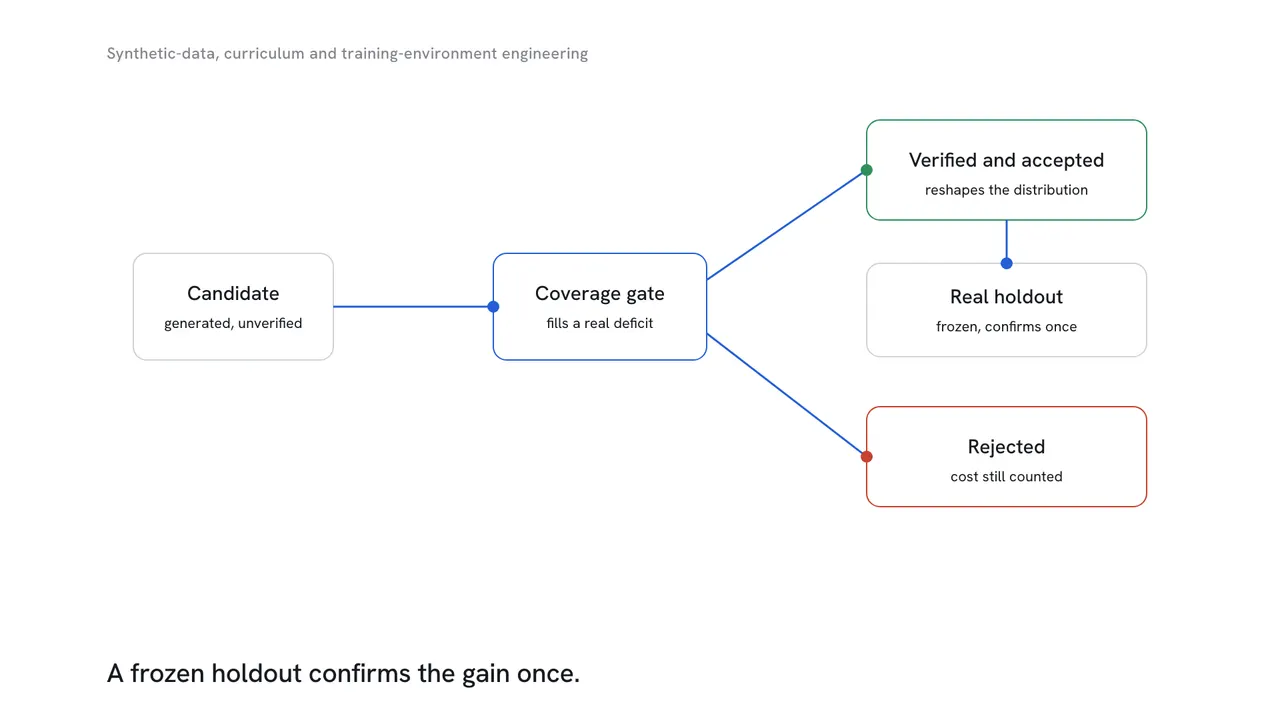
The coverage gate decides whether a candidate example is worth generating, sampling from a table of task types, skills, populations, difficulty levels and known failure modes rather than whatever the model produces easiest.
The verification gate is where most programs quietly fail. A verifier must check its property with reward computation kept outside the model under training, hidden tests authored independently of generation, and where feasible a second implementation to catch a shared mistake. A method that accepts three times as many attempts can still cost the same per accepted example, so a yield improvement alone never proves a cost advantage.
The holdout gate is the one most curricula quietly erode. A real, independently sourced set of tasks must stay inaccessible to the teacher, the generator and the verifier, frozen before curriculum optimization begins, and consulted once, at the end, to confirm a claim rather than shape it.
Ownership belongs split, on purpose. The team accountable for the downstream skill decides what gets generated, while a separate team owns verification and the real holdout, permissions kept apart so no group can both claim progress and grade it. Two calls belong to the executive alone: setting the smallest improvement worth shipping and the largest tolerable regression before anyone sees the holdout results, and deciding when a curriculum is frozen for evaluation.
What it is worth
Fund the coverage table, independent verification and the holdout discipline before more generation volume. A second, independent verifier is worth its cost on anything with real stakes, since one exploited stays invisible until it fails in production. Measure yield-adjusted cost per accepted example, independent real-task transfer, and rare-case recall, since averages hide where a curriculum fails. Stop funding programs judged mainly on acceptance yield or surface resemblance to real text.
Money and risk show up in three places: compute spent training on an artifact rather than a skill, unrecorded cost from rejected generations never entered in a lifecycle total, and exposure when a private synthetic corpus preserves surface similarity to sensitive source material while failing to teach the capability it replaced.
The 2026 evidence supports funding careful, per-task curriculum design and independent verification, and treating privacy budgets and capability as separate metrics that must both be reported. It does not support a universal synthetic-data recipe, a fixed collapse threshold, or one optimal ratio of real to synthetic data. No dollar return appears in the underlying evidence, and anyone who quotes one is going beyond what the record shows.
Questions leaders ask
- Does more synthetic data always make a model more capable?
- Not by default. Acceptance is a filter, not a neutral copy, so whichever verifier or reviewer approves an example reshapes what the model actually learns. Fluent, correct-looking output is not proof of new information, since a model can reorganize what it already knows without acquiring anything external. Measure independent real-task transfer, not acceptance yield or teacher confidence, before trusting any volume claim.
- Is model collapse from synthetic data an inevitable outcome?
- The 2026 evidence does not support that conclusion. An information-theoretic bound published in May 2026 limits what a closed generation loop can learn about an external fact, but it does not prove accuracy must fall at every step, and new human examples, tools or observations change that boundary. Treat collapse as a mechanism to test on your own pipeline, not a label to assume.
- Can synthetic data protect privacy and still teach new skills?
- Sometimes, but the two goals can diverge sharply. A June 2026 benchmark found that in one four-billion-parameter setup, nonprivate synthetic text scored 92.5 on one task while a tightly private version scored 3.86, even though a fluency-style similarity score barely moved. Judge private synthetic data on the capability it was meant to transfer, not on how natural it reads.
- Who inside the company should own curriculum and verification?
- Split them deliberately. The team accountable for the downstream skill should own what gets generated and why, while a separate team owns verification, reward computation and the real holdout, with permissions kept apart so no group can both write a claim of success and grade it. Route any teacher or verifier change through the same regression review a dataset change would require.
- What is the costliest mistake in a synthetic-data program?
- Counting only what survives to training. A method that accepts three times as many attempts can still cost the same per accepted example once rejected attempts are counted, so a yield improvement alone never proves a cost advantage. Track full lifecycle cost, including every rejected generation, human review and failure, against independently measured capability gained.


