
The Intervention Test Behind Every AI Causal Claim
A fluent explanation or a strong benchmark score is not proof an AI system understands cause and effect. Here is the test that separates the two.
Yash Sharma5 min readModel architecture and training
Research area 69: Causal abstraction and compositional-generalization engineering
In brief
- A fluent explanation or a high benchmark score is not proof of causal understanding.
- The intervention ladder ranks a causal claim by what it actually proves before it can be acted on.
- Budget this as risk reduction against a wrong intervention, not as a technology purchase with a proven payback.
Causal abstraction and compositional-generalization engineering asks one question of any AI system that claims to reason about cause and effect: does it know what would happen if you changed something, or only what happened when nothing changed. The two look identical on a benchmark leaderboard and diverge the moment a leader acts on the answer.
What it is
Compositional generalization is the ability to answer correctly about a new combination of parts the system has only seen separately, not one it memorized. Systematicity is the narrower claim that answers stay consistent across related combinations, and transportability asks whether a causal question can be answered in a new setting at all. Causal abstraction is stricter still: a defined map between a detailed model and a simplified one, valid only if it preserves the answers to the specific interventions the simplified model must serve.
None of these follows from a large training set, a convincing chain of reasoning, or a strong score on a held-out split, which frequently keeps the same templates and mechanisms on both sides and so rewards memorized pattern-matching. A model can also produce a fluent, consistent explanation without it tracking the actual causal structure of the problem.
The stakes changed in 2026 as more systems moved from describing the past to recommending an intervention in the present, and this year's evidence is honest about how unresolved the science still is. A controlled study posted in August 2026, using a frozen half-billion-parameter base model and a shared low-rank adapter, found masking evidence improved outcomes in nine of ten matched comparisons, but the study's stricter, preregistered stress test against those conditions failed, a caveat the authors reported openly and one to ask for behind any nine-out-of-ten headline.
A separate August 2026 paper restricted a noisy evidence channel between two parts of a system to force what the authors call grounded reasoning, but verified premise text still traveled forward outside that channel, so a low score there did not bound what the full system used. Two formal papers from earlier and mid-2026 describe a mathematical framework for transporting a causal model between systems, a proven relationship between abstract models, not a demonstrated bridge to how a transformer behaves.
The architecture
The intervention ladder is the operating framework I use to rank how much weight a causal or compositional claim deserves before it drives a real decision, and to force an explicit choice when the evidence does not clear the bar.
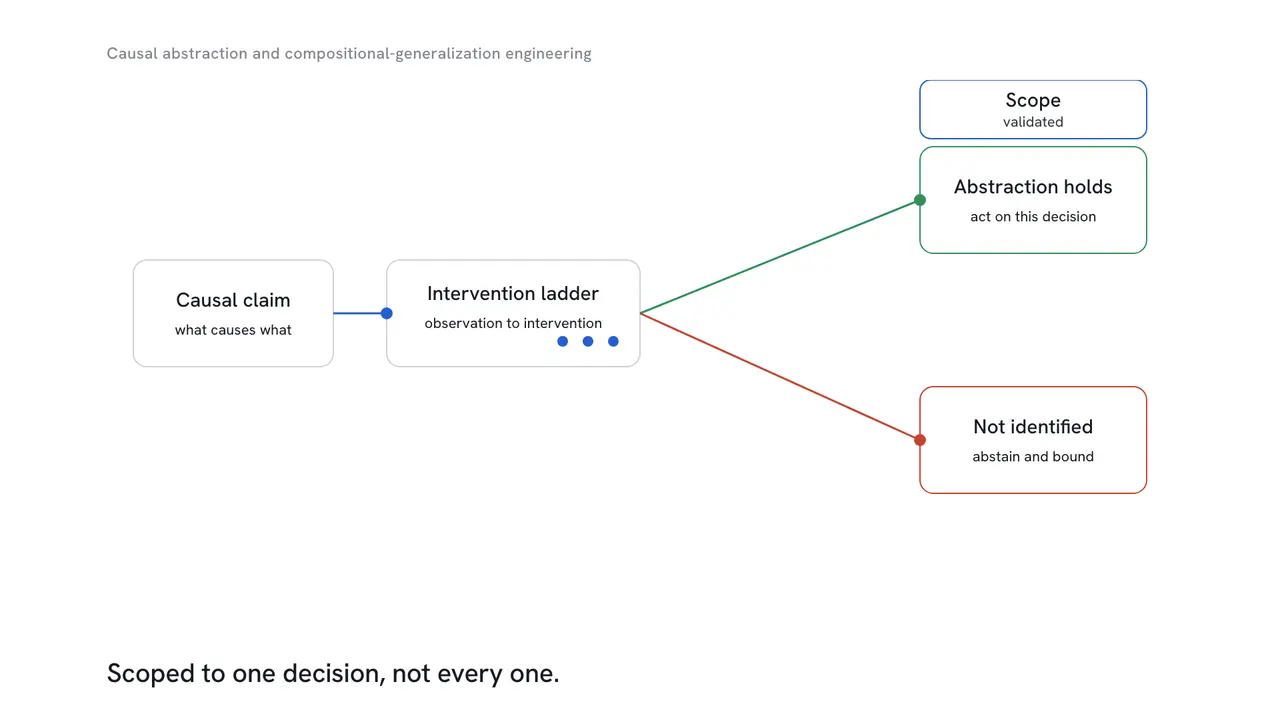
The ladder has four rungs, in order of what they prove. Rung one, observation: the system predicts correctly on historical data, achievable by exploiting a confound, proving nothing about what happens if the confound changes. Rung two, counterfactual text consistency: the system answers consistently with a hypothetical stated in the prompt, testing whether it can follow a premise, not whether that premise matches reality. Rung three, controlled intervention: a specific variable is actually changed, synthetic or live, and the answer is checked against the true effect. Rung four, validated query-specific abstraction: a simplified representation is checked against held-out interventions it was not tuned on, earning trust only for the decisions it was validated against.
As the evidence above shows, a masking or bottleneck intervention can pass its main comparison and still fail a stricter version of the same test. The ladder carries one governance rule that matters as much as the four rungs: when an effect is not identified, the system returns a bound or a request for the missing experiment, never an invented point estimate with false confidence.
Ownership sits with whoever owns AI evaluation and model risk, working with the team the claim informs. Fund a compositional stress test held out on mechanism, a library of controlled interventions matched to the baseline compared against, and a strict separation between the role that proposes a causal model and the role that solves it, so an exact solver answering the wrong model perfectly cannot pass as evidence the model is right. Stop accepting an aggregate accuracy number as sufficient evidence, and stop letting a fluent explanation substitute for an intervention test.
Two decisions belong to the executive alone: how strong the evidence must be before the business acts, and when the system must abstain and return a bound rather than a confident answer. Log every claim with the rung it cleared, and let no claim above rung two drive an irreversible decision without a controlled intervention test behind it.
What it is worth
The money and risk show up in three places: the cost of controlled interventions over cheaper observational data, the cost of a held-out test suite, and the cost of a wrong causal decision that looked validated and was not. Measure whether a claimed improvement survives a stricter, preregistered stress test beyond its main comparison, whether a measured bottleneck genuinely bounds what the full system uses, and whether a system, when its effect is not identified, returns a bound rather than an invented number. Track the share of decisions that cleared rung three or four before acting, not the share explained well.
The evidence does not support a return-on-investment figure for this work in general. Every source available this year is graded as preliminary or bounded, none independently replicated, and the two formal transportability frameworks remain unverified against actual trained models. Budget this as risk reduction, priced against the cost of the wrong intervention it prevents.
Questions leaders ask
- Does a model that explains its reasoning have a real causal understanding of the problem?
- Not necessarily. A fluent, consistent explanation shows the system can follow a stated premise, not that the premise matches the real causal structure of the business problem. Two systems can agree on every past outcome and still give opposite answers the moment something is actually changed, because agreement on history does not pin down what an intervention would do. Test the claim with an actual controlled change, not with how convincing the explanation reads.
- Should we trust a compositional-generalization benchmark score before rolling out an agentic system?
- Only partly. A 2026 controlled study found that restricting evidence access improved results in nine of ten matched comparisons, a strong-looking main result. But the same study's stricter, preregistered stress test failed against those same conditions. Ask for both numbers before trusting either one, and treat a favorable headline reported without its stress test as incomplete evidence.
- What does a formal causal-abstraction theorem actually buy us in production today?
- Less than the name suggests. Two 2026 papers describe a rigorous mathematical relationship for transporting a causal model between systems, genuine progress in theory. Neither has been shown to hold for how a trained transformer's internal representations actually behave, so treat both as a direction worth tracking, not as a production guarantee to build a real decision on yet.
- How do we know an AI system is not gaming an information-bottleneck test?
- Check what travels outside the bottleneck, not just the score measured inside it. A 2026 paper restricted one noisy evidence channel and reported a low information score there, but the system also carried verified premise text forward through the rest of its context. A narrow, well-instrumented channel does not bound what the full system actually used.
- What should an AI system do when a causal effect cannot be identified from the available data?
- It should say so. The right response is a bound, a sensitivity range, or a specific request for the missing experiment or data, never an invented point estimate delivered with confidence it has not earned. Keep the role that builds the causal model separate from the role that solves it, since an exact solver can answer the wrong model perfectly.


