
Latent Reasoning and Recurrent Depth: What Hidden Loops Are Worth
Latent reasoning lets a model loop over hidden state instead of writing text. What the thin 2026 evidence supports, and the depth ledger to fund it.
Yash Sharma5 min readModel architecture and training
Research area 63: Latent reasoning, recurrent depth and adaptive halting
In brief
- Latent reasoning loops a model's hidden state for more computation, and the thin 2026 evidence supports only narrow, unreplicated gains.
- The depth ledger names the recurrence type, halting policy, used evidence, and full economics before funding a loop.
- Skip the ledger and a system can multiply compute twenty times while converging confidently on the wrong answer.
Latent reasoning, recurrent depth and adaptive halting ask one question: can a model spend more computation on a hard problem by looping over its own hidden state, without writing the intermediate thought down. The 2026 evidence is real but narrow: a handful of small, task-specific, author-reported results with no independent replication. Before a hidden loop earns production budget, a leader needs its recurrence type, what stops it, whether it is doing real work, and its full cost.
What it is
Latent reasoning is computation inside a hidden state, revisited before anything is read out as an answer. Three mechanisms get bundled under this label. Depth recurrence reuses shared parameters and updates the same state repeatedly, thinking longer without writing anything down. Sequence recurrence processes more input, carrying a working state forward, closer to reading more than thinking harder. Fast-weight learning changes a parameter-like piece of the state using its own objective mid-session, closer to a training step than either.
A converged state is not automatically a correct one. A repeated block of computation can settle into a stable value the way a simple averaging rule settles toward a fixed point regardless of the right answer, so a model can be confident and wrong in the loop that produced its answer.
Hidden-loop systems are moving toward architecture decisions faster than the evidence is growing. Four 2026 studies matter, none independently replicated. An August 10 paper combined fixed-weight recurrence with latent depth in a 150-million-parameter system, reporting a pass-at-two score of 29.5 percent on ARC-AGI-1, not a clean measure of the loop alone. An August 5 paper, revised August 27, audited shared hidden state and found a naive zero-value control can push a model off its normal range and exaggerate the effect. A September 3 paper added attention over a loop's earlier states plus a trained halting mechanism, reporting 56.92 percent on a math benchmark at roughly two loops, across three training seeds and eight evaluation seeds. A fourth paper, posted July 8, found a simpler post-training confidence readout can match or beat a jointly trained halting mechanism, challenging the assumption that more elaborate stopping machinery earns the gain. This evidence supports funding a pilot, not a rollout.
The architecture
The clearest way to hold a team or a vendor accountable is what I call the depth ledger: four entries a hidden-loop system should fill in before it earns production budget.
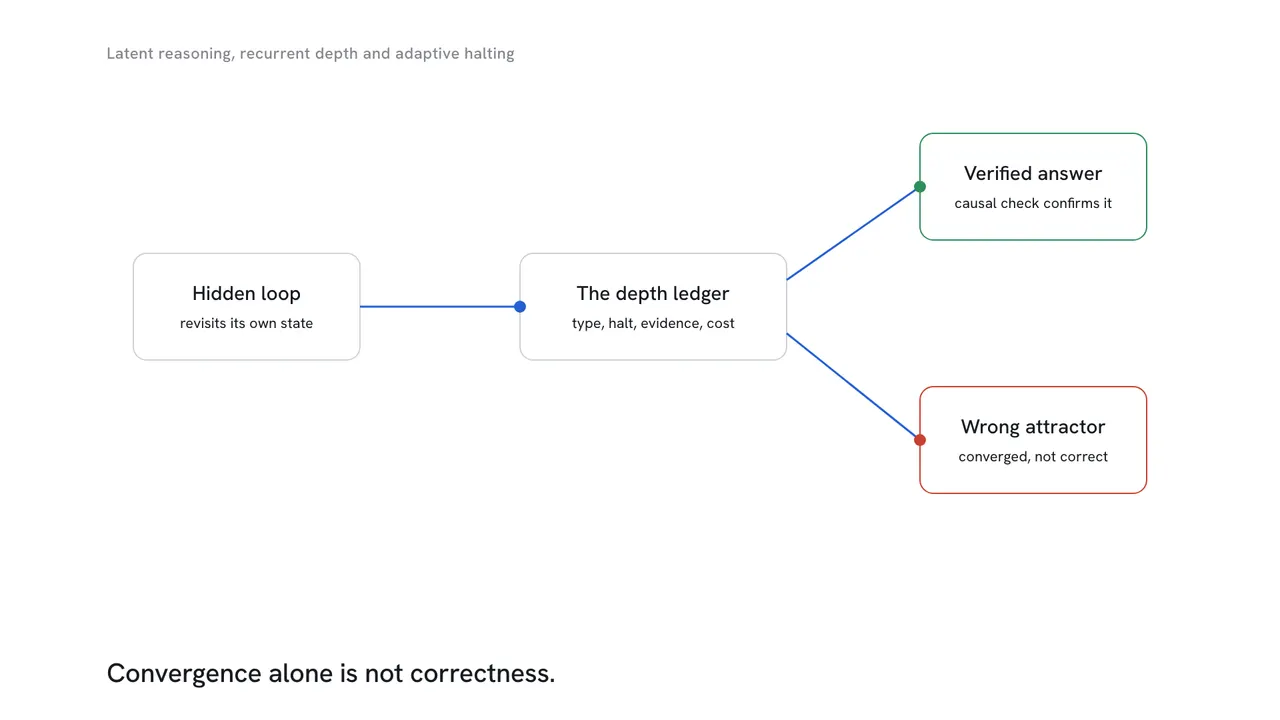
The first entry is the recurrence type: whether the system spends more work on one problem, reads more input, or updates a parameter-like state mid-session. Each carries a different cost and failure mode, and a system that blends them without naming the blend is describing a marketing term, not an architecture.
The second entry is the halting policy. A fixed loop count wastes computation on easy inputs and starves hard ones. A confidence threshold needs calibration against real inputs or it stops early on confident nonsense. A learned halting mechanism needs its own training objective and a hard cap, and a budget controller weighs each extra loop's benefit against its cost. The system must report why it stopped, converged, capped, or exhausted its budget, not return a result assumed correct.
The third entry is used-versus-recoverable evidence. A diagnostic probe that predicts an answer from the hidden state proves the state carries recoverable information, not that the model's own readout used it. Trust an account of the loop only when it survives a causal test built from mismatched content, not a zeroed-out control.
The fourth entry is full economics: count every attempt, candidate transformation, tool call and loop step actually run, not the headline accuracy of the best attempt. A shared block repeated twenty times does not become a twenty-times-larger model, but it spends roughly twenty times the compute of one pass, and that compute is what a leader is paying for.
Ownership sits with whoever runs model serving and evaluation, not the research team behind an encouraging benchmark number. Fund the disclosed, bounded path first: a named recurrence type, a halting policy with a hard cap, full economics alongside accuracy. Fund more loop sophistication only against a held-out test built to catch the failure the July 2026 evidence flagged, that a simpler post-hoc readout can match a more complex trained gate.
Two decisions belong to the executive alone: the budget cap on how much hidden computation any request may spend before returning its best answer, and disclosure, whether a customer-facing system may describe its own hidden reasoning in natural language at all, since such an account can be a plausible invention, not a faithful report. Where internals are not accessible, require the same governance through an external substitute: repeated-answer or external-memory baselines.
What it is worth
The financial case shows up in two places: tasks a smaller, looped model can solve that would otherwise need a larger model or an external tool call, and compute saved when a budget controller halts an easy input early instead of a fixed, wasteful depth. The cost case sits next to it: a shared block repeated many times is real compute every run, a trained halting mechanism is a training investment with its own calibration risk, and loop-history memory is storage that grows with every beat remembered.
The 2026 evidence does not support a general claim that hidden loops make language models better reasoners. It supports narrower claims: a small, task-specific system can post a real gain on a structured benchmark, a naive control can manufacture an effect a better control removes, and a simpler stopping rule can rival a more complex one. Measure before and after against a fixed-depth sweep, a compute-matched alternative, and a repeated block with the state mechanism removed. No return figure appears in the evidence, and none is invented here.
Questions leaders ask
- Is latent reasoning the same thing as chain-of-thought prompting?
- No. Chain-of-thought writes intermediate steps out as text the model then rereads. Latent reasoning updates an internal state across repeated passes and never writes any of it down, so nothing about the intermediate work is visible, auditable, or cheap to inspect the way written text is. Treat the two as different mechanisms with different costs and different failure modes, not as two names for the same behavior.
- How do I know if a hidden reasoning loop is actually converging on the right answer?
- A stable internal state is not proof of a correct one. A simple repeated computation can settle into a fixed value regardless of what the correct answer actually is, so convergence needs to be checked against a real outcome, not assumed from stability. The dossier behind this essay includes a worked counterexample: a basic averaging rule converges reliably to the wrong number every time.
- Does the 2026 evidence support putting a recurrent-depth system into production today?
- Only as a pilot. Every study behind this essay is graded as a preliminary, author-reported result with no independent replication, and the strongest one reports a task-specific score on a narrow benchmark, not a general reasoning gain. That is evidence worth testing against your own workload, not evidence strong enough to justify a rollout without a held-out evaluation of your own.
- What is the biggest hidden cost of a system that loops internally before answering?
- Uncounted compute. A shared block of parameters run twenty times does not grow the model, but it spends roughly twenty times the computation of one pass, and that cost hides easily behind a parameter count that never changed. Full accounting means counting every attempt, candidate transformation, tool call, and loop step a request actually ran, not just its headline accuracy.


