
The Four-Layer Envelope for Embodied AI and Robot Simulation
A realistic robot simulation is not proof a plan is safe. The four-layer envelope shows where independent verification has to sit.
Yash Sharma5 min readAgentic AI in production
Research area 29: Embodied, world-model and simulation engineering
In brief
- A realistic robot simulation is not evidence a plan is safe to run on real hardware.
- The four-layer envelope puts an independent verification layer between prediction and execution.
- Real transfer evidence is narrow: around fifteen to twenty trials, no physical safety certification.
Embodied, world-model and simulation engineering is the discipline of teaching a system to predict what happens next in the physical world, then deciding how much of that prediction to trust before a robot or autonomous vehicle actually moves. The 2026 evidence is blunt: a simulation can look completely real and still be physically wrong, and a plan that scores well inside a learned world model can fail, or hurt someone, the moment it reaches real hardware. Leaders funding a physical AI program need to know where the trust boundary sits and who is accountable for it.
What it is
Four kinds of system get lumped together under this label, and confusing them is where budgets get wasted. A world model predicts how state or observation evolves. A simulator implements a specified transition process built on known rules. A language planner proposes goals or breaks them into steps. A vision language action, or VLA, policy maps what a camera sees directly onto motor commands. None of these four is a robot, and none is safety, on its own.
Model predictive control is the discipline's working method: a system plans over a short horizon, executes a brief segment, then reobserves before continuing. Demos conflate properties that need separate measurement: how realistic a predicted scene looks, how accurately a model predicts state change, whether actions influence outcomes as intended, and whether the plan respects physical constraints such as contact and collision. A video can be beautiful and physically impossible at once, and a model with low pixel error can still miss the one contact force that determines whether a task is safe.
The architecture
A study made public August 17, 2026, revised September 1, evaluated eighteen world models across 330 cases using 5,000 human pairwise judgments: human agreement about a plausible looking video is not evidence of correct physical dynamics. A study made public July 2, 2026 tested four frozen world models across six tasks and found that checking a proposed action against physical cause and effect can reject imagined transitions, though two learned models sharing a training blind spot can agree on an outcome that is still wrong. I call the pattern this evidence supports the four-layer envelope: a state layer anchored to real sensors, a prediction layer proposing candidate futures, an independent verification layer that rejects candidates the prediction layer cannot be trusted to reject itself, and a bounded execution layer that acts on a short segment and reobserves.
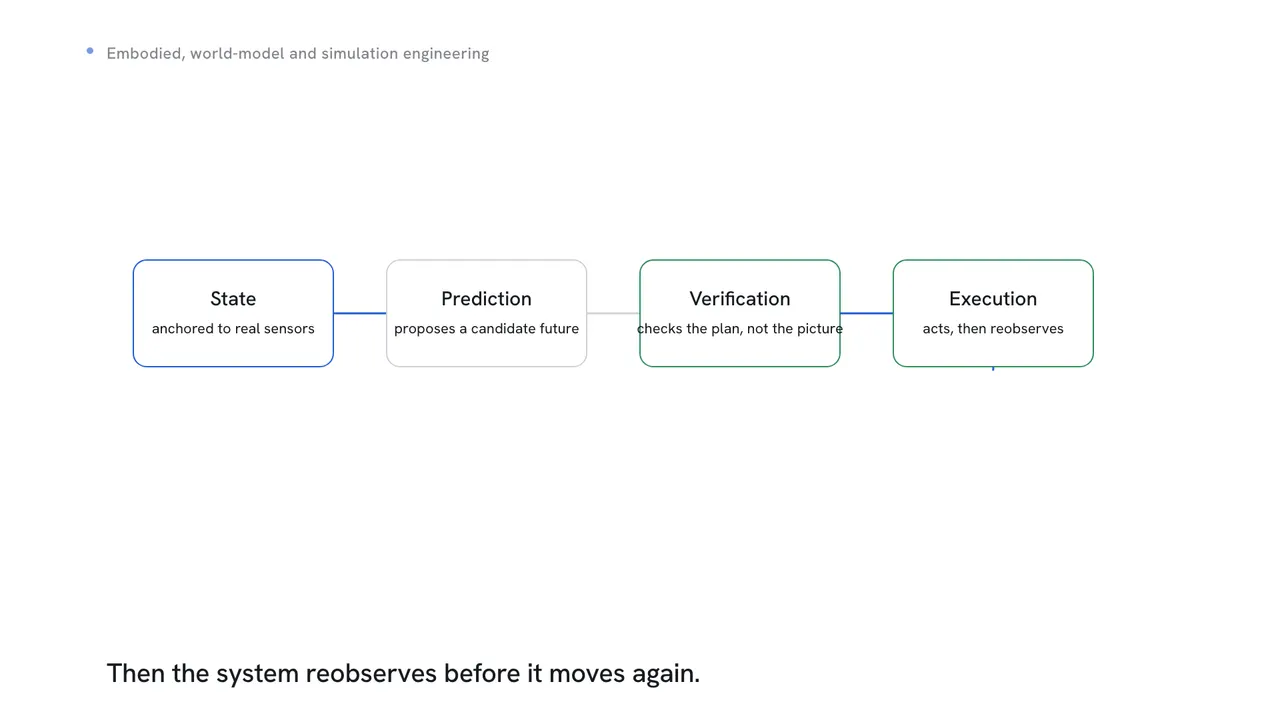
The state layer holds the actual measured condition of the world: object identities, geometry, contact state, timestamps and how uncertain each reading is. When belief falls outside a validated region, the correct response is a safe fallback, not a confident prediction. The prediction layer is where the world model or VLA policy proposes what might happen over a bounded horizon, using language goals translated into typed constraints with real tolerances, because a phrase like move safely is not a specification.
The verification layer is the one most programs skip, and the one the evidence says cannot be skipped. It checks each candidate plan against something the prediction layer does not fully trust itself, typically a geometric collision check or an inverse dynamics test, rejecting a plan that is visually plausible but physically wrong, such as an object reaching its target by passing through a wall. This layer should sit on a different model than the one that generated the plan. The execution layer is a fast, bounded controller that carries out only the next short segment, inside a stated envelope of workspace, speed, force and permitted objects, then reobserves. Nothing crosses from prediction to execution without passing through verification built to catch what the predictor cannot see in itself.
How to lead it
Ownership belongs with whoever is accountable for the physical outcome, typically a head of robotics or physical operations, working with safety engineering, never a model team alone: the verification layer only works if it reports to someone other than the team whose plan it checks.
Fund the verification layer before funding a bigger predictor. Fund calibration of the operational envelope against the real plant, because a simulator's proxy threshold is not a safety certification. Fund the real world trial budget as its own line item: the strongest 2026 transfer evidence covers a small number of tasks with real trial counts around fifteen to twenty, a narrow claim, not a general one.
Measure task success and hazard exposure as two separate numbers. Track how often the verification layer rejects a candidate: a zero rejection rate over time warns the check has gone stale, not that the predictor is trustworthy. Two decisions stay with the executive: naming the accountable operator for every physical action the system may take, before deployment, and fixing the operational envelope and intervention procedure in writing, requiring any change to go through the same approval the original one did.
What it is worth
Money shows up in the training and adaptation pipeline, not only at deployment. The one study with real robot evidence needed extensive simulation pretraining before its fifteen to thirty minute adaptation step worked, and any economic claim has to count that pretraining.
Risk shows up in small trial counts treated as proof. With zero observed failures across thirty independent trials, the honest upper bound on failure probability at ninety five percent confidence is still near nine and a half percent, not zero. The real robot evidence used fifteen to twenty trials, fewer than thirty, so its uncertainty bound is wider still.
What the 2026 evidence supports is narrower than a general claim of embodied competence: separated diagnostics over a single visual score, action consistency checks as a useful but shareable blind spot diagnostic, and narrow real robot transfer under heavy simulation pretraining. It does not support broad transfer across arbitrary objects or environments, and no physical safety certification follows from any of the appraised studies. That gap is the dossier's own stated boundary, and it belongs in the budget conversation.
Questions leaders ask
- Does a realistic robot simulation prove a plan is safe to run on real hardware?
- No. A 2026 study that gathered 5,000 human pairwise judgments across eighteen world models found that human agreement about how plausible a predicted scene looks is not evidence of correct physical dynamics, let alone of safe control. Treat a convincing simulation as a diagnostic worth investigating further, not as proof.
- What is the difference between a world model and a simulator?
- A world model predicts how state or observation will change, learned from data. A simulator implements a specified transition process built on known rules and physics. A simulator's behavior follows from its stated model, while a world model's prediction can be wrong in ways that are hard to detect from the output alone.
- Why keep an independent verification layer instead of trusting a better prediction model?
- Because two learned models can share the same training blind spot and agree on the same physically impossible transition, so a second opinion from the same family of model proves nothing new. A 2026 study of four frozen world models found that checking a candidate plan against inverse dynamics catches errors the predictor cannot see in itself.
- How much real-world evidence exists for transferring a learned robot policy out of simulation?
- Less than most demonstrations imply. The strongest 2026 transfer evidence covers narrow tasks, a single robotic arm and a single legged robot, with real trial counts around fifteen to twenty, and it depended on extensive simulation pretraining before a short real-world adaptation step worked.


