
What Automatic Prompt Optimization Is Actually Worth
Automatic prompt optimization pays off only when you measure headroom first, isolate the prompt's parts, and confirm gains on a holdout.
Yash Sharma5 min readContext, retrieval and memory
Research area 01: Prompt engineering and automatic prompt optimization
In brief
- Automatic prompt optimization pays off only when you measure real headroom before searching.
- The four-gate prompt model checks headroom, isolates components, confirms on a holdout, then decides to ship or escalate.
- Skipping confirmation risks paying for a search that makes prompts worse while looking like a win.
Prompt engineering and automatic prompt optimization decide how much a language model's instructions are worth changing, and whether that change should be found by a person or searched for by a machine. The 2026 evidence is neither dismissive nor triumphant: some workloads carry real, repeatable prompt sensitivity and some carry almost none, and the only way to know which is true is to measure it before paying for a search. For an executive funding this work, the discipline that matters most is not a better prompt. It is a gate that decides when prompt work is worth funding at all.
What it is
Prompt engineering is a person choosing an instruction, demonstrations and an output format by judgment. Automatic prompt optimization uses measured feedback to search across many candidate prompts instead. The dossier treats both as work on one object, the prompt program: the instruction, demonstrations, output contract and control choices around them, not one undifferentiated block of text.
Its parts are separable and each does a different job, so changing several at once makes it impossible to say which change caused an improvement. Most consequential for an executive: a prompt can change what a model says without adding any new knowledge to it. Retrieval, memory and fine-tuning move information into a system, while prompt work only moves interpretation of information already there, and confusing the two means editing wording for a problem that was never about wording.
The stakes are financial before technical: every optimization run consumes evaluation and generation calls plus staff time, and every shipped prompt keeps consuming inference cost for as long as it runs. A 2026 study by Zhang and colleagues, testing six optimization methods on a held-out set, found forty nine percent of runs against Anthropic's Claude Haiku underperformed a plain zero-shot prompt: an optimizer can make a prompt worse while still looking successful on the metric it was tuned against. A study by Gao and colleagues, training a separate model to generate prompts with reinforcement learning, reported meaningful gains but required training infrastructure, not only API access. A third, from Büssing and colleagues on cost-aware search, beat a standard baseline in most tested cases, evidence the dossier grades as preliminary. Assuming prompts never matter, or that any optimizer pays for itself, are both ways to overspend.
The architecture
The evidence resolves into an operating sequence I call the four-gate prompt model, four checkpoints a prompt program must clear, in order, before an organization keeps spending on it. Skipping a gate is where most wasted optimization spend originates.
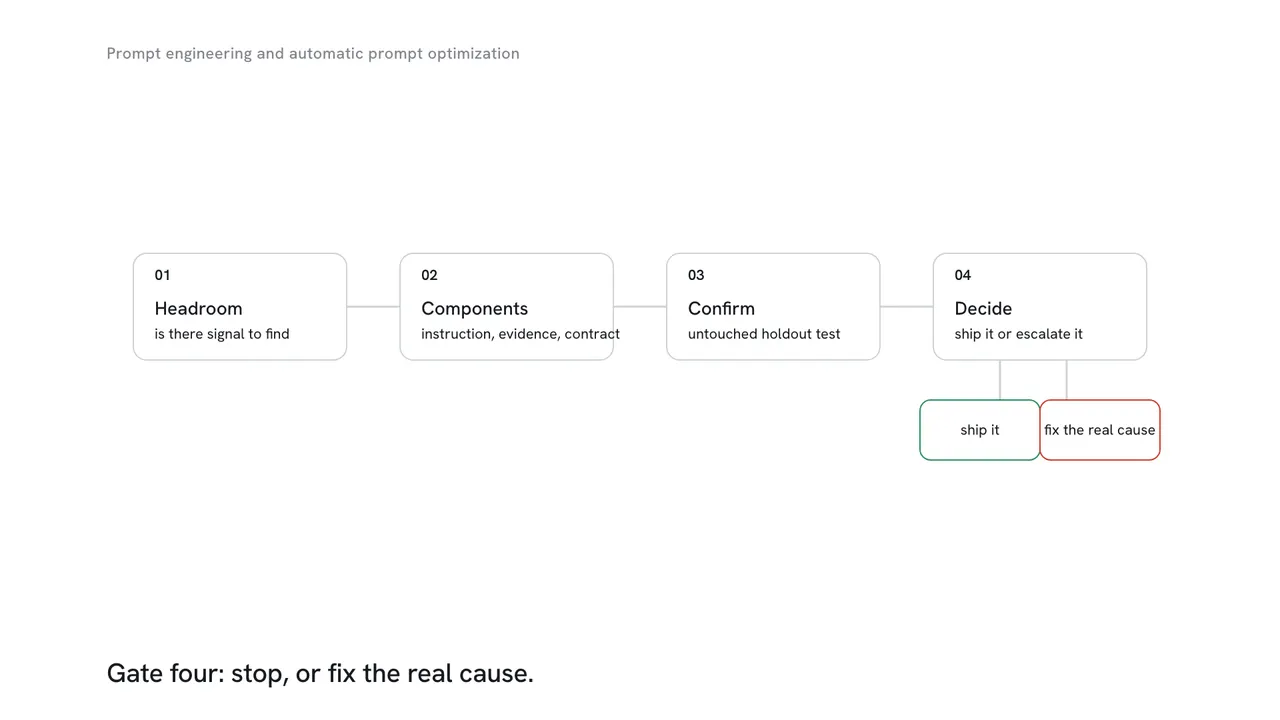
Gate one is headroom: measure how much of the output's variation comes from the prompt itself versus the model's own sampling randomness and the grader's inconsistency, before editing a word. A flat result with wide uncertainty is inconclusive, not proof prompts do not matter here.
Gate two is component isolation: separate the instruction, the evidence available to the model, the output contract and the evaluator, and change one at a time. A vague instruction and missing evidence can look identical in a bad answer, but they call for different fixes.
Gate three is confirmation: a development set, a selection set, and a final holdout the optimizer never touches, opened once. With roughly a hundred candidates of near-equal quality and ordinary measurement noise, the apparent winner's validation advantage can run close to nine points before it has done anything real. An optimizer that cannot beat a frozen baseline on that holdout has not earned its cost, whatever its leaderboard showed.
Gate four is the stop-or-escalate decision, owned by a senior technical leader, not whoever is closest to the prompt text. When the problem is missing evidence, an undefined target, a tool the model cannot use, or disagreement among labelers, no further editing closes the gap. Change retrieval, decomposition, the verifier or fine-tuning instead, then rerun the baseline to confirm the problem is gone.
How to lead it
Ownership belongs with whoever already owns model evaluation. Prompt programs should be version-controlled, tied to a specific model version, demonstrations and grader: changing one without revalidating the others is how a prompt that worked in March breaks in September.
Fund headroom measurement on real production workloads before funding any search. Fund an independent, frozen confirmation set the optimization team cannot touch during search, which protects against selection noise dressed up as a genuine gain. Fund the regression check that reruns whenever the model version, output schema or grading rule changes. Stop funding open-ended prompt tweaking once the diagnosis points upstream of wording, and keep acceptance labels entirely outside the optimizer's reach: a search that can redefine what counts as correct has stopped measuring quality and started measuring its own drift.
What it is worth
The dossier does not support a headline return figure, and none should be invented here. What it does support is a way to frame the arithmetic: optimization is worth funding when the expected benefit of the improved prompt, multiplied by how many times it will run before the next model change makes it obsolete, exceeds what the search costs in evaluation calls, staff time and delay. That benefit must include the inference cost of the winning prompt, since a longer, more elaborate prompt can win on quality and lose on cost per call.
The clearest financial risk is paying for a search that produces a worse prompt while an internal leaderboard shows it winning. An untouched confirmation set, a frozen baseline, and a rule that the optimizer never sees the final test turn an appealing leaderboard number into a defensible one.
Questions leaders ask
- Should we fund automatic prompt optimization for our AI workloads?
- Only after you measure headroom on the actual production workload. Some tasks show real, repeatable prompt sensitivity and some show almost none, and a 2026 study by Zhang and colleagues found close to half of tested optimization runs performed worse than a plain prompt. Fund the measurement first, then fund the search only where headroom is real.
- What is the difference between prompt engineering and automatic prompt optimization?
- Prompt engineering is a person choosing instructions and examples by judgment. Automatic prompt optimization is a search process that proposes and scores many candidate prompts against measured feedback. Both work on the same object, a prompt program made of an instruction, demonstrations and an output contract, but one relies on expertise and the other on evaluation discipline.
- How do we know if a prompt actually needs optimizing?
- Measure how much of your output quality varies with the prompt itself, separate from the model's own randomness, task selection and grader inconsistency. If that headroom is small or the result is inconclusive, spend the budget on retrieval, task decomposition or the evaluator instead. Editing a prompt when the real problem is missing evidence never closes the gap.
- What does the evidence say about the return on automatic prompt optimization?
- The dossier behind this framework does not support a universal return figure, and treats a bare percentage claim with suspicion. It does support a break-even logic: optimization pays when the expected benefit of the improved prompt across its remaining useful life exceeds the true cost of the search, including the inference cost of the winning prompt itself.
- When should we stop editing the prompt and fix something else instead?
- Stop when the diagnosed failure sits upstream of wording: missing evidence, an undefined target, a tool the model cannot use, or disagreement among the people labeling correct answers. At that point, change retrieval, decomposition, the verifier or fine-tuning, then rerun the same baseline to confirm the real problem is gone before any further prompt work resumes.


