
The Transfer-Compatibility-Confidentiality Test for Agent Memory
Before AI agents share raw internal state, prove transfer survives a scrambled message, compatibility holds across models, and confidentiality is real.
Yash Sharma5 min readAgentic AI in production
Research area 71: Latent multi-agent communication and state-interoperability engineering
In brief
- A working demo of agents sharing raw internal state does not prove they exchanged private content, only that a cache was present.
- The transfer-compatibility-confidentiality test checks whether content actually transferred, whether the model can use it, and whether it stays private and true.
- Skipping these checks wastes engineering budget, burns compute on unneeded caches, and risks private data leaving a system without its access rules.
Latent multi-agent communication and state-interoperability engineering is the discipline of letting one AI system hand another its raw internal state, a slice of attention memory, a compressed hidden vector, a learned prompt, instead of a plain sentence. A 2026 causal audit of relayed attention caches found that swapping a sender's real message for a scrambled one of the same shape left task accuracy statistically unchanged across seven model pairings, graded B evidence. That should stop any executive from treating a working demo as proof agents are reading each other's private information.
What it is
Latent communication covers several distinct objects treated as one thing: token embeddings, residual stream states, soft prompt vectors, key value caches, recurrent hidden state, and fast weight parameters written into a model. Two payloads with identical array dimensions can carry different meanings, so matching shapes is a starting point for engineering, not a compatibility guarantee.
State interoperability is the engineering contract that tries to make one model's internal state usable by another, a family of mechanisms, not an established standard. Shared dimensions and pretraining are conveniences: tokenization, positional encoding and layer depth still have to line up.
I evaluate every channel through three questions, because conflating them is the most expensive mistake in this area. Transfer asks whether the receiver's answer depended on the sender's private content, not merely on having any message present. Compatibility asks whether the receiving model can genuinely use the sender's state, not just accept an array of the right shape. Confidentiality asks whether the private information stays protected, and whether an authenticated message can be trusted. A channel can pass one and fail the rest.
The evidence moved toward more caution in August 2026. A causal audit made public on August 5 compared correct, scrambled, missing and randomized relayed caches across five seeds and 500 examples per condition, and found seven pairings met a prespecified equivalence bound, meaning the content inside the cache added little beyond the presence of some cache at all. StateBridge, the leading proposal for making one model's state readable by another, published results only within a single model family per run. Proven interoperability across model families is currently unsupported.
The architecture
The transfer-compatibility-confidentiality test is the sequence I require before any channel moving raw internal state between agents is approved for production, because each gate catches a failure the other two miss.
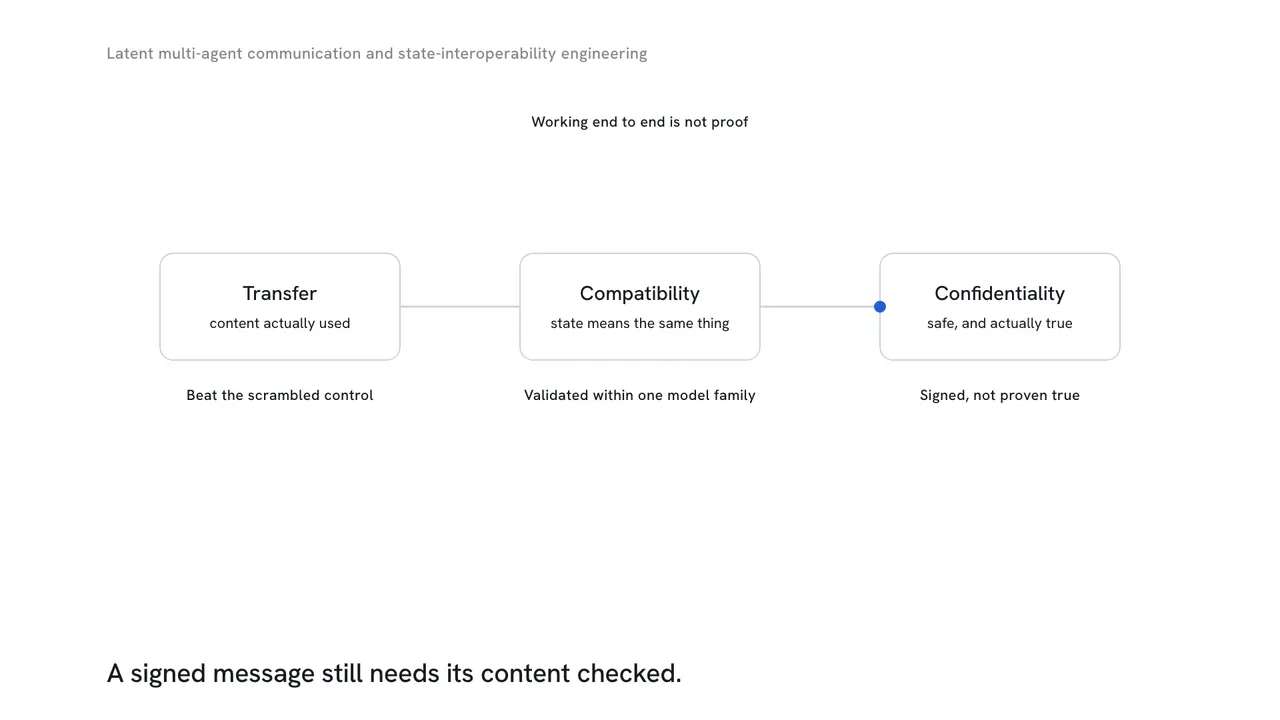
Transfer asks for a causal comparison, not an accuracy score: compare a correct message against a scrambled one of matching format, against no message, and against distribution matched noise, holding shared context fixed. In the audited relay study, natural task results were markedly weaker than the team's synthetic private lookup tasks, and seven pairings only reached equivalence within a stated margin, a result its authors treat as compatible with a small real effect, not zero communication. A channel clears this gate only when correct-message performance beats scrambled-message performance by a margin set in advance.
Compatibility asks whether the receiving model can use the state at all, regardless of whether its content matters. StateBridge's method, whitening, rotating, recoloring, normalizing and anchoring the sender's state to shared vocabulary, is training free and reports working results, but every run paired agents from one model family, with no mismatched pairing tested as a control. Treat a compatibility result as scoped to that exact family and task.
Confidentiality asks whether the private information stays protected, and whether the message is authentic and true. An integrity manifest binding sender, session, model and payload digest catches corruption and replay, one reviewed system reported correctly accepting 774 honest payloads and rejecting 295 recorded corruptions under its stated assumptions, graded C evidence, but an authorized sender who summarizes misleadingly still passes. Exported latent states should inherit the source system's access and retention rules, since neither unreadability nor a valid signature makes content safe or true.
Ownership belongs with a named state contract owner, tracking which gate each link has passed. Fund the scrambled and no message control inside the evaluation pipeline, a versioned state contract naming checkpoint hash, tokenizer identity, layer map, shape, precision and expiry, and the plain baseline first, structured text plus a shared evidence store. Stop treating a pilot as proof of transfer, approving a bridge for an untested pairing, or letting a system retry corrupted state instead of falling back or halting.
Two decisions belong to an executive alone: how much private evidence the company will let leave a source system inside an unreadable but not provably confidential export, and when a compatibility result must be re-certified rather than assumed to still hold.
What it is worth
The money shows up first as wasted engineering time on a relay pipeline a scrambled message control later shows delivers little beyond any cache's presence. Second as unnecessary compute and storage, a full attention cache for one exchange can run to tens of megabytes against a fraction of that for a compact learned prefix. Third as compliance exposure, when a private fact leaves a source system inside an export that inherits none of its access or retention rules.
The 2026 evidence supports scrambled message controls as the only demonstrated way to separate genuine content transfer from a generic cache effect, and a training free geometric bridge within one model family. It does not support proven interoperability across families, a settled privacy guarantee for exported state, or any specific return figure.
Questions leaders ask
- Does an AI agent that answers correctly after receiving another agent's internal state prove the two agents actually communicated?
- Not by itself. A 2026 causal audit of relayed attention caches found statistical equivalence across seven model pairings within a stated 2.8 point margin when a correct message was compared against a scrambled one of matching shape, graded B evidence. Task success can come from simply having a cache attached, not the private content inside it, so content specific transfer needs its own scrambled message control, separate from end task accuracy.
- Can two AI models built by different vendors reliably exchange raw internal state today?
- The best documented bridging method, StateBridge, was only evaluated with agents from the same model family inside each run, with different families tested in separate runs rather than against each other, graded B evidence. That is a portability gap, not proof cross family alignment is impossible, but no inspected result shows one vendor's model reliably reading another vendor's raw state.
- If a message between two AI agents is cryptographically signed, is its content safe to trust?
- Signing proves who sent the bytes and that they were not altered in transit. One integrity study reported correctly accepting 774 honest payloads and rejecting 295 recorded corruptions under its stated key assumptions, graded C evidence. An authorized sender can still sign a misleading summary of what actually happened, so authentication answers a transport question, not a truthfulness question.
- When does it make financial sense to invest in latent state sharing instead of plain text messages between agents?
- Only once private evidence has been shown causally necessary for the task, the channel's benefit survives a scrambled message control, and the combined cost of adapters, verification and migration still leaves a net gain. For most teams today, concise structured text plus a shared, queryable evidence store is the documented starting baseline.
- What is the biggest risk of shipping a working latent communication demo without evaluating it first?
- A demo that works end to end can still be running on the generic benefit of having any cache present, not the specific private evidence the sender meant to send, and a compressed export can carry a private fact out of its source system without inheriting that system's confidentiality rules. Both risks stay invisible until someone runs the causal and privacy controls.


