
The Adaptation Gate: When Fine-Tuning Earns Its Keep
Fine-tuning earns its cost only when behavior is stable and lifecycle math beats a cheaper prompt, retrieval or tool call, not on a benchmark score alone.
Yash Sharma5 min readData, adaptation and alignment
Research area 15: Fine-tuning, adaptation and domain-transfer engineering
In brief
- Fine-tuning earns its cost only when it beats every cheaper alternative on lifecycle economics.
- The adaptation gate is the sequence of checkpoints a candidate weight update must clear.
- Skip the gate and you cannot tell real capability from an expensive way to match a prompt.
Fine-tuning, adaptation and domain-transfer engineering is the discipline of deciding when changing a model's weights is the right way to change its behavior, and when a cheaper, reversible mechanism such as a prompt, retrieval or a tool call would do the same job for less. The mistake I see most often is treating a domain benchmark gain as proof that tuning was worth doing. A gain that quietly costs a model some of what it already did well, or that a strong prompt would have matched for less, is not a result worth funding again.
What it is
Five terms get flattened together in the reviews I sit through. Full fine-tuning updates the model's available weights outright, demanding memory, optimizer state and controls against forgetting. Parameter-efficient adaptation, the family that includes low-rank adapters, trains a small update on a frozen base instead of touching every weight. Continued domain pretraining changes what the model has seen, not necessarily what it has learned to do. Instruction tuning changes behavior using supervised examples of the task. Personalization is not a training method: it is an outcome context, retrieval or an adapter can each deliver.
Low-rank adaptation is the label most likely to mislead a board. It is a parameterization, not a guarantee the task is genuinely low in complexity or that the update carries no privacy risk. The only question worth funding is whether the model earns back what it cost across its full working life, against the cheapest plausible baseline.
2026 produced the first concrete evidence a tuning decision can be checked against, useful but far from settled. A theoretical study made public in May 2026 by Zindari, Mulayoff and Stich found restricting an update to low rank trades a spectral bias for a dimension-dependent variance, a theorem about a simplified linear model, not production behavior. A study made public in August 2026 by Zheng and colleagues trained Qwen3-4B to acquire 1,938 new facts at ranks 8 through 64 plus full tuning, across five seeds, and found acquisition and retained-task performance moved together: more capacity taught more facts while disturbing more of what the model already did well. An industrial comparison made public in May 2026 by Sturm and colleagues found retrieval outperforming fine-tuning on a manuals and generated-question workload, but its cost comparison was modeled, not measured, so its preference for retrieval is conditional. Funding tuning on a domain benchmark gain alone, without checking retained capability or a cheaper baseline, means not knowing whether it bought real capability.
The architecture
The framework I use is the adaptation gate, a sequence of checkpoints a candidate weight update must clear before it is trusted in production, rather than a single comparison against a domain benchmark.
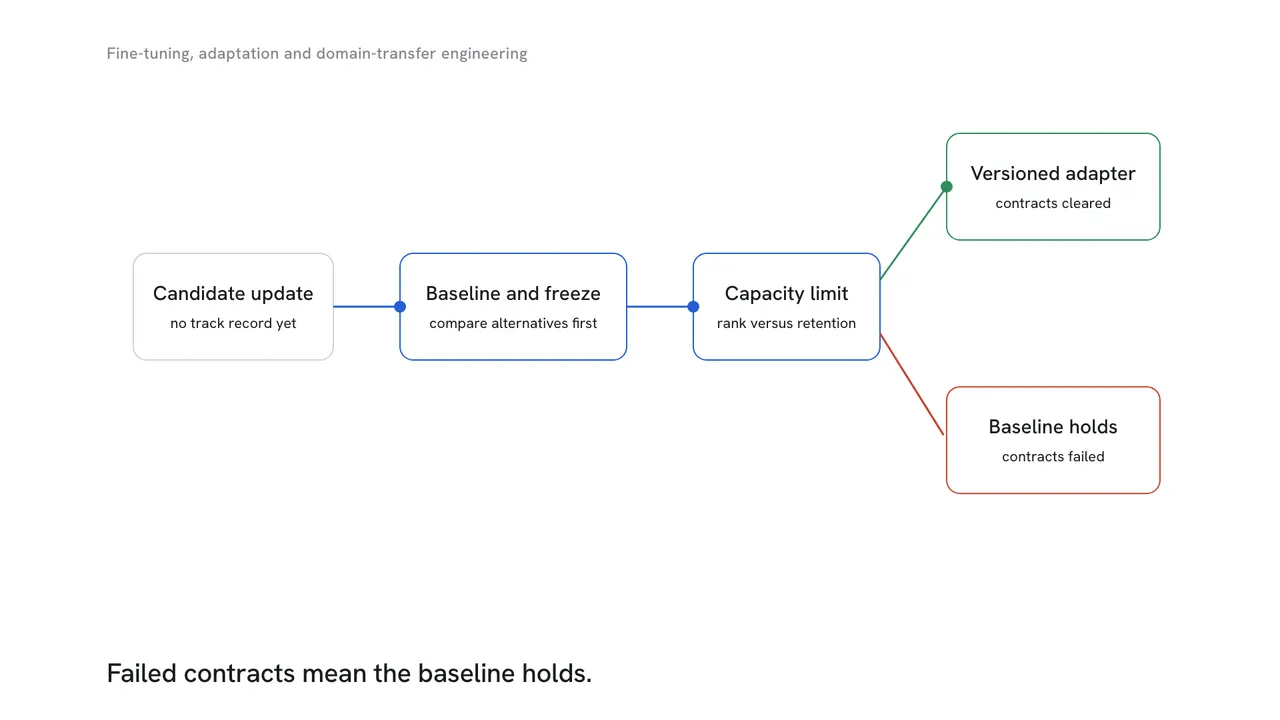
The first checkpoint benchmarks the candidate against every cheaper alternative, a strong prompt, retrieval, a deterministic tool, a smaller specialized model, the frozen base model, each charged for its full lifecycle cost. Only a candidate that still looks worthwhile proceeds.
The second checkpoint freezes what must not move: a retention set covering general tasks, native languages, abstention, calibration, safety behavior and tool contracts, plus a confirmation set nobody has used to pick a rank or select a checkpoint. Tuning that has already seen its own grading criteria is fitted to the test, not evaluated.
The third checkpoint sets capacity as a tradeoff, not a dial to maximize. Rank and target modules are set against the frozen retention constraint, not the highest domain score, because more capacity also means more room to drift from what the model already did well.
The fourth checkpoint evaluates the artifact that will actually be served, quantization and kernel included, against every mandatory contract. Cleared, the update releases as a versioned, rollback-ready adapter. Not cleared, the baseline holds and the need routes to context, retrieval or a tool.
Ownership sits with a named adaptation owner holding the retention set, the confirmation set, the rollback target, and the authority to decline a promotion no matter how good its domain score looks. Fund benchmarking against the full field of cheaper alternatives before training budget is spent, a protected retention and confirmation set, and evaluation capacity sized to test the actual serving artifact.
Stop promoting on an aggregate domain score with no retention check behind it. Stop treating a low-rank adapter's small footprint as a privacy guarantee: no source here shows restricting an update's shape prevents cross-user leakage. Stop accepting a pilot's zero observed failures as evidence of low risk: zero in 30 trials is consistent with a roughly 9.5 percent underlying failure rate at 95 percent confidence, while zero in 300 tightens that to roughly 1 percent.
Two decisions belong to an executive alone: setting the smallest domain gain worth funding and the largest retention regression the business will accept, before anyone sees the final holdout, and whether a personalization or federated program requires affirmative user consent and a cross-user leakage test before it ships, since keeping data local is an engineering property, not a privacy proof.
What it is worth
The money and risk show up in three places: compute spent tuning a behavior a strong prompt or retrieval would have matched for less, incident cost from a retention regression surfacing once a contract or calibration check fails in production, and audit exposure from adapters merged across teams without a compatibility check. Measure before and after against one yardstick: domain gain, retained-task regression by slice, calibration, abstention, tool validity and cost per validated task, at matched budget against the frozen base model.
The 2026 evidence supports that low-rank restriction is a genuine bias-variance tradeoff, not a free efficiency win, that acquisition and retention move together as capacity changes, and that retrieval beat fine-tuning in one cost-modeled setting. It does not support a universal ranking of tuning against retrieval, a safety case for adapter merging, or a privacy guarantee for federated personalization. No return figure appears in that evidence, and none should be assumed here.
Questions leaders ask
- What is the adaptation gate, in practical terms?
- A sequence of checkpoints a candidate weight update must clear before production: benchmarked against every cheaper alternative, tuned only within a retention limit frozen before training, evaluated on the actual serving artifact against every mandatory contract, and released as a versioned adapter with a rollback target, or declined for the baseline. A domain benchmark gain alone does not clear it.
- Does fine-tuning usually beat prompting or retrieval for the same task?
- Not on the evidence available. One 2026 industrial comparison found retrieval outperformed fine-tuning on a manuals and generated-question workload, though its cost comparison was modeled rather than measured, so its preference for retrieval is conditional on that setup. No study here establishes a general ranking of fine-tuning against retrieval, prompting or a specialist model at equal lifecycle cost.
- Does giving an adapter more capacity, a higher rank, make it better?
- Not by itself. A 2026 study training Qwen3-4B to learn thousands of new facts at ranks 8 through 64 found acquisition and retained-task performance moved together, so more rank taught more new facts while disturbing more of what the model already did well. The right rank clears a declared retention limit, not the highest domain score.
- Is a low-rank adapter automatically safer or more private than full fine-tuning?
- No. Low-rank adaptation is a choice about how an update is shaped, not proof a task is genuinely low complexity or that an update carries no privacy risk. A 2026 federated fine-tuning study presents a thermal-aware, robustness-tested design as an engineering proposal with bounded evidence, not a certification against cross-user leakage.
- When should a team decide not to fine-tune at all?
- When representative labels are too sparse or unreliable, the target behavior changes faster than the team can retrain and re-evaluate it, weight access or serving support is inadequate, or nobody has the capacity to sustain retention testing after release. Try context, retrieval or a tool first, since those are reversible in a way a trained weight update is not.


