
Stop Paying for Information That Cannot Change a Decision
Active learning only pays off when a query changes a decision, not when it reduces uncertainty. The net-value gate prices every query against its full cost.
Yash Sharma5 min readData, adaptation and alignment
Research area 68: Active learning and value-of-information acquisition engineering
In brief
- A query is only worth buying if it can change a decision, not just lower uncertainty.
- The net-value gate prices every candidate query against a locked decision loss and its full cost.
- 2026 evidence supports narrow, bounded gains, not a general controller for pricing information.
Active learning and value-of-information acquisition engineering decides which missing piece of information is worth paying for: a human label, a database lookup, a live experiment or a question put to a customer. The costly mistake is treating any drop in uncertainty as progress, when the only test is whether the information would change what the organization does next. A 2026 review found genuine, bounded gains in narrow settings, and no established evidence for a general controller that can price a noisy source at production scale.
What it is
The discipline covers five ways an organization goes looking for missing information: labeling pool examples, inspecting a live-stream item, running an experiment, retrieving a document, and asking a person to resolve an ambiguity. Each costs differently, carries different consent requirements, and feeds a different downstream estimate. Treating them as one pool is the first mistake.
Three principles hold regardless of which is running. Entropy reduction and decision value are not interchangeable: a query can lower a model's uncertainty while leaving the actual choice unchanged, worth nothing to the decision even though a dashboard looks more informed. The objective has to be locked before the query policy is chosen, since test error, rare-event detection, decision loss and a tighter parameter estimate each favor different information, and choosing it after the fact lets the method optimize whatever is easiest to measure. And the source of uncertainty needs naming: repeated samples, self-reported confidence and embedding similarity all need calibration first.
Labeling and acquisition budgets keep growing while the return is rarely checked against the decision it was meant to improve. The clearest 2026 evidence for a bounded version of this is LOBSTER, a loss-informed labeling method for summarization models, whose authors report acceleration of up to 665 times. That figure describes scoring speed, not the cost of the full labeling and training pipeline, and random selection can remain competitive as the label budget grows. The method was also publicly available on OpenReview in March, months before its August posting elsewhere, so it reads as earlier-2026 work rather than a fresh finding. Two adjacent studies extend the same caution to human-facing systems, and neither licenses a claim that current systems can price a live source alone.
The architecture
I call the framework that should govern this work the net-value gate. No acquisition proceeds until its expected benefit to a named decision clears its full cost, and every action that does proceed is logged so the record can be trusted later.
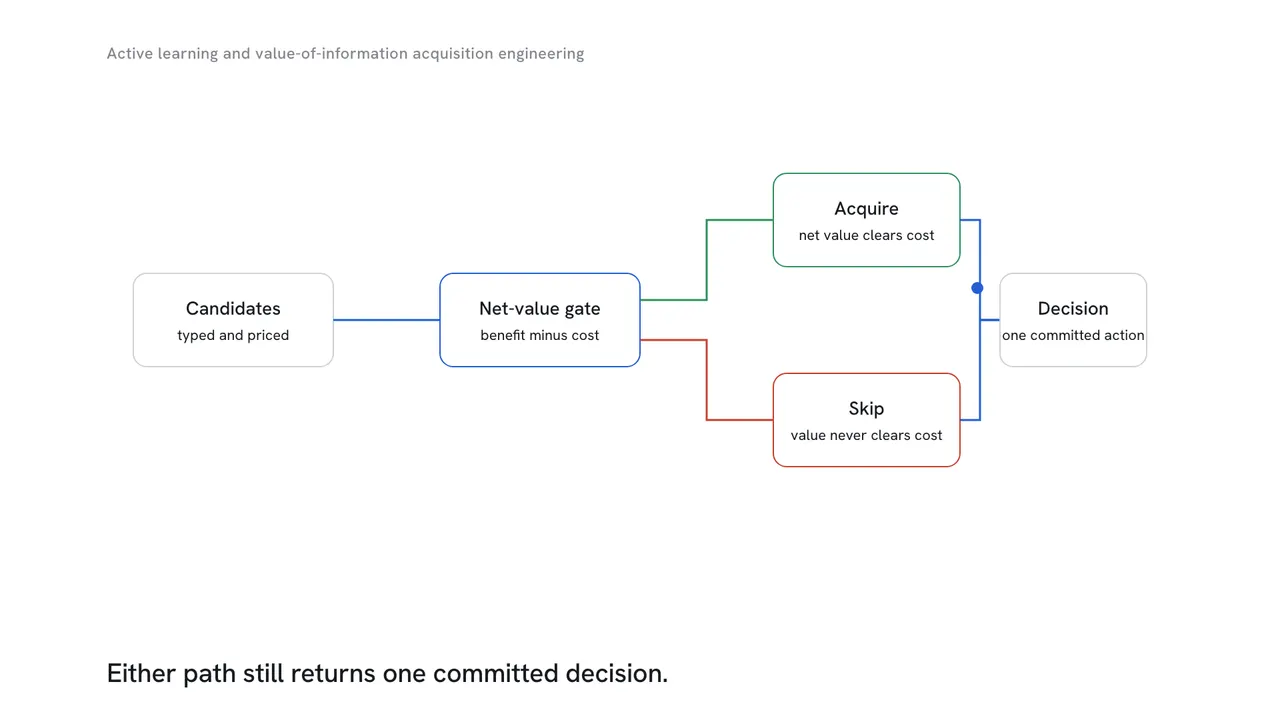
The gate has three moving parts. A fixed decision core: a named loss tied to a real business decision, locked before any query is scored, so the acquisition step cannot quietly redefine success around whatever is cheapest to reduce. A typed catalog of candidate acquisitions carrying source, cost, delay, and permission scope. And the scale itself, which estimates each candidate's expected reduction in decision loss, then subtracts its full cost in price, delay, and burden on whoever answers.
A worked case: choosing between two routes, a wrong choice costing 100 units and both equally likely, carries a current risk of 50 units. A diagnostic source correct 90 percent of the time drops expected risk to 10, a gain worth 40 units, or 35 after its cost of 5. An equally uncertain fact about an unrelated road reduces entropy just as much and is worth nothing, since it cannot change which route gets chosen.
Only a candidate whose net value clears zero, is authorized, and can return before the deadline passes through, its reason logged alongside its probability of being chosen, so the data can later estimate a broader quantity without bias. Everything else is skipped or triggers a commitment to the current best action.
Put one named owner over the decision core, typically a head of decision science reporting to the chief data or technology officer, kept separate from whoever builds the acquisition tooling, since the same team should not write the scoring method and also judge its own queries worth their cost. Fund a written decision loss agreed with the business owner, a typed catalog of every acquisition action, an independent evaluation panel, and a selection log recording why each query was chosen. Stop funding any program that reports only an uncertainty metric or cannot state what decision it improves.
Reserve two decisions for yourself: the decision loss and what an error is allowed to cost, and authorization for any action touching a restricted record or spending past a threshold, since a high estimated value is not the same thing as consent.
What it is worth
The clearest 2026 value sits with bounded, well-specified programs. LOBSTER's loss-informed selection genuinely speeds up candidate scoring, and the human-communication studies show a model's estimated beliefs can drive a working, if partially calibrated, question-selection policy. None of this is evidence for a general controller that prices a noisy source correctly at production scale. That evidence does not yet exist, and a pitch implying otherwise extrapolates past what has been shown.
Measure a program by its cost-weighted decision loss, not accuracy or entropy, against a random and a stratified baseline at the same budget, before and after adoption. Where LOBSTER-style acceleration is claimed, ask whether it covers scoring alone or the full pipeline, since only one is what the business pays for. Fund the next increment of spend only when net decision value moves the right way.
Questions leaders ask
- What is the net-value gate?
- It is the framework this essay uses for deciding what information to buy. It locks a named decision loss first, prices every candidate query by its expected benefit to that decision minus its full cost, and only lets a query through when that net value clears zero, the action is authorized and it can return before the deadline. Everything else is skipped or triggers a commitment to the current best action.
- Does reducing uncertainty always help a business decision?
- No. A query can lower a model's measured uncertainty about the world while leaving the actual choice unchanged, in which case it is worth nothing to that decision even though a dashboard shows less entropy. A worked example in the source dossier shows a diagnostic worth 35 units after cost, while an equally uncertain fact about an unrelated matter is worth zero to the same choice.
- Can an acquisition system decide its own information budget without a person?
- It should not. Setting the decision loss and what an error is allowed to cost is a business judgment that belongs to an executive, not to the acquisition method. Any query that touches a restricted record, asks a real person a question, or spends past a set threshold needs its own authorization, separate from however high its estimated information value is.
- Is the LOBSTER labeling study evidence that active learning is now solved?
- No. LOBSTER reports up to 665 times faster candidate scoring for summarization labeling, but that figure covers scoring speed, not the cost of the full labeling and training pipeline, and random selection can stay competitive as the budget grows. The method was also publicly available in March, months before its August posting elsewhere, so it reads as earlier-2026 work, not a fresh result.
- How do you know when to stop acquiring more information?
- Stop when the best remaining candidate's expected benefit to the decision falls below its full cost, or when a deadline would make the answer arrive too late to use. Irreversible or highly asymmetric errors can justify paying more for confirmation, but that is different from repeatedly delaying a decision for information that was never going to change it.


