
Fast Weights and Test-Time Training: A Leader's Guide to Model Memory
Fast weights let a model update its own state mid-session. What test-time training actually proves in 2026, and the state contract leaders should require.
Yash Sharma5 min readData, adaptation and alignment
Research area 59: Fast weights, test-time training and nested learning
In brief
- Fast weights let a model change part of its own state mid-session, not just what it can see.
- The state contract sets four clauses a fast-weight system must answer before production.
- Two August 2026 studies show early gains but no poisoning resistance or deletion guarantee yet.
Fast weights, test-time training and nested learning ask the same question three ways: can a model change its own internal state while running, and who authorized it. Two studies posted in August 2026 show a scheduled, session-scoped update to a working memory tensor can measurably help a bounded task, but a deeper inner update is not automatically a better one, and almost none of this can be built by calling a hosted model through an ordinary text API.
What it is
Fast weights are tensors inside a model allowed to change within one authorized session, distinct from the slow weights set once during training. Optimizer state (momentum and similar bookkeeping) is not a memory of what happened. Recurrent state evolves forward through a fixed recurrence without necessarily learning a new rule. External memory is data a system retrieves, kept separate from the model's own parameters. Who owns each tensor, what resets it and what it may retain differ across all four.
Nested learning is a useful claim only once someone names the actual objective being optimized, the timescale each layer runs on, and the precise transition from one state to the next. Absent those three specifics it is a framing, not a mechanism.
What decides a fast-weight system's real capability is its information access, update and read order, numerical precision, and reset scope, not the label attached to it. A constant-size fast-weight tensor compresses whatever it sees and cannot promise arbitrary exact recall.
Two studies posted in August 2026 are the direct evidence base for this area, both early, not settled engineering. One, posted August 3, describes test-time context distillation, where a longer-window teacher forms targets a shorter-window student updates a fast projection against. The other, posted August 7, builds test-time training as a composable graph of inner learners with a causal readout path, and reports that adding depth to the inner learner hurt performance once activations grow, against the instinct that more capacity should help. Neither has been independently replicated, and the second reports results from five paired runs, a small base for a consequential claim.
The architecture
The clearest way to hold a vendor or your own engineers accountable is what I call the state contract: four clauses any fast-weight system should answer before it goes near production data.
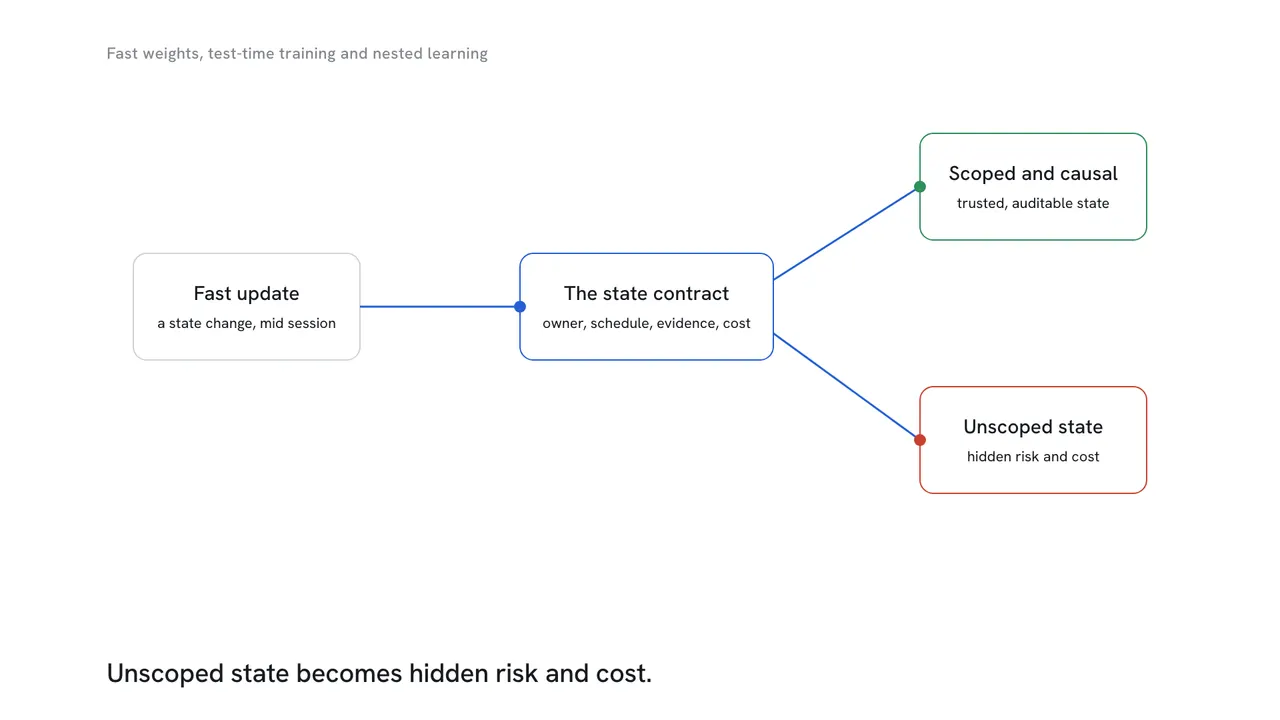
The first clause is ownership and reset scope: a named owner, initialization and lifetime for every mutable tensor, per document, session or tenant, not quietly persisting across users because that was cheaper to write. Cross-tenant sharing belongs to data governance, not whoever wrote the kernel.
The second clause is the causal schedule: what the system predicted from state it already had, what it observed, how it updated, and what it may read afterward. A system that looks accurate because its state already absorbed the scoring target is leaking the answer backward, not adapting, and the check is to perturb information the model has not seen yet and confirm nothing earlier changes.
The third clause is the evidence class actually tested: exact retrieval, general semantic retention, adaptation to a shifted distribution, and learning a new rule are four different claims. A system strong on one can fail another. Report these separately, never averaged.
The fourth clause is disclosed cost and access: every teacher pass, backward operation and byte of per-session state, and whether a text-only interface could build it at all, since such an interface can add notes and retrieval but cannot alter hidden projections or guarantee the causal schedule.
Ownership sits with whoever runs model serving and the data platform, not the research group that produced a promising result. Fund the deterministic, disclosed path first, before a deeper inner learner, and only against a held-out test built to catch the failure the August evidence flagged. Measure retrieval, retention and adaptation as three separate numbers, never blended, and require any gain to survive a suffix-perturbation test. Stop funding pitches that use nested learning without naming the objective, timescale and transition behind it.
Two decisions belong to the executive alone: whether fast state may persist across sessions or tenants, a governance question before an engineering one, and the deletion standard, since removing a token from a cache does not remove its contribution from a nonlinear update, so decide in advance whether deletion requires recomputing state from a clean prefix.
What it is worth
The financial case shows up in work that would otherwise repeat on every call inside a session, and errors avoided when a system adapts to something it was just told rather than answering from a stale default. The cost sits next to it: teacher passes, backward operations and per-session state are real spend, and an update that looks free on parameter count can be the most expensive part of serving a request.
The risk case is where the evidence is most incomplete. Neither study establishes reliable poisoning resistance, since a document can shift fast state without reading like an instruction, and neither establishes a secure deletion guarantee for nonlinear updates. Measure before and after against baselines the evidence points to: an explicit cache of the same size, an additive update against a delta-rule update, and a text-only external-memory version of the same task, all at the same wall-clock cost rather than the same parameter count.
No return percentage or dollar figure appears in the evidence, and none is invented here. Scheduled, well-scoped fast-weight updates can measurably help a bounded task, and the business case has to be built one task at a time, against real baselines, not assumed from the mechanism's name.
Questions leaders ask
- What is the practical difference between fast weights and a longer context window?
- A longer context window only changes what a model can see when it answers. Fast weights change a tensor inside the model during the session, an internal update with its own owner, schedule and reset rule. A system with no extra parameters can still carry a real per session memory and compute cost, so treat the two as separate line items, not variations on the same feature.
- Does test-time training reliably work in production today?
- The direct evidence is two August 2026 studies, both graded as author claims from inspectable but limited experiments, neither independently replicated. One reports genuine gains from a teacher student update scheme. The other reports that adding depth to the inner learner can hurt once activations grow. Treat both as early, task specific results worth piloting, not a settled capability.
- Can we build this by calling a hosted model through a normal API?
- Not the internal version. A text only API can add external notes or retrieval layered on top of a session, which can be useful, but it cannot alter a model's hidden projections or guarantee the causal update schedule true fast weight test-time training requires. Label it as external memory, not as the mechanism the August 2026 studies tested.
- What does the term nested learning actually require to be meaningful?
- Three specifics: the actual nested objective being optimized, the timescale each layer of learning runs on, and the precise transition from one state to the next. Without those three named, nested learning is a framing rather than an engineering claim. Ask for the state inventory before approving budget against the term.
- Can fast-weight state be securely deleted when a session or user requires it?
- Not automatically. Removing a token from a cache does not remove its contribution once it has shaped a nonlinear fast-weight update. Exact removal currently requires recomputing the state from a clean prefix that excludes the deleted material. Decide the deletion standard in advance and fund the recompute path rather than promise something the mechanism cannot yet guarantee.


