
The Reacquisition Clock: Testing Whether a Model Can Relearn
Low forgetting does not prove a model can still learn. The reacquisition clock times relearning speed and checks full state before an update ships.
Yash Sharma5 min readData, adaptation and alignment
Research area 58: Continual reinforcement learning, plasticity and path dependence
In brief
- Retention and plasticity are different properties, and a model can pass one while its ability to learn something new quietly degrades.
- The reacquisition clock times relearning speed and checks full learner state before certifying any continual update.
- Ignoring reacquisition speed risks shipping updates that look safe on retention but have quietly lost the ability to learn.
Continual reinforcement learning, plasticity and path dependence is the discipline of keeping a model both accurate on what it already knows and able to learn something new, because the two properties do not move together. A system can score well on a forgetting test while taking far longer to relearn a lost skill than a model trained on everything at once, and a system that never touches its own weights can look adaptive purely because of what it stores outside them. An executive who funds only the forgetting number is buying half an answer.
What it is
Three properties get compressed into one headline number too often. Retention is how much of a model's earlier performance survives new training, usually reported as a forgetting score. Plasticity is different: how quickly the model can acquire something new or recover a lost skill. A model can hold retention steady while plasticity quietly erodes, learning new tasks slower even as old scores stay flat, and an averaged metric hides the difference. Reacquisition cost measures plasticity directly: the additional training needed to bring one skill back to a working threshold.
Path dependence is separate again. A model with external memory or a replay store can behave in a history sensitive way without that history touching its weights. That is path dependence in the agent's behavior, not weight level plasticity, and a benchmark built to test one should never stand in for the other.
A joint trained reference model, given every task from the start, is a useful labeled oracle, not a fair peer for a sequential learner: it trains on a different data mix and always carries an information advantage, so comparing the two without flagging that advantage inflates or deflates the sequential system's apparent gap.
A continual learner's true state is not just its weights. It also includes the optimizer's internal state, external memory and replay buffer, the evaluation harness and environment version, the reward definition, and the random seed. Two checkpoints can show identical weights and still sit on different future trajectories if any of the rest has changed. This matters more each year as continual reinforcement learning moves from a research benchmark into production pipelines that revise a deployed model's behavior on a running basis, where a pipeline tracking only a forgetting score will not catch a system quietly losing its ability to learn.
The architecture
I call the governing instrument the reacquisition clock: an evaluation and checkpointing protocol that runs after every continual update and refuses to certify it on a single score.
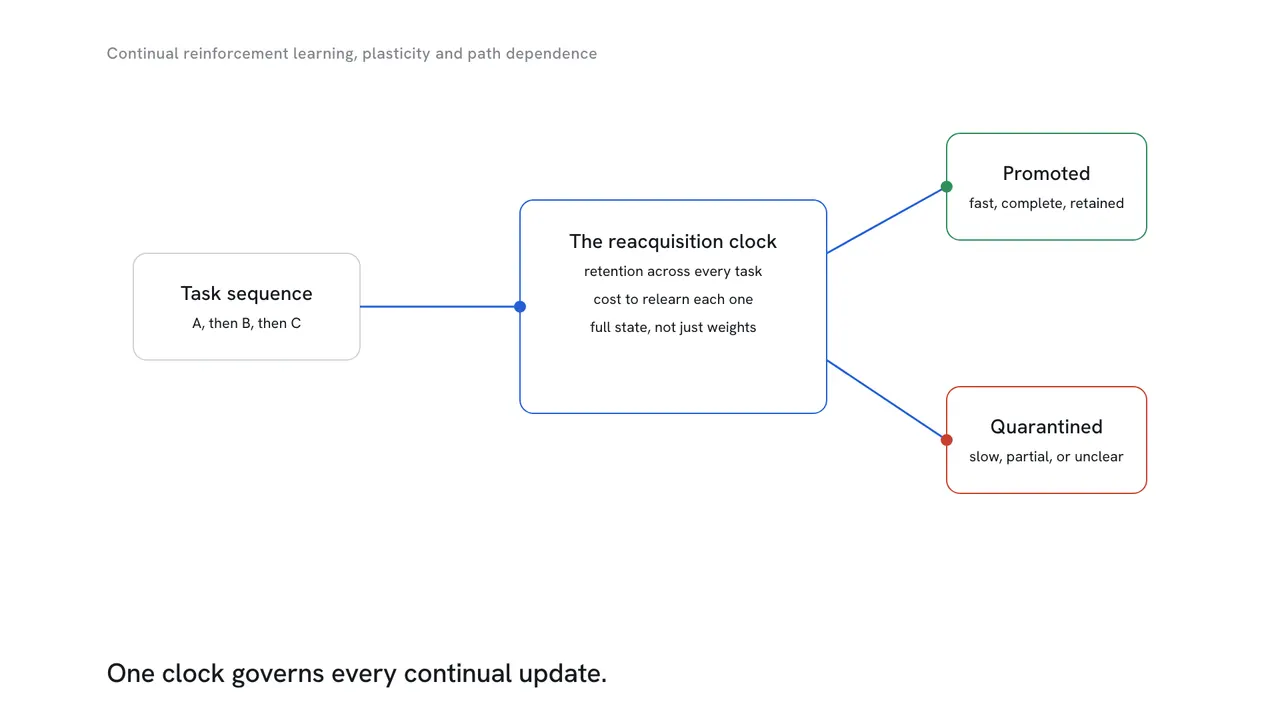
The clock builds a full task by time performance matrix rather than one blended average, recording performance on every prior task after every new phase, because that is the only way to see whether a decline sits on one task or spreads across many. Against that matrix it computes retention conventionally, and separately times reacquisition: how much additional training brings a slipped task back to a working threshold. A model can pass retention and fail reacquisition, and the clock exists to catch that split rather than average it away.
The clock also checks locus, asking where a behavior actually lives. If apparent learning traces to an external memory or a replay store rather than to the weights, that must be recorded as such, never allowed to stand in for the other inside the same report.
Before promotion, the clock requires a complete state checkpoint, not a weights only snapshot: the optimizer, the external memory and buffer, the harness and environment version, the reward definition and the random seed, alongside the weights themselves. A candidate that fails retention, reacquisition or the state checkpoint is quarantined, not deleted, held for review. A rollback itself has to be revalidated against current requirements, because restoring an earlier checkpoint can reintroduce a problem a later step was meant to fix.
Ownership belongs to one named continual learning owner with standing authority to hold a capability update over a reacquisition failure or an incomplete checkpoint, regardless of how good its retention number looks. Two decisions stay with the business, not engineering: the working threshold a reacquisition test must clear, and how much of a persistent gap to a joint trained oracle is worth closing against how much compute. Governance should also require that external memory or replay data tied to a revoked permission or a known reward defect be excluded from future replay immediately, its residual influence on already trained weights tracked as an open item rather than assumed resolved.
What it is worth
The money and the risk concentrate in three places: compute spent chasing a retention score while reacquisition speed quietly degrades unmeasured, engineering time spent on a rollback that reintroduces a problem because the restored checkpoint was incomplete, and safety exposure created when a capability update ships on the assumption an earlier safety result still holds. No 2026 method reviewed here guarantees a model's safety behavior survives further reinforcement learning, so a repeated safety panel after every capability phase is the safer practice.
The evidence supports three claims. A 2026 study of continual reinforcement learning on verifiable reward tasks reported that low forgetting and a persistent gap to joint training can coexist in the same system. A 2026 benchmark for history dependent coding and tool use agents found path dependence in an agent's external memory, preliminary evidence and a distinct claim from plasticity in its weights. A study first public in April 2026, evaluated only in a small grid world, reported that retaining a neighborhood of past policies improved relearning speed, a real result in a narrow domain that does not establish it holds at language model scale. None of this supports a general claim that any 2026 method preserves both capability and safety indefinitely, and no return figure belongs here because none of the three studies reports one. Fund the clock instead of the headline number.
Questions leaders ask
- What is the reacquisition clock?
- The evaluation and checkpointing protocol that certifies any continual update. It builds a full task by time performance matrix instead of one blended score, times how fast a slipped skill returns to a working threshold, and requires a complete state checkpoint covering optimizer, memory, harness, environment, reward and seed. A failure quarantines the update rather than deleting it.
- Does low forgetting mean a model can still learn new things?
- No. A 2026 study of continual reinforcement learning on verifiable reward tasks reported modest forgetting alongside a persistent gap to a joint trained reference, showing the two properties can move apart in the same system. Retention measures what survived. Reacquisition measures how fast a skill returns, and only that tells you whether the system can still learn.
- Is an agent's use of external memory the same thing as weight level learning?
- No. A 2026 benchmark for history dependent coding and tool use agents measures how much an agent's behavior depends on accumulated memory and task history, which is path dependence, not learning inside the weights. The evidence is preliminary and should never be read as a result about the model's own learning capacity.
- Can a bad continual update just be rolled back?
- Not safely without checking first. A continual learner's real state includes its optimizer, external memory, replay buffer, harness, environment version, reward definition and random seed, not only its weights, so two checkpoints with identical weights can sit on different future trajectories. Restoring an earlier checkpoint can reintroduce a problem a later update fixed, so any rollback must be validated against current requirements first.
- Does passing safety tests once mean a model stays safe after further training?
- No. No 2026 method reviewed here established otherwise. A capability update that clears retention and reacquisition tests can still erode a safety property only checked before that update ran. The safer practice is to re-run the same protected safety panel after every capability phase, alongside new challenges written independently of it, rather than assume an earlier pass still holds.


