
The Dataset Contract: Governing What a Model Learns
Data curation, annotation and provenance decide what a model learns and whether that decision can be audited later, not a single quality score.
Yash Sharma5 min readData, adaptation and alignment
Research area 09: Data curation, annotation, provenance and quality engineering
In brief
- A single quality score hides which specific data problem a dataset actually has.
- The dataset contract binds permission, provenance, annotation and deletion into one auditable record.
- Skipping it means paying for curation gains that may just be leaked benchmark answers.
Data curation, annotation, provenance and quality engineering decides which examples a model learns from and what evidence exists to reconstruct that decision later. The mistake I see leadership teams make most often is collapsing all of it into one quality score. A document can pass a content filter and still carry an unresolved permission question, a label annotators disagreed on, or a resemblance to the benchmark used to grade the model, and one number hides each problem behind a passing grade.
What it is
Five ideas get flattened into one word, and the flattening is where the damage starts. Curation selects and transforms examples. Annotation adds an interpretation under a stated rubric. Provenance is the record of where something came from. Content authenticity is whether a purported origin is genuine, and truth is whether the underlying claim is correct. None implies the others. Exact duplicate removal is not semantic deduplication, benchmark overlap is not demonstrated answer leakage, and lawful access to a source is not permission for a specific downstream use.
The practical answer is to treat a dataset as a sequence of independently auditable decisions rather than one opaque cleaning step. A dataset that can only explain itself as having passed a quality filter has lost the ability to answer the one question that matters once something goes wrong.
Curation is also becoming automated, harder to audit from outside. A March 2026 study describes a system, DataEvolve, that filtered 672 billion candidate tokens to 504 billion and raised an eighteen-benchmark average from 40.17 to 44.13, while one benchmark, HellaSwag, fell over the same run, and the authors state the comparison lacked benchmark decontamination.
The architecture
The clearest way to hold this together is what I call the dataset contract: a versioned agreement, attached to every dataset a model trains or is evaluated on, that binds permission, provenance, an annotation rubric, a split policy and a named deletion owner into one auditable object, instead of scattering them across a script, a spreadsheet and someone's memory.
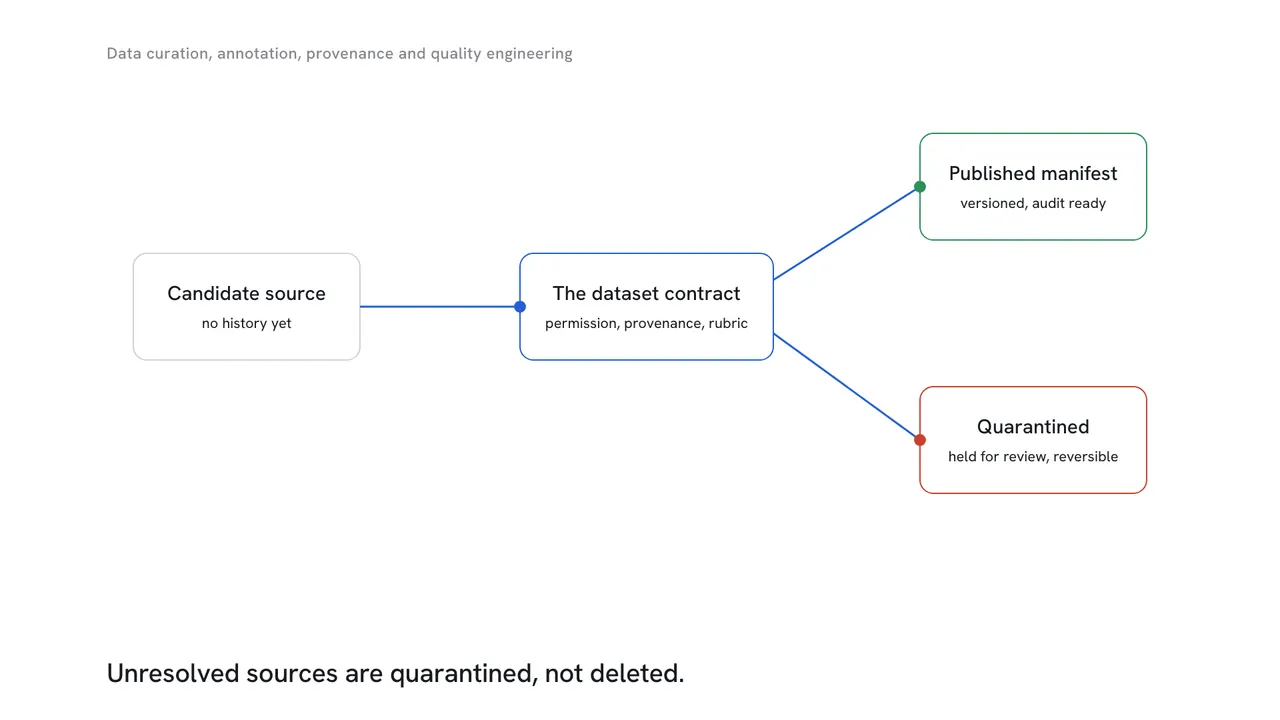
The contract is built in a fixed order, and the order is the point. A source is admitted only under recorded permission and a preserved original, then parsed with an accounting of what parsing lost, and assigned to duplicate and dependency groups. Only then does the contract freeze splits and set an embargo registry that all downstream jobs must honor. Annotation keeps uncertainty and abstention as first-class outcomes, with individual judgments kept alongside the rubric version that produced them rather than collapsed into an unexplained majority label. A 2026 study reusing predictions on more than 12,000 MMLU-Pro and 448 GPQA questions found substantial disagreement among the strongest models on which answers were actually correct. The training mixture is selected from the frozen data, compute cost included, and evaluated once against an untouched holdout, checking tail cases specifically. The outcome is a published, versioned manifest or a quarantine, a reversible hold with a stated reason, never a silent deletion.
The most common failure is skipping straight from raw sources to a single passing score. The more dangerous one is letting an adaptive loop see, and shape itself around, the evaluation set it will later be judged against. An August 2026 study built an 88 billion-token corpus with controlled knowledge exposure, audited 6,000 items for leaked material, and found only three clearly out of scope, a bounded check its authors say is not proof none occurred.
How to lead it
Ownership sits with a named data product owner, not whichever research team is training that quarter, holding the rollback target, the deletion lineage, and standing authority to quarantine a dataset without asking the shipping team.
Fund recorded permission at admission, loss accounting for lossy transformations, blinded adjudication so disagreement gets resolved by evidence rather than majority vote, and lineage tooling that traces a deletion through every store, index, cache and export. Measure tail-slice quality, contamination detections, disagreement rates, deletion completeness, and cost per validated task rather than cost per token, and stop funding a promotion decision that rests on an aggregate score with no decontamination check behind it.
Two decisions belong to an executive alone: setting, before anyone sees final holdout results, the smallest improvement worth shipping and the largest regression the business will tolerate, a statement of risk appetite rather than a statistical default, and deciding what a deletion request actually requires, retraining, an external correction, or targeted unlearning, since deleting a file does not reverse what a model already learned from it.
What it is worth
The money and risk show up in three places: compute spent on a curation gain later explained by benchmark overlap, human review re-litigating the same disagreement instead of resolving it once, and exposure when a deletion request cannot be traced through everything downstream of the original file. Measure with the same yardstick the evidence uses, rare-slice quality, contamination detections, annotation disagreement, deletion completeness and total cost, against a random, token-matched baseline rather than an unfiltered pool.
The 2026 evidence supports that adaptive filtering can raise an aggregate benchmark score at a fixed token budget, with limits its own authors state. It does not yet support a universal ranking of curation approaches, a matched-cost comparison across languages, a watermark that substitutes for a truth check, or complete cost accounting for OCR repair, license transitions and deletion propagation. No return figure appears in that evidence, and none should be assumed here.
Questions leaders ask
- What is the dataset contract, in practical terms?
- A versioned record, attached to one dataset, that binds a recorded source permission, a preserved original, an annotation rubric with its disagreement kept, a frozen split and embargo policy, and a named deletion owner into one auditable object. A team that cannot produce that record should not promote the dataset into training, however good its aggregate quality score looks.
- Does curating or filtering training data always improve a model?
- Not on the evidence available. A 2026 study reported an aggregate benchmark gain from adaptive filtering at a fixed token budget, but one individual benchmark fell over the same run, and the comparison explicitly lacked a decontamination check, so part of the gain could reflect leaked evaluation material rather than real improvement.
- Can annotator agreement be trusted as evidence that a label is correct?
- No. Agreement measures consistency, not correctness, and two annotators who copy the same wrong source can agree perfectly while both being wrong. A 2026 study found substantial disagreement among the strongest available models on which answers to thousands of benchmark questions were actually correct.
- Is deleting a file enough to satisfy a data deletion request?
- No. Deleting a training file does not reverse what a model already learned from it, so a request needs a separate assessment of whether retraining, an external correction, or targeted unlearning is required, alongside a lineage trace through every store, index, cache and export the file touched.
- What decision should stay with an executive rather than a technical team?
- Setting, before anyone sees the final holdout results, the smallest improvement worth shipping and the largest regression the business will accept. That is a statement of risk appetite specific to the business, fixed in advance rather than adjusted afterward to match whatever the results show.


