
Why Confident AI Answers Still Need a Calibration Layer
AI confidence scores are not probabilities. Calibrating them and building a cost-based rule for when to abstain is what makes an AI answer trustworthy.
Yash Sharma5 min readEvaluation and assurance
Research area 33: Uncertainty, calibration and abstention engineering
In brief
- A model's confidence score is not a probability until it is calibrated on unseen, population-specific outcomes.
- The three-layer confidence stack separates the signal, the calibration and the cost-based decision.
- Skipping it lets confident wrong answers, unmeasured queues and unproven guarantees compound risk in regulated products.
Every AI system that returns an answer is quietly making a second decision too: whether it should have answered at all. Uncertainty, calibration and abstention engineering makes that decision on purpose, separating what a model reports about itself from what is actually true and from what the business should do next. Skip it and a company funds a stream of confident, fluent, wrong answers, because sounding sure and being right are not the same event.
What it is
Three objects get collapsed into one number too often. A signal is raw evidence a model might be wrong: a stated confidence, agreement across samples, a verifier's score, or a pattern read from internal activity. A probability is that signal calibrated against real outcomes on unseen data, for the population it will serve. A decision is the actual choice of what to do next, and belongs to business economics, not statistics.
Discrimination and calibration differ: a system can rank correct answers above wrong ones well while still reporting badly miscalibrated numbers, and agreement across samples does not catch a wrong answer built on a shared premise. No guarantee travels further than its stated assumptions: a model, prompt or task change can invalidate a calibration even when the interface looks unchanged.
The stakes are rising because AI systems now make first-pass judgment calls in law, medicine and finance, just as the evidence shows a model's stated confidence cannot be trusted to steer its behavior. A 2026 study called RiskEval tested ten models on hard reasoning benchmarks, including the full GPQA Diamond set, scoring a correct answer positively and a wrong one heavily negative. Even after adding an external confidence gate, expected utility under the harshest penalty setting stayed negative for every model tested: belief and action are governed by different mechanisms.
The architecture
The framework worth installing is the three-layer confidence stack: a signal layer, a calibration layer and a decision layer, with a recalibration trigger running across all three.
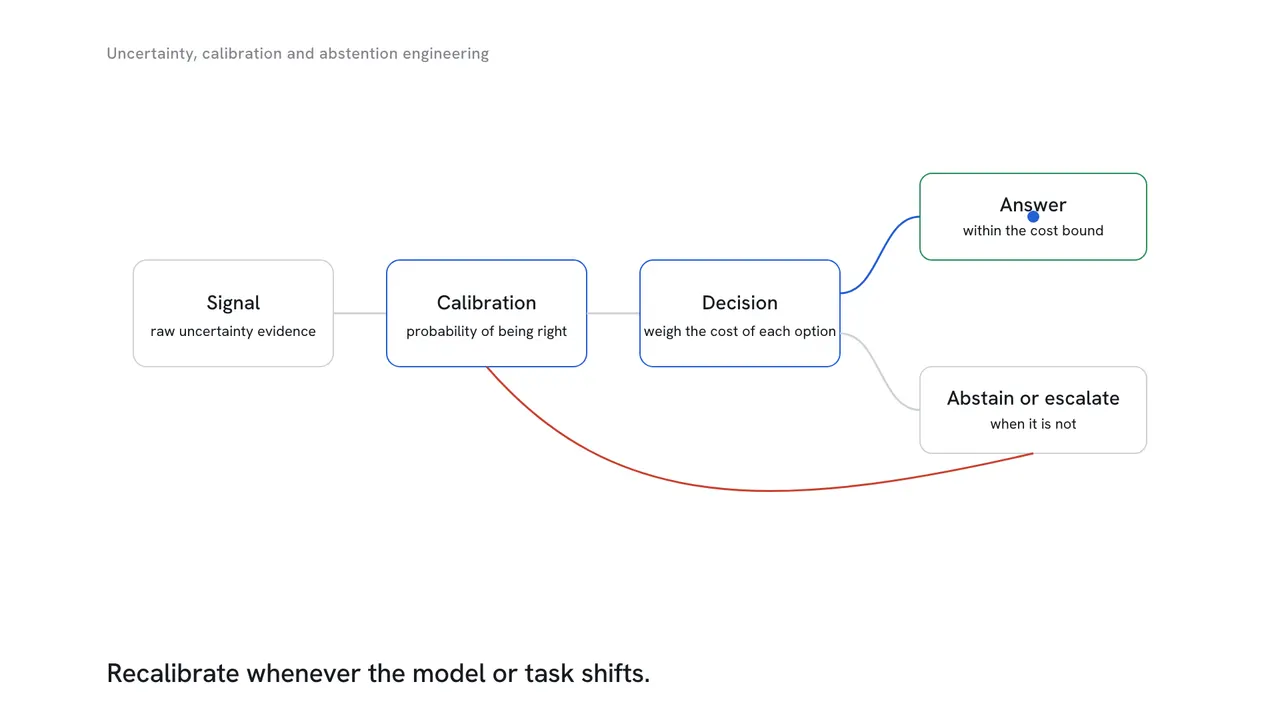
The signal layer collects raw evidence cheaply. A stated confidence is prompt-sensitive and can be confidently wrong. Repeated sampling can hide a blind spot shared across every sample, and a verifier model can reward a fluent answer over a correct one. A trained proxy model runs cheaply at answer time but hides real offline training cost: a 2026 comparison study reported a trained proxy reaching a correctness-ranking score of 0.7321, worth using operationally, alongside a caution about the exact bound claimed for its training method.
The calibration layer turns a chosen signal into an actual probability, checked on data the production system has not seen, and revalidated the moment the model, prompt or population changes. Most organizations quietly cut this corner, treating a raw score as a probability because it sits between zero and one.
The decision layer is where the business shows up: it compares the expected cost of every option, answering, clarifying, retrieving more evidence, escalating, or routing to a person, and takes whichever costs least. One illustration from the research: if a wrong answer costs fifty times what an abstention costs, the rule should not answer below about 98 percent calibrated confidence.
The stack fails two ways: a guarantee gets treated as covering the algorithm actually deployed, and nobody rebuilds the calibration layer after the model changes. A 2026 audit found a theorem built on a fixed family of thresholds with a shared statistical correction, paired with a shipped algorithm that scanned thresholds without that correction. An interface keeps working right up until the probabilities it reports stop meaning what they used to.
How to lead it
One executive owns this stack, not each product team, with named sign-off from whichever function bears the cost of a wrong answer. Fund an independent calibration data pipeline, a written decision-cost table for what a wrong answer and an abstention cost, and a recalibration trigger tied to model or population change. Measure reliability curves with the case count behind each point shown, since a handful of confident cases can flatter a curve, and check whether abstention reduces risk or just moves work onto an unmeasured queue.
Two decisions belong at the executive table alone: the ratio between the cost of a wrong answer and an abstention for a regulated product, and whether a guarantee is labeled formally proven or empirically observed, since the audit above shows those labels are not interchangeable.
What it is worth
Money shows up in three places: fewer expensive wrong answers reaching a customer, regulator or clinician, fewer unresolved cases dumped on an unmeasured queue, and faster launches once a real decision-cost table replaces an argument re-litigated at every release.
The evidence supports specific, narrow claims, not one general return figure. An external confidence gate alone did not close the costly gap between stated belief and behavior in the RiskEval study. A trained proxy signal reached a useful correctness-ranking score while carrying real offline training cost. A formally stated guarantee can rest on assumptions a shipped algorithm does not satisfy unless audited line by line. With zero observed failures across thirty independent trials, the honest upper bound on the true failure rate is still roughly 9.5 percent, not zero.
What it does not support is a single confidence threshold that travels safely across models, tasks or languages, or a return-on-investment figure for a calibration program. The underlying research rates all eight core questions as only partially answered. Treat this stack as a discipline to install now, not a solved problem to defer.
Questions leaders ask
- Is a high confidence score from an AI system the same as a probability of being correct?
- No. A raw confidence score, whether it is a stated percentage, agreement across repeated attempts, or an internal likelihood, is only a signal. It becomes a probability of a real outcome after it is calibrated on independent data for the specific population it will serve. Until then, treat it as one ingredient, not a verdict, and never let a product surface it to users as a finished probability.
- Does adding a confidence gate on top of a model fix overconfident answers?
- Not by itself. A 2026 study called RiskEval found that even after applying an external confidence gate, expected utility stayed negative under high-penalty conditions for the models it tested. Gating a model's stated belief changes the number somewhat but does not automatically produce a policy that matches the true cost of being wrong. The decision rule has to be engineered on its own terms.
- How often should a calibrated confidence threshold be revalidated?
- Every time the model, prompt, tool set or population changes, because any of those can move the relationship between a score and the true outcome even when the score's ranking of good answers over bad ones looks unchanged. Treat a calibration as a versioned artifact tied to one configuration, not a constant that survives updates. No evidence in the underlying research supports one threshold transferring safely across models, tasks or languages.
- Can a mathematically proven abstention guarantee be trusted at face value?
- Only after checking that the algorithm actually running matches the assumptions the proof covers. A 2026 audit found a theorem built on a fixed family of thresholds with a shared statistical correction, paired with a shipped algorithm that scanned thresholds without that correction, a mismatch that changes what is truly guaranteed. Ask for that audit, not just the word proven, before a compliance team relies on it.
- Is three out of three agreeing sampled answers strong evidence that an answer is correct?
- It is weaker than it looks. Even if all three sampled answers are independently confirmed correct, the resulting lower bound on the model's true success rate is only around 37 percent at standard statistical confidence, and three samples sharing one wrong assumption offer less evidence than that. Agreement measures repeatability, not truth, and should never stand in for a validated calibration.


