
Why Most AI Failure Explanations Are Not Proof of Cause
A trace shows what happened, not what caused it. The causal proof ladder is the four checks that turn a plausible story into a demonstrated cause.
Yash Sharma5 min readEvaluation and assurance
Research area 34: Observability, debugging and causal-error-attribution engineering
In brief
- A trace proves what happened, not what caused it, so treating one as proof causes wrong repairs.
- The causal proof ladder is four checks: trace, declared target, controlled test, validated repair.
- Evidence does not yet show observability spending itself shortens detection or repair, so measure it directly.
Observability, debugging and causal-error-attribution engineering decides whether a leader can trust an explanation for why an AI system failed, or is only holding a plausible story. A trace that links events by a shared identifier proves that things happened in a certain order. It does not prove that one caused another, and mistaking the two is how organizations repair the wrong thing and watch the same failure return.
What it is
Observability means building a system that can be reconstructed after the fact: every prompt, retrieval, tool call, approval and state change tied together by stable identifiers so an incident can be replayed rather than recalled from memory. A span records one operation, an event a state change, a trace the links across a task. Debugging finds what went wrong. Causal error attribution is the stricter task of proving which recorded event caused the failure, not just correlating with it.
Two principles hold the discipline together. A correlation identifier proves sequence, not causality. Attribution has no single correct target: identifying the responsible agent is a different, easier question than identifying the exact erroneous step or the earliest true cause, and a score under one target cannot be compared to a score under another. Treating a timeline as an explanation is the discipline's most common and most expensive mistake.
Why it matters now
Agentic systems are being wired into consequential decisions faster than the tools to diagnose their failures are maturing. A 2026 benchmark called TraceElephant built 380 traces, 220 of them failures: human annotators agreed on the responsible agent only 72 percent of the time and on the exact failing step only 64 percent, before any automated system was even scored. Automated attribution reached 65.9 percent at the agent level and 30.3 percent at the step level, and removing structured metadata cut the step level score roughly in half.
The architecture
The clearest way to run this discipline is what I call the causal proof ladder: four rungs of increasing evidentiary strength between noticing that something happened and proving what caused it, each a separate check a team has to pass rather than skip.
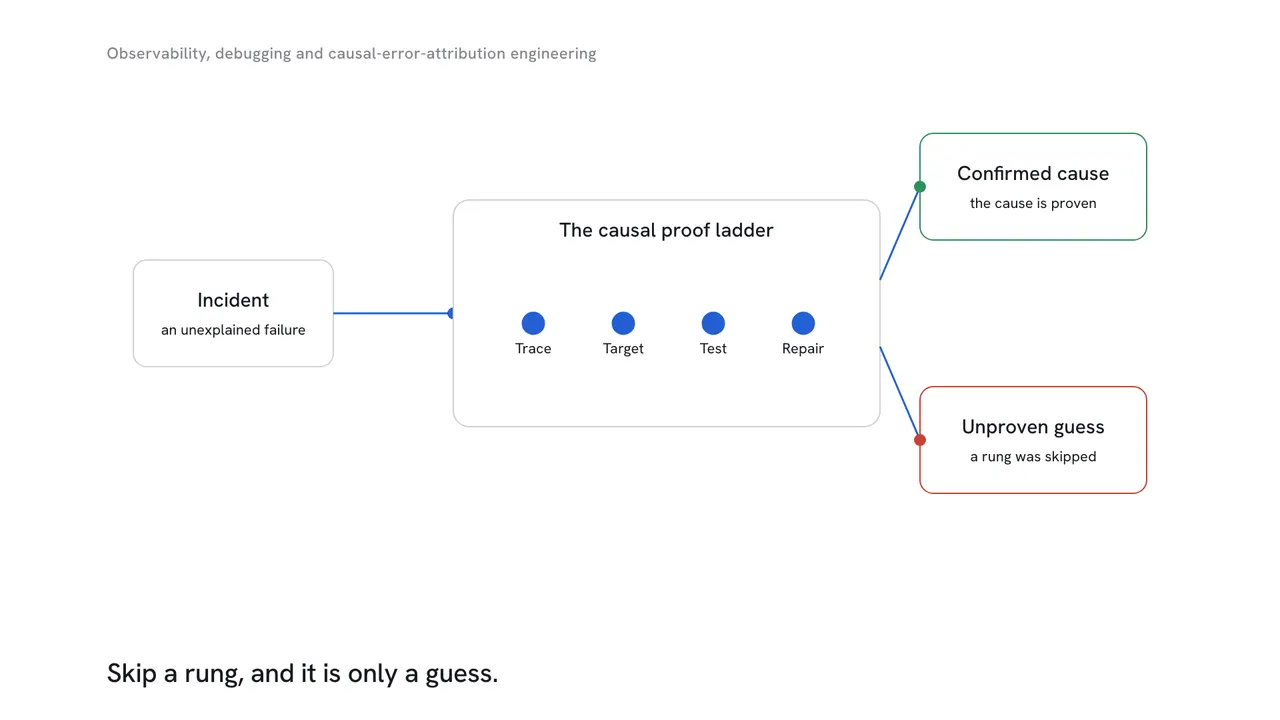
The first rung is the correlated trace. Structured identifiers, versioned context and tool hashes, and recorded state changes show the sequence of what happened, necessary but proving nothing about cause on its own. Most organizations stop here and treat proximity as explanation.
The second rung is the declared target: which agent was responsible, which step was wrong, or where the last chance to recover was missed. TraceElephant shows the gap is not small, since the same traces score more than twice as accurately when the question is which agent as when it is which step.
The third rung is the controlled test: freeze the state before the suspected cause, change one component, rerun the remainder to see whether the outcome reliably changes. A 2026 replay study reported encouraging results in controlled, synthetic environments with mocked tools, and named its own limit: resampling an earlier, seemingly irrelevant step can reroll a later, pivotal event by chance, showing a total downstream effect rather than a demonstrated direct cause.
The fourth rung is the validated repair, confirmed on the original failing case and a regression set, not one fortunate rerun. A study of failure propagation in retrieval augmented pipelines found localization accuracy of 91 percent at the shallowest failure depth, collapsing to zero at deeper stages. Among cases still failing deeper, freezing the earlier steps and regenerating only the failing one recovered 67 percent of them, against 11 percent for regenerating from scratch. Diagnosis and repair are different properties: tracking only one misjudges whether the system is working.
How to lead it
Ownership belongs to whoever is accountable for the system's decisions, not a platform team alone, since declaring the target on rung two is a risk decision before an engineering one. Fund structured, versioned telemetry as the default, full content capture only as a deliberate, access restricted exception, since the reviewed telemetry standard's own guidance discourages full content collection by default because of sensitivity. Fund controlled replay and validating a repair against a regression set, not just the case that triggered it.
Measure four things on every material incident: time to detection, diagnosis accuracy against the declared target, whether the repair held on the regression set, and recurrence. Stop treating one successful rerun as proof of a fix. Setting the attribution target per severity tier is a risk decision executives own, not an engineering team, and so is the retention policy for full content capture, since the telemetry standard is still marked under active development.
What it is worth
The financial case shows up in three places: incidents diagnosed and repaired faster, exposure avoided because full content capture stayed the exception, and engineering time not wasted repairing a plausible but wrong explanation a controlled test would have ruled out. Measure before and after with the same four numbers used to lead the program: detection time, diagnosis accuracy, validated repair rate, and recurrence.
The 2026 evidence supports declaring an attribution target before scoring, using a controlled intervention over a narrative, and tracking localization and recovery separately. It does not support a claim that observability spending measurably improves detection or repair economics as opposed to accumulating more logs, and it does not support treating one successful replay, or a confident automated explanation, as a demonstrated cause. No return figure appears in the source evidence, and none should be assumed here.
Questions leaders ask
- What is the causal proof ladder, and why is a trace not the same as a cause?
- The causal proof ladder is the four checks a failure explanation should pass before a team trusts it: a correlated trace showing sequence, a declared attribution target stating exactly what counts as the cause, a controlled test that changes one component and reruns the rest, and a repair validated on a regression set. A trace alone only proves order. Skipping the later rungs is how organizations end up repairing the wrong thing.
- Why does attribution accuracy change so much depending on what a team is trying to attribute?
- A 2026 benchmark scored the same set of failure traces against two different targets and found accuracy of 65.9 percent when asking which agent was responsible, against 30.3 percent when asking which specific step was wrong. Removing structured metadata cut the step level score roughly in half. The target has to be declared before scoring, or two teams reporting different numbers may simply be answering different questions.
- Can replaying a failed run reliably prove what caused it?
- Only within real limits. A 2026 study of controlled replay showed that resampling an earlier, seemingly irrelevant step can reroll a later, pivotal event by chance, meaning a successful rerun can reflect a total downstream effect rather than a demonstrated direct cause. Replay is a useful way to test one intervention at a time in a controlled setting. It is not yet reliable evidence on its own for a production causal claim.
- Is there a stable, agreed standard yet for AI observability telemetry?
- Not fully. The reviewed OpenTelemetry conventions for agent spans, pinned at their April 2026 release, are marked Development rather than stable, and the paired guidance discourages capturing full conversation content by default because of sensitivity. A later release moved the generative AI work into a separate repository, so the parent project's latest version does not by itself establish the current standard. Version every adapter and expect the contract to keep moving.
- Does more observability spending actually reduce the cost of AI incidents?
- The dossier behind this area is explicit that independent evidence for that return is currently insufficient. Structured metadata and controlled replay are shown to help diagnosis in the studies reviewed, but no study establishes that observability spending, as opposed to more logs and dashboards, measurably improves detection time, repair success or recurrence. Measure those four outcomes directly rather than assuming the investment pays for itself.


