
AI Model Routing: How to Cut Cost Without Losing Quality
How AI model routing cuts inference cost per task without losing quality: the eligibility ladder, what 2026 evidence supports, and what to fund first.
Yash Sharma5 min readOperations and economics
Research area 41: Routing, cascade and model-portfolio engineering
In brief
- Routing picks the cheapest eligible model or tool for each task, not the cleverest router.
- The eligibility ladder filters hard constraints first, then lets cost-cheap options try before escalating.
- Savings are real but unproven on quality, and no dollar return figure is established yet.
Routing, cascade and model-portfolio engineering decides, task by task, which model, tool or person does the work at the lowest cost the business's risk tolerance allows. A cheap model is not cheap once the rework, the escalation calls and the missed deadlines it causes get counted. The organizations seeing real savings are not the ones with the cleverest learned router, but the ones who exclude the wrong options first and prove a shortcut is actually a shortcut before depending on it.
What it is
Routing is a constrained decision policy, not a preference. For every task it selects an eligible capability at the lowest cost the business will justify: a deterministic tool, a classical predictor, a retrieval step, a language model call, an added reasoning pass, or human review. A cheap model call stays cheap only once the rework, escalation and delay it creates are added back in.
Pre-call routing chooses upfront, from task type, data sensitivity, required tools and deadline. Post-call routing acts on a first answer or a calibrated uncertainty score, with richer information because that call is already paid for. A cascade asks more capabilities only when the first is not enough.
Four distinctions matter: confidence is not authorization, a router's score is not a calibrated probability of correctness, a mixture of experts inside one model is not a portfolio choice, and switching models mid-task changes the trajectory, not just the answer quality.
Why it matters now
Routing decisions now run automatically, at volume, and a bad one stays invisible until the bill or the failure count arrives. A January 2026 benchmark tested ten router baselines against tens of thousands of prompts: on the hardest 410 queries, the two leading routers correctly selected a working model only 24.6 percent and 23.2 percent of the time, even though an oracle that could see every outcome showed real complementarity. Complementarity is a ceiling on what routing could achieve, not evidence a deployed router will reach it.
The architecture
The clearest structure to run on top of this evidence is what I call the eligibility ladder: a sequence that filters hard before it ever compares soft, and only lets escalation happen for a stated reason.
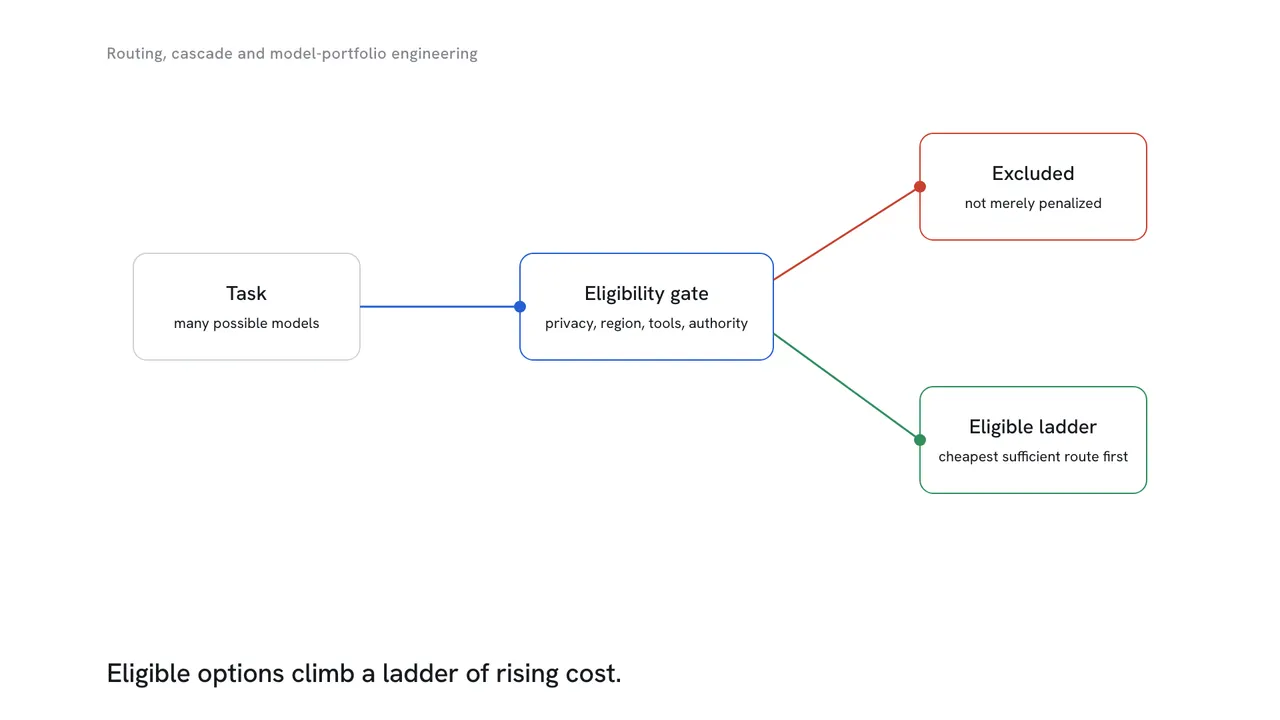
The base is a capability registry: every tool, model and human reviewer available, recorded with its allowed data classes, regions, tool access, cost, latency and refusal behavior. An unknown permission is treated as no permission.
Above it sits the eligibility gate, applying hard constraints, privacy, jurisdiction, identity, tool capability and authorization, before any cost or quality comparison. A cheaper option requiring unauthorized data movement is removed outright: no quality buys back a failed mandatory constraint.
Everything that survives enters the ladder. One strong, fully eligible model sits at the top as a fixed baseline, always a legitimate answer on its own. Below it, static rules or a bounded cascade try the cheapest sufficient route first. The ladder climbs only on a defined failure, a rate limit, a malformed response, low confidence, a timeout, and each failure has one permitted next step: a rate limit justifies a delay, not the assumption that another provider shares the same data guarantees.
The top rung is earned, not assumed. A learned router joins only once held-out, live evaluation on real outcomes, not an oracle benchmark, shows it beats the fixed baseline at equal risk. It is re-tested whenever models, prices or task mix change underneath it.
How to lead it
Ownership sits with whoever answers for the ladder's outcomes, typically the platform or AI engineering leader, working from eligibility rules a compliance or security owner has signed off on. Fund the registry and a few transparent rules before funding anything learned: they are inspectable, cheap to run and already capture most of the savings. Fund a learned router only once a held-out harness can test it against that baseline honestly.
Two decisions belong to an executive alone: setting which data classes, regions and tool permissions are mandatory exclusions, a risk-appetite call, and approving any learned router or bandit for production traffic along with its exploration budget against sensitive tasks. Stop funding routing results whose savings depend on lower coverage or uncounted rework.
What it is worth
The clearest 2026 evidence on money is a live, held-out coding benchmark from May 2026: across 100 real tasks, a lightweight router resolved 75 for $25.66 in billed spend, against 74 resolved by always calling one strong model for $54.73, and 73 by a rule-based router for $172.56. That is a real cost difference on real outcomes, not proof of equal quality, since no equivalence test was reported and the comparison excludes the router's own running cost.
Run the arithmetic before trusting a cascade to save money. One paying $0.04 for a first call, $0.03 to verify it and escalating 80 percent of the time to a $0.20 second call costs $0.24 on average once repair is added, more than a single $0.20 strong call. Break-even sits below roughly 65 percent escalation, and only if that rate is not reached by quietly accepting more wrong first answers.
How a routing policy should adapt to drifting prices and task mix without destabilizing quality is documented but not proven stable over time, and no study shows a routing layer cannot be talked into bypassing a refusal or moving sensitive data to an unauthorized provider. No dollar return figure appears in the research, and none should be assumed here.
Questions leaders ask
- What counts as a routing decision, in practice?
- It is the choice, made for one specific task, of which eligible capability handles it: a deterministic tool, a small model, a strong model, a cascade of several, or a human reviewer. The choice is constrained first by hard eligibility rules such as privacy and authorization, and only then optimized for cost and quality among whatever survives that filter.
- Should we build a learned router or start with fixed rules?
- Start with a capability registry, a strong fixed baseline and a small number of transparent rules. The 2026 evidence supports that a learned router or bandit can add value, but only when tested with held-out live evaluation against that baseline, not against an oracle benchmark or a same-item selection. Add one only after that test runs, and rerun it whenever models, prices or task mix change.
- Does routing to a cheaper model always reduce cost?
- No. A cascade that calls a cheap model first and escalates to a strong one on failure only saves money if the escalation rate stays low enough to offset the first call, the verification step and the human repair it sometimes needs. In one worked example from the routing research, an 80 percent escalation rate made the cascade cost more than simply calling the strong model every time.
- Which routing decisions require executive sign-off?
- Two decisions should not be delegated. Setting the eligibility rules, which data classes, regions and tool permissions are mandatory exclusions rather than trade-offs, is a risk-appetite call. So is approving any learned router or bandit for production traffic and setting how much exploration budget it gets against sensitive or high-stakes tasks.
- How reliable are today's AI model routing benchmarks?
- Mixed, and worth reading carefully. A large 2026 benchmark shows real complementarity across models, but that is a ceiling, not deployable router performance, since the leading routers selected correctly on only about a quarter of the hardest cases. A separate finding that most of the routing gap is explained by task type was measured entirely in-sample, with no independent holdout, so treat it as a lead worth testing, not a settled result.


