
LLMOps and AgentOps: How to Release AI Agents Safely
An AI release spans the model, prompt, tools, memory and policy together. The compound release chain names what to version, gate and recover.
Yash Sharma5 min readOperations and economics
Research area 42: LLMOps, AgentOps, deployment and release engineering
In brief
- An AI release must version the model, prompt, tools, memory and policy as one compound unit.
- The compound release chain binds a manifest, stages it through gates, and recovers along three separate paths.
- The 2026 evidence supports these patterns as architecture, not as a proven cut in incidents.
LLMOps and AgentOps are the discipline of shipping AI systems whose behavior can change without a code diff, and of recovering when it does. A prompt edit, an index refresh, a memory write or a silent provider backend update can each alter production behavior, so an executive must govern the whole compound system, not the model name on the invoice.
What it is
LLMOps and AgentOps recombine release engineering, evaluation, access control and observability around systems that reason and act, not just return text. A release manifest describes what was intended to run, an execution receipt records what actually ran, and the two must stay linked. A release is compound: model or provider identifier, prompt, retrieval policy, index snapshot, memory schema, tool definitions, verifier and authorization policy all move together, since any one change can shift behavior as much as a new model. Shadow execution earns its name only if genuinely isolated, and pinning a model alias does not guarantee reproducibility, since a provider can change what it points to without a version bump.
Why it matters now
Agentic systems now take actions with financial and legal consequences, and a regression can hide where conventional release never checks. Anthropic's April 2026 Managed Agents description documents durable event logs, a stateless execution harness, sandboxed tool access and lower time to first token, but reports no sample size, latency or traffic data.
OpenAI's March 2026 account of monitoring internal coding agents reports asynchronous review of tens of millions of trajectories over roughly five months, about 1,000 moderate-severity alerts, and no highest-severity alert confirmed in real traffic, a detection system with pre-action blocking still on the roadmap.
An August 2026 study of continuous skill evaluation scanned 145 skills, reporting 947 paired comparisons across 58 skills and four harnesses, a composite lift of 0.2134, a bootstrap interval of 0.1898 to 0.2350, and 87 negative cases.
The architecture
I call the shape that holds these pieces together the compound release chain: one manifest, staged gates, and three separate recovery paths, more than "rollback" alone captures.
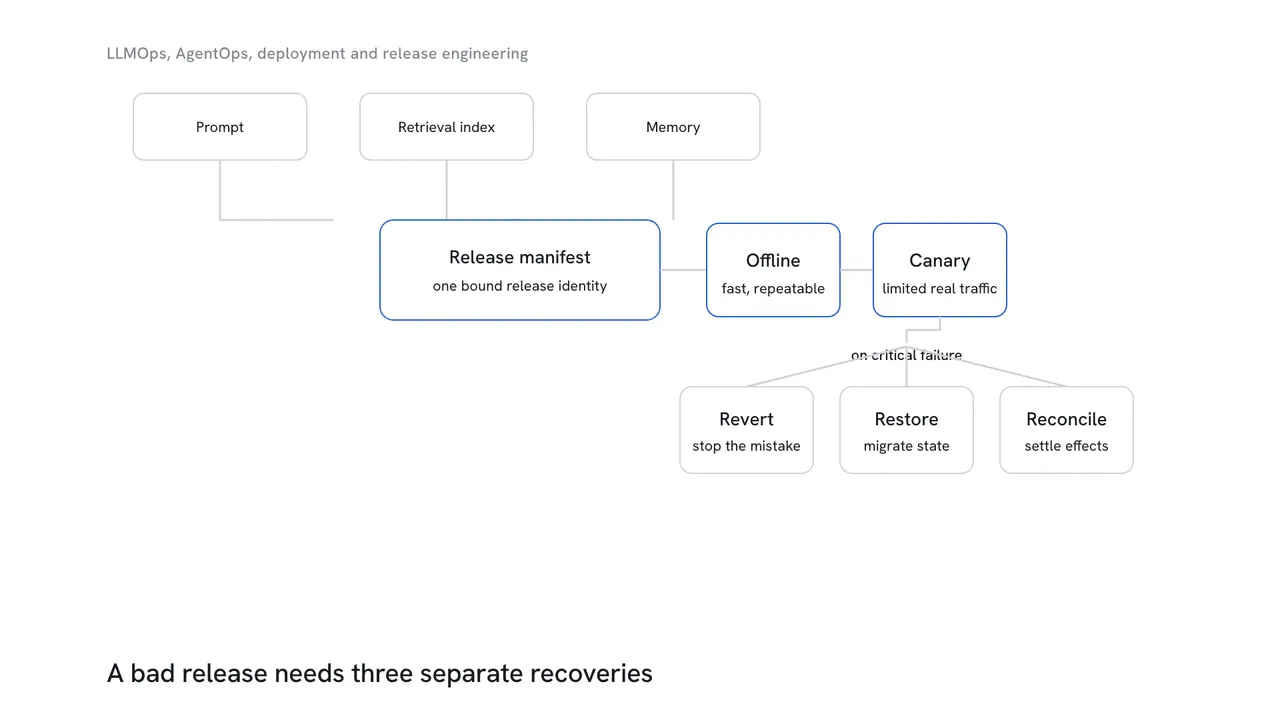
The chain starts with the manifest, binding every part that can change behavior, model or provider identifier, prompt, index snapshot, memory schema, tool definitions, verifier and authorization epoch, into one release identity, catching even a semantically breaking change, such as reinterpreting an amount from dollars to cents, that passes as harmless.
From there the release moves through gates: an offline gate of fast, bounded checks blind to live delay, a shadow run observing real inputs without producing real effects while writes and budget stay isolated, and a canary exposing a limited slice of traffic without cross-arm contamination. Staged autonomy governs how much the agent may act alone, from suggestion through drafted, approved and automatic execution, each stage needing its own verification. Promotion is a predeclared decision, and pending exposure stays bounded, since unfinished cases with no observed error are not evidence of a clean release.
A critical failure splits into three lanes: revert the code so the mistake stops recurring, restore the internal state it corrupted, and reconcile whatever effect already reached the outside world. A reverted prompt cannot unsend a message, cancel a payment or correct a memory record that now states a task finished when it did not, so treating them as one action leaves real damage standing.
How to lead it
Ownership belongs to whoever answers for the chain's outcomes, typically a platform or AI engineering leader: a domain owner for risk criteria, a platform owner for release identity, a security owner for credentials, an evaluation owner for scorers, and a provider liaison for vendor drift.
Fund the manifest and gates first, since they pay for themselves regardless of vendor, before canary infrastructure and staged autonomy. Measure outcome quality, safety failures, latency, cost and availability as separate figures, never folded into one score that hides a rare failure behind fast, correct volume.
Two decisions do not belong to the team running the pipeline: setting the exposure and rollback budget for each stage of autonomy, and authorizing compensation for an incident that cannot be reversed, since that commits the business to a new, risky action.
What it is worth
Evidence here is architectural, not financial. Durable event logs, an execution harness and sandboxed tool access are a documented pattern with a plausible latency benefit, and continuous, skill-specific evaluation catches a regression a generic benchmark would miss. Neither extends to a proven cut in incidents, and no eligible 2026 study establishes that for canaries, rollback or any AgentOps product.
The exposure math argues against allocating canary traffic by volume alone: a routine task group with 1,000 exposures, a one percent error probability and a harm unit of one contributes ten units of expected harm, while ten consequential exposures at a two percent error probability and a harm unit of one thousand contribute two hundred units, twenty times more from a tiny fraction of traffic. Allocate exposure by stakes and reversibility, not request count.
Two gaps deserve naming: formal conformance work on exactly-once resume semantics proves useful properties for reference models, but its authors disclose an unreplicated implementation defect, and the guarantee holds only per branch, not across a remote payment. No source here establishes how to detect a provider's silent backend change behind a pinned alias. Both are worth building defenses for, neither is settled, and no dollar figure appears in the underlying research.
Questions leaders ask
- How is releasing an AI agent different from a normal software release?
- A normal release changes code behind a version number. An agent's behavior can also change through its prompt, tool definitions, retrieval index, memory policy or the model provider's own backend, none of which show up as a code diff. LLMOps and AgentOps exist because the unit that must be versioned, tested and rolled back is the whole compound system, not the model name alone.
- Does a canary release reliably catch a bad AI agent before it causes harm?
- A canary limits exposure, it does not guarantee detection. Outcome labels often arrive late, so a rollout can accumulate pending, unlabeled work while it looks clean. The 2026 evidence supports canaries as a defensible pattern for bounding exposure. It does not establish a universal threshold or a proven incident reduction, so treat the pattern as provisional and measure it on your own workload.
- Why doesn't reverting a bad release fix the damage it already did?
- Because reverting software only stops new instances of the mistake. It cannot cancel a payment already sent, undo a message already delivered, or correct a memory record that now states something false. The compound release chain treats reverting code, restoring internal state and reconciling external effects as three separate operations, each with its own authority and its own way of failing.
- Who should own AI release decisions, and what should stay with an executive?
- Day to day ownership sits with a platform or AI engineering leader working from a manifest and gates that a domain owner and a security owner have signed off on. Two calls should not be delegated: approving the exposure and rollback budget for each stage of autonomy, and authorizing when a stuck or ambiguous incident gets compensated rather than left unresolved.


