
What AI Model Compression Actually Changes Before Release
Distillation and quantization change what an AI model does, not just its size, so test the deployed artifact before trusting any compression claim.
Yash Sharma5 min readSmall, specialised models
Research area 17: Distillation, compression and quantization engineering
In brief
- Distillation and quantization can change model behavior while accuracy scores stay flat.
- The compression release gate tests the deployed artifact through four checks before it ships.
- Skipping those checks means a compliance or safety failure a customer finds after launch.
Distillation, compression and quantization engineering decides whether a smaller, cheaper AI model still does the job it replaced, or only looks like it does on the one metric someone chose to report. A model can keep an almost unchanged accuracy score while its refusal behavior, explanations or handling of a rare case shift underneath it. The only way to know is to test the exact artifact you plan to run in production, not the parameter count or bit width on the proposal.
What it is
Three techniques get compressed into the single word efficiency, and treating them as interchangeable is where compression programs go wrong. Distillation trains a smaller student to approximate a larger teacher: response distillation learns only final outputs, logit distillation needs matching vocabulary, feature distillation needs architectural compatibility, on-policy distillation trains on the student's own trajectories at extra cost. Quantization changes how numbers are stored and computed, not what was learned, across three surfaces: weights, activations and the key-value cache. Post-training quantization is simple when calibration data represents real use and hardware supports the target precision. Quantization-aware training tolerates the error instead, at higher cost but more preserved behavior.
2026 evidence shows compression can change behavior an aggregate score will not catch. A study first published in June 2026 and revised in August tested key-value cache quantization across 11 models and 1,894 prompts. In one Mistral-7B example at 4-bit precision, perplexity barely moved, at 1.03 times the original, while 50 of 328 refused prompts came back with an answer instead, a conditional rate of about 15.2 percent, using simulated rather than deployed kernels. A second study, published January to August 2026, quantized six models from 7 billion to 72 billion parameters. A Qwen-7B explanation-faithfulness proxy, how well a model's stated reasoning tracks its answer, fell from .362 to .277 under one 4-bit method, a drop a headline accuracy number would not surface. Ignoring findings like these risks a compliance failure a customer or regulator finds after shipping.
The architecture
I call the discipline that catches this before release the compression release gate: four checks a candidate must clear, in order, before it replaces the model it succeeds.
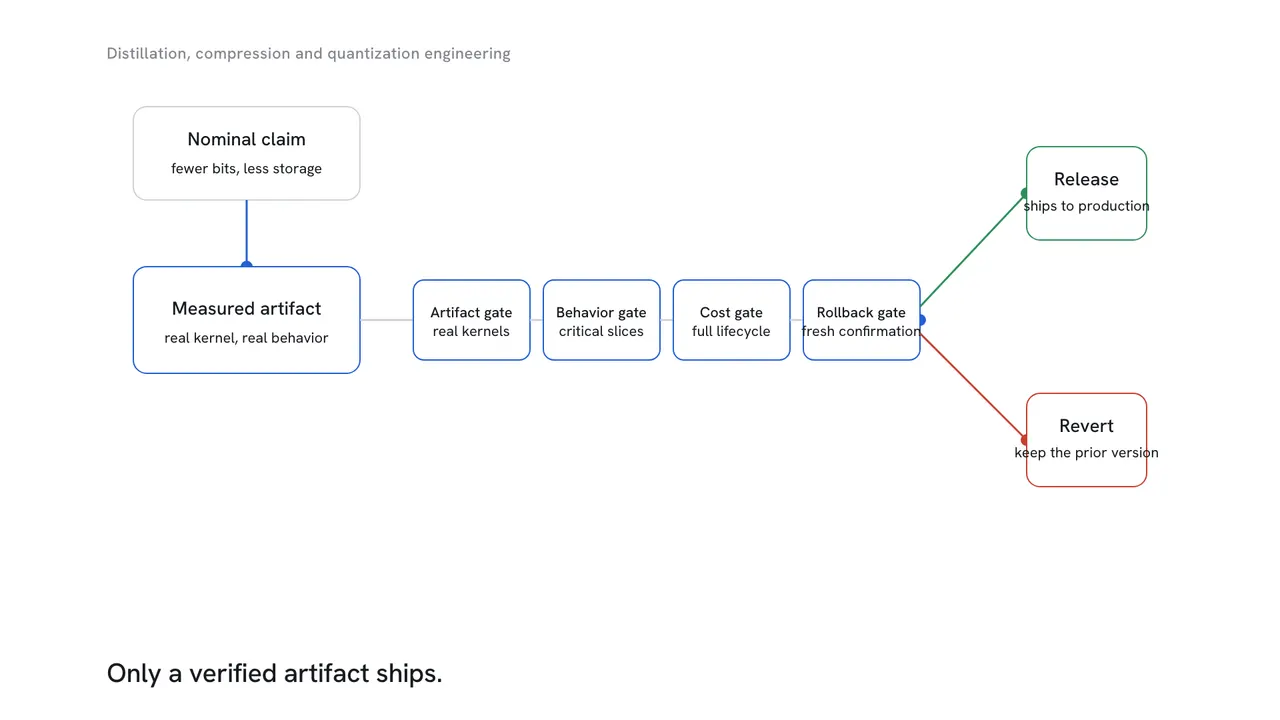
The artifact gate tests the model as it will actually run in production, the real kernel, hardware and batch size, not a parameter-count ratio or a fake-quantization simulation. The behavior gate catches what the studies above show: average quality can stay flat while one specific behavior moves, so an evaluation suite covering rare cases, refusal boundaries and permissions must check each directly. The cost gate counts the full lifecycle, not the headline ratio: teacher inference passes, rejected samples, calibration data, training compute, and dequantization overhead at serving time. A 2026 study reporting MATH gains from on-policy self-distillation on Dream-7B and LLaDA-8B is not free once its extra teacher passes and label-dependent filter are counted against it. The rollback gate promotes only after confirming the result on data the checkpoint was not selected against, since checking repeatedly against the same gold set turns that set into training data by another name: keep the prior artifact ready to revert to, and treat any correction to the teacher or base model as a trigger to re-review everything distilled or quantized from it. A candidate that fails any gate does not ship.
Ownership belongs with whoever owns the model lifecycle and serving platform, working with safety, compliance and cost owners. Fund the evaluation suite, a full lifecycle cost model, and a shadow deployment path testing candidates against real traffic. Stop funding decisions resting on a vendor's benchmark alone or an unverified announcement: one widely discussed 2026 quantization method was excluded here because a September 2025 vendor account already described it at a comparable model size months earlier.
Two decisions are the executive's alone: setting the noninferiority margin, the smallest acceptable improvement and largest tolerable regression, before the final evaluation runs, since that tradeoff is a judgment about harm and cost, not a constant a vendor can hand you, and deciding when a routine update counts as a full requalification rather than a drop-in swap. My rule: no compressed model gets promoted on teacher agreement or a small gold set alone, and every released artifact carries a record of what taught, calibrated and gated it.
What it is worth
The money and the risk show up in three places: inference cost at serving time, the teacher and calibration cost of producing a candidate, and the cost of a regression discovered after release. Measure both with the same paired evaluation on the same real hardware, before and after.
Be honest about what a small passing test set proves. With zero observed violations across independent trials, the one-sided 95 percent statistical bound is roughly three divided by the number of trials, so zero failures in 30 trials still permits a risk near 9.5 percent, and zero failures in 300 trials still permits roughly 1 percent.
This evidence supports testing behavioral slices rather than trusting an average, and counting teacher and calibration cost against any claimed saving. It does not support a universal best bit width, a settled ranking of pruning against quantization, or a return figure for any compression choice, and it rests on three primary studies with limited corroboration. Treat every compression number as a hypothesis about the artifact you have not yet tested, not a result you can budget against.
Questions leaders ask
- Does a 4-bit model actually use a quarter of the memory a full-precision model uses?
- Not exactly. Raw weight storage does shrink close to that ratio, but the number usually quoted leaves out scale factors, group metadata, any layers kept at higher precision, packing and the memory a running system allocates for the key-value cache. Ask for the deployed artifact's measured peak memory on your own hardware and workload before you plan capacity around a bit-width ratio.
- If a compressed model's perplexity barely changes, is it safe to release?
- Not on its own. A 2026 study across 11 models and 1,894 prompts found a 4-bit Mistral-7B example with perplexity barely above the original, yet about 15 percent of prompts the original model had refused came back with an answer instead, a change perplexity never registered. Test refusal behavior and other specific outcomes directly rather than inferring safety from one average score.
- Can we trust a vendor's announcement of a new compression or training method?
- Verify what is actually new before funding it. One widely discussed 2026 quantization method was excluded from this review because a September 2025 technical account from its own vendor already described the method at a comparable model size months earlier. Ask any vendor to isolate the specific new contribution and its date before treating an announcement as fresh evidence.
- Is a larger quantized model always the better choice over a smaller full-precision one?
- No, and defaulting to it is a common and costly mistake. A smaller full-precision model, or even a deterministic rule-based classifier, can be faster and more dependable on a bounded task than a larger quantized model whose kernels or cache behavior add hidden cost. Compare candidates on equal hardware and the actual workload rather than assuming more parameters plus compression wins.


