
The Hidden-Sequence Audit For Diffusion Language Models
Diffusion and flow-matching language models are not simply parallel. A three-check audit finds what still runs in sequence before you fund it.
Yash Sharma5 min readModel architecture and training
Research area 62: Diffusion, flow-matching and non-autoregressive language generation
In brief
- Diffusion and flow matching language models are not fully parallel, a hidden sequence remains in every one.
- The hidden sequence audit runs three checks: block order, decoder dependency and refinement count.
- The 2026 evidence supports bounded pilots only, not a replacement decision or a return figure.
Diffusion, flow-matching and non-autoregressive language generation refine or denoise a block of text instead of predicting one token after another. The pitch is speed and cost: fewer sequential steps, cheaper serving at scale. The 2026 evidence says that pitch is real in narrow cases and misleading as a blanket claim, because the label hides a different dependency in every method it covers. A team that does not find that dependency before buying is funding a marketing claim, not a system.
What it is
The area covers three mechanisms grouped under one label because none strictly generates left to right. Discrete masked diffusion replaces selected tokens with a mask state and predicts them back over several refinement passes, using all of a block's currently visible tokens at once. Continuous latent flow matching encodes text into a vector space, learns a velocity field that moves noise toward that space, then depends on a separately trained decoder to turn the result back into text. Blockwise semi-autoregressive generation splits a response into fixed blocks, commits each in order, and only parallelizes refinement inside the block currently open.
Two principles matter for a leader evaluating a claim. A method must be described by its data space, corruption process, prediction target and sampler, since the architecture's name alone says almost nothing. And cost is the total number of network evaluations a response needs, including every partial pass and remasking event, not the step count printed on a chart.
The architecture
Three studies made public within days of each other in August 2026 show both the appeal and the limits of this family, all at the same evidentiary level: author reported, not yet independently corroborated, graded preliminary. LLaDA MoE v2 (August 4) reports a mixture-of-experts diffusion model with 30 billion total parameters and 3 billion active, trained on 23.5 trillion tokens. That figure alone cannot say how many refinement passes a response actually costs. AURORA-LM (August 3) builds a continuous latent generator on a trained encoder and decoder at roughly one billion parameters, and is explicit that a well trained autoencoder is not automatically evidence of a good generative model. A third study (August 6) retrofits linear attention into six of twenty layers of a 16 billion parameter diffusion model while keeping exact attention inside the block being generated, so the block still commits in order, and any throughput gain is specific to its own hardware.
I call the discipline for evaluating any of these claims the hidden-sequence audit, because every method in this family marketed as parallel or non-autoregressive is still hiding a sequence somewhere, and the job of the audit is to find it before a budget commitment does.
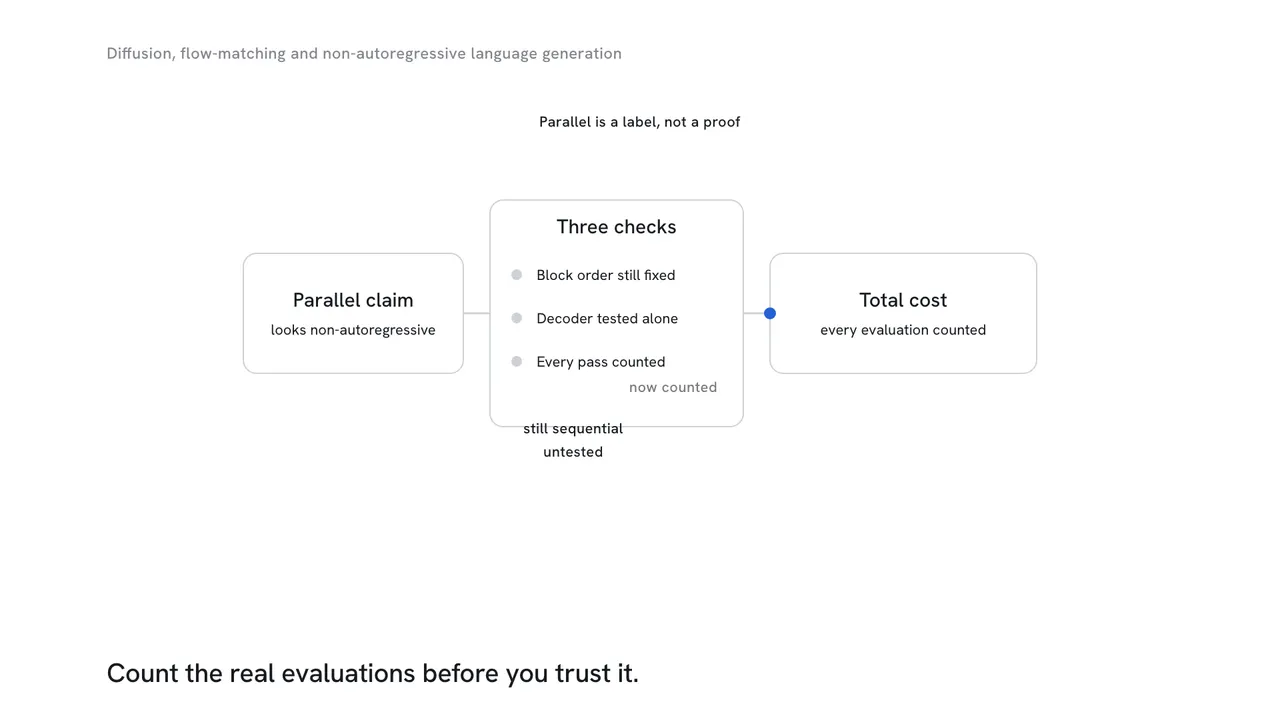
The audit runs three checks. The block-order check asks whether the method still commits fixed blocks one after another, each conditioned on the block before it, as the linear-attention retrofit does. The decoder-dependency check asks whether quality depends on a separately trained decoder or autoencoder whose reconstruction fidelity on numerals, identifiers and strict syntax has not been measured on its own, as the continuous-latent study's design requires. The refinement-count check asks how many total network evaluations one response actually requires, counting every partial pass, remasked token and rejected draft, not the headline step count. A response of 1,024 tokens generated in blocks of 128, at 16 evaluations per block, costs 128 block evaluations before any comparison to standard cached decoding is attempted.
A method that fails all three checks can look identical to a genuinely parallel method on a slide and behave nothing like one in production.
How to lead it
A named generation-architecture owner runs the hidden-sequence audit on every parallel-generation claim before it enters a roadmap, and keeps the result, which checks passed and which failed, attached to the decision record.
Fund a bounded pilot on one workload where the audit result is favorable, measured against a strong autoregressive baseline using speculative decoding, on matched hardware. Measure total network evaluations, decodability tested independently, and failure rates on exact copying and numerals, not a single aggregate score.
Stop two things. Never let an agent execute a tool call, a financial action or an identifier-bearing output from text that has not passed a formal commitment step, since a partially denoised sequence is provisional and can still change. And do not fund a reinforcement-learning roadmap for this family yet: the evidence does not establish whether the right unit of action is a token reveal, a block proposal or a full trajectory.
Two calls belong to an executive alone: how much production traffic to risk on a family whose reinforcement-learning path is unresolved, a risk-appetite decision, and setting a fixed re-review date for any pilot's numbers tied to the next hardware or model-version change.
What it is worth
Money, risk and time surface in three places: serving-cost estimates built on a step count rather than total network evaluations, decoder maintenance cost a continuous-latent design adds without disclosing it, and operational exposure if a partially denoised output is executed as final.
Measure before and after in the same units the evidence uses: total network evaluations and latency at matched hardware and quality, and decodability tested on its own terms. Rerun any comparison after a hardware or model-version change.
The evidence, three author-reported studies at the same preliminary grade, supports piloting mixture-of-experts diffusion scaling, continuous-latent generation and linear-attention retrofits on bounded workloads. It does not support a general claim that these methods replace standard cached decoding, a specific return figure, or a resourced plan for reinforcement learning on this family.
Questions leaders ask
- What does non-autoregressive actually mean in these systems?
- It means the method does not strictly predict one token after the previous token, not that generation happens with no sequence at all. The 2026 evidence covers discrete masked diffusion, continuous latent flow matching and blockwise generation, and every one of them still commits something in order, a block sequence, a decode step or a multi pass refinement schedule. Treat the label as a starting question, not a guarantee of full parallelism.
- Should we replace our autoregressive model with a diffusion language model for speed?
- Not on the evidence available now. The three 2026 studies inspected here are author reported at a preliminary evidentiary grade and were not compared against a strong autoregressive baseline using speculative decoding under matched hardware and quality constraints. A bounded pilot on one workload, measured against that baseline, is the right next step, not a wholesale replacement decision.
- What is the hidden-sequence audit?
- It is the three check discipline for evaluating any claim that a generation method is parallel or non-autoregressive. Check whether blocks still commit in a fixed order, whether quality depends on a separately trained decoder that has not been tested alone, and whether the total number of network evaluations per response has actually been counted rather than assumed from a headline step count.
- Is it safe to let an agent act on output from these models while it is still generating?
- No. A partially denoised sequence is provisional by construction and can still change before generation finishes, so it must never trigger a tool call, a financial action or any identifier bearing output. Validate a complete structured action only after the relevant block has been formally committed, and use an idempotency key so a repeated or interrupted commitment cannot execute the same action twice.
- Does the current evidence support using these methods for reinforcement learning or preference tuning?
- Not yet. The available 2026 evidence does not establish what the right unit of action is for training a diffusion or flow matching language model against a reward or a preference signal, whether that is a token reveal, a block proposal or a full refinement trajectory. Treat that part of the roadmap as a research question, not a resourcing decision, until direct evidence closes the gap.


