
Browser Agents That Prove an Action Actually Happened
Browser and computer-use agents need proof, not a success toast. The three-proof model for grounding, authority and verified effect.
Yash Sharma5 min readAgentic AI in production
Research area 27: Browser, computer-use and digital-action engineering
In brief
- A click is not proof an action landed, only a receipt from the system of record is.
- The three-proof model checks grounding, authority and confirmed effect before counting a task done.
- Skipping proof of effect creates duplicate payments and wrong account actions no dashboard catches.
Browser, computer-use and digital-action engineering is the discipline of building AI agents that click, type and submit on real interfaces, then proving that what looked like success actually changed the system of record. The question for a leader is not whether the agent found the right button, but whether the payment posted, the record updated or the message sent, confirmed by the receiving system rather than the on-screen message that told the agent it was done.
What it is
Scope runs wider than a browser tab: it covers any interface an agent operates by perceiving pixels or structure rather than calling a stable, versioned contract, including legacy desktop software and internal tools never built with an application programming interface in mind.
Four principles hold the discipline together, equally for a browser tab and a desktop application. Observation must be fresh, since a state read seconds ago can already be stale by execution. Grounding must be exact: a target matching two plausible recipients is an ambiguity, not a choice to make silently. Authorization must attach to the specific action and its exact arguments, not merely to a login session, since a session proves who is signed in, not what that identity may do with a given amount. And an action only counts as complete once its effect is confirmed by an authoritative record, not an intermediate signal like a confirmation message a transaction can still roll back behind.
Enterprises are handing these agents real accounts, payment flows and customer records, while the 2026 evidence base stays narrow and, in places, contradictory. SentinelBench, published June 2026, tested monitoring agents across 100 tasks and found one model's overall score rose from 0.68 to 0.75, while its score on tasks requiring an actual action reversed from 0.60 to 0.50: an improving aggregate can hide a regression on the tasks that carry consequences, and its environments never tested a real session expiry. A separate study, published late May 2026, found cutting per step latency from 65.7 to 30.2 seconds retained only 84 percent of task success on the WorkArena benchmark, a real trade, not a free speedup.
The architecture
The clearest way to hold a digital agent accountable is what I call the three-proof model: an action only counts as done once it has separately proven where it acted, who authorized it and what actually changed as a result. Treating these as one bundled success signal, a green checkmark, is the most common design mistake in this area.
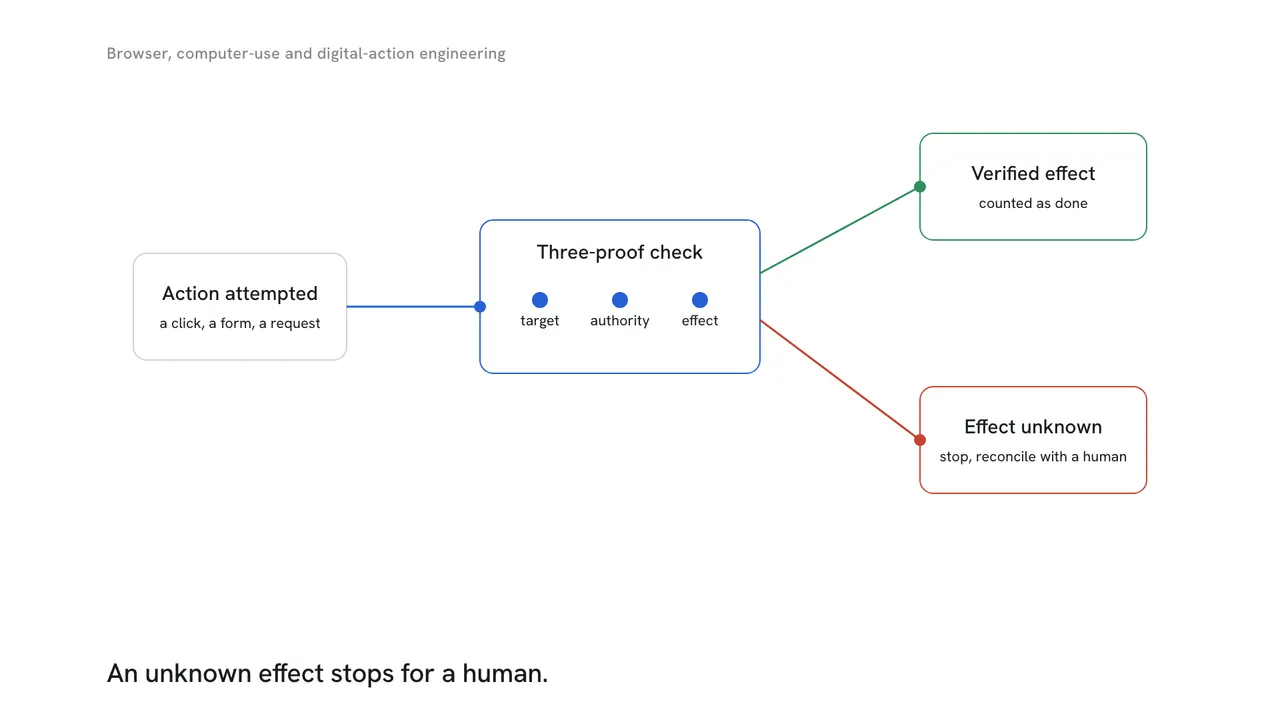
The flow starts with a fresh observation: interface, acting account and a version marker, captured at once. Proof of grounding matches a specific target using stable identifiers, not a remembered coordinate. A target matching more than one plausible recipient is an ambiguity that should stop the agent, not a choice to make silently. Proof of authority is checked immediately before execution, not once at login, since approval for one amount does not silently extend to a changed one. Only once both hold does the agent execute, through a stable operation identifier, so a retry is recognized as the same request rather than a second one.
Proof of effect is the step most systems skip. A successful click and a confirmation message are proposals, not receipts: the agent needs an authoritative post action record, such as a server side status or transaction reference, before reporting success. When that record is unavailable, the honest result is an explicit unresolved state, not a guess. Wrong account selection is the sharpest failure mode, since it corrupts grounding and authority at once: the agent finds a real target belonging to the wrong person, caught only if authority was checked against a specific account.
Ownership sits with whoever owns the underlying transaction, not a central automation team, with a security function owning the authority and consent boundary every agent operates inside. Fund the stable path first, since an authorized application programming interface or deterministic script is cheaper and easier to verify than a visual agent reasoning over a screen. Measure verified effect completion, not click completion, since apparent successes cannot distinguish a real transaction from one that later rolled back. Two decisions belong to an executive alone: where an agent may act unattended versus needing a person to confirm recipient and amount, and the authority model behind every cross account workflow, including when access is revoked.
What it is worth
Latency and integration spend fall wherever a visual agent is replaced by a direct contract. Waste accumulates wherever agents lack an idempotent operation identity, producing duplicate submissions. Exposure grows wherever cross site handling relies only on same origin rules: a June 2026 study recorded zero violations across 50 source and destination pairs, but noted its provenance tracking can under count what an agent carried, with adaptive attacks still untested.
Measure the same metrics before and after, not raw click success a system can inflate by trusting its own confirmation messages. The 2026 evidence supports measured trade-offs between speed and success. It does not yet support a general reliability figure for live account switching or irreversible actions, since the benchmarks behind it used a single preauthenticated session and synthetic environments that reset a mistake a real account cannot. With zero observed failures across even 30 trials, the honest upper bound on failure probability still sits near 9.5 percent. No return figure exists in the evidence, and none should be assumed here.
Questions leaders ask
- What makes a browser agent's click different from a completed business transaction?
- A click only proves the agent found a button and pressed it. What I call the three-proof model requires the target to be correctly identified, the acting account to be authorized for that specific action, and an authoritative record, not a success message, to confirm the external system actually changed. Any one of the three can fail while the other two look fine.
- Should agents click through interfaces, or connect to systems through an API instead?
- Use a direct, authorized application programming interface or a deterministic script whenever a valid contract for the operation already exists, because both are cheaper to run and easier to verify. Reserve visual, screen based interaction for interfaces that genuinely lack that contract, such as older desktop software or a partner site no one controls.
- How do we stop an agent from acting on the wrong account or paying twice?
- Bind every action to a freshly observed account identity and version, and treat any mismatch or ambiguous target as a reason to stop, not a reason to guess. Execute through a stable operation identifier so a retry after a timeout can be recognized as the same request, and treat any outcome that cannot be confirmed as unresolved until a person reconciles it.
- Can content on a web page manipulate what an agent decides to do?
- Yes, if the agent treats page text, documents or emails as instructions rather than as data. The system should let an agent read facts from that content but never let it grant tool authority or rewrite what the agent is permitted to do, and the same caution applies to text embedded in an image as much as to text in the page's own structure.


