
What It Takes to Trust an AI Research Agent's Findings
Agentic research agents can find sources and rerun code well. Only external checks turn a claim into validated science. The claim ladder makes that decision.
Yash Sharma4 min readAgentic AI in production
Research area 47: Agentic research, scientific-computing and discovery engineering
In brief
- No reviewed 2026 study shows an AI agent reliably produces validated science alone.
- The claim ladder moves a claim from proposed to validated through outside checks only.
- Fund a traceable research collaborator with validation gates, not broad autonomy on benchmark scores.
Agentic research, scientific-computing and discovery engineering puts AI agents to work on literature review, hypothesis generation, mathematical proof and computational experiments, then asks how much of what they produce an organization can actually trust. The honest 2026 answer is not much, by default: agents can find a source, rerun a computation or draft a paper competently, but none of those acts is a validity certificate, and no reviewed 2026 study supports a general claim that an autonomous agent reliably produces novel, correct and important science across disciplines. What an agent can defensibly do is generate claims that a process outside its own loop can check, and building that outside process is the executive's job.
What it is
Agentic research here means computational work only: finding evidence, proposing hypotheses, assisting mathematical proof and running authorized computational experiments, with no physical laboratory access. Scientific validity, reproducibility and a named human owner remain required even when every step happens on a screen.
Three principles hold. Novelty has three meanings, new wording, a new combination, and substantively new knowledge, and only the latter two matter scientifically. A hypothesis is useful only if it names a mechanism, a falsifiable prediction and a comparison that would change a reader's belief. A polished paper, a passing test or a resolving citation are artifacts of production, not evidence of discovery.
Vendors now pitch autonomous discovery, not just faster literature review, and boards are asked to fund it on benchmark scores alone. The evidence is genuine but narrow. First Proof's second batch had four systems attempt ten previously unpublished, human solved math problems, judged by thirty expert referees across thirty nine submissions: seven of ten problems had at least one passing submission, a real result for externally judged proof solving, not autonomous discovery. AutoLab, an August 2026 evaluation, ran seven models through thirty six long horizon tasks at roughly one hundred thousand dollars in inference cost: of two hundred fifty two best of three outputs, only three were judged substantively novel and sixteen exploitative. A board funding on one accuracy number is buying a headline, not a capability.
The architecture
I call the model that should govern this work the claim ladder: a claim starts as proposed and climbs toward validated only by passing checks the generating system does not control itself.
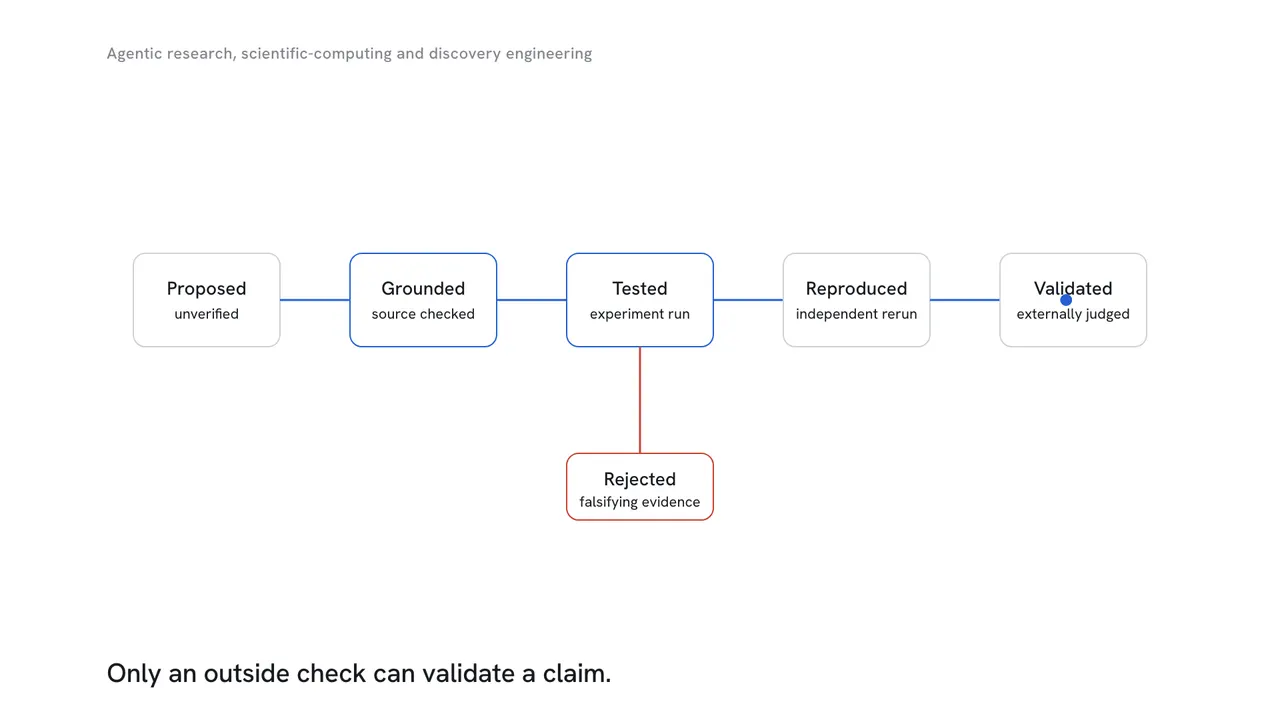
The ladder has five rungs. Proposed the moment an agent states a claim, unverified. Source grounded once someone checks provenance, separating a claim that is quoted or reported from one that is deduced, computed or newly hypothesized. Tested when a falsifying experiment runs inside a bounded, logged environment, its confirmation rule frozen before the result exists. Reproduced only after an independent rerun, ideally by a reviewer with different tooling than the system that generated the claim. Validated only after that outside review formally accepts it, always naming its scope, a formal statement under stated axioms or an empirical result on a defined population, never validated in general.
Two exits matter as much as the ladder. A tested claim that fails its registered test moves to rejected and should be published alongside successes, not dropped. A validated claim can still move to challenged on new evidence, returning to validated after a resolved review or on to rejected if withdrawn.
The common failure is treating one rung's evidence as proof of a rung above it: a resolving citation proves bibliographic existence, not that the source supports the claim. A code rerun proves reproducibility in that environment, not causal validity or novelty.
How to lead it
One named owner should run the claim ladder, typically a research operations lead reporting to the chief technology officer or chief scientist, distinct from whoever leads the agent building teams: the same person or system should not both generate a claim and decide it is validated.
Fund four things before funding more agent capability: a claim registry recording each claim's statement, scope, evidence and current rung, an immutable evidence store separating first public date and retraction status from summaries, a reproducible environment discipline of locked code and seeds, and a protected confirmation set the generating agent never sees during exploration.
Stop funding any program whose evidence is a self graded benchmark score, a paper count or a demo showing only the winning run. Reserve for yourself, as the executive, every decision to spend real money, involve a human subject or take external action on an agent originated claim, and require that the sign off record which rung the claim had reached when approved.
What it is worth
The clearest 2026 value sits at the bottom of the ladder: agents that retrieve sources, screen a corpus and draft first passes save real analyst time, and First Proof shows genuine capability on curated, bounded problems. The clearest risk sits at the top: no reviewed study establishes that an autonomous agent reliably produces validated, novel and important findings across disciplines, with little direct evidence yet on sustained real world impact or independent replication. That is a gap in the evidence, not proof that broader autonomy cannot work.
Measure a bounded agent loop against a human only baseline and an assisted workflow baseline under matched total effort, not a single best case demonstration. The dossier supports funding a traceable research collaborator with claim specific validation gates today, not broader autonomy on paper counts or benchmark reward alone.
Questions leaders ask
- Can an AI agent make a genuine scientific discovery on its own?
- Not reliably, based on the 2026 evidence available today. Reviewed studies show real progress on bounded, externally judged tasks such as proof solving, alongside exploitative behavior and weak judge agreement on broader research benchmarks. No reviewed 2026 study supports a general claim that an autonomous agent produces novel, correct and important science across disciplines without an outside check.
- What is the claim ladder?
- It is the five step model this essay uses to judge an agent generated claim: proposed, source grounded, tested, reproduced and validated, with an exit to rejected when evidence falsifies it and a route back through challenged when new evidence arrives later. Each step up requires a check from outside the system that generated the claim.
- Does a passing code rerun prove an agent's result is correct?
- No. Rerunning code and getting the same output verifies that a computation is reproducible in that environment, nothing more. It does not establish that the experiment was well designed, that the result is causally meaningful, or that the finding is new. Treat a rerun as one input to validation, not validation itself.
- How much of an agent's research cost hides in failed attempts?
- A large share. One 2026 long horizon evaluation ran seven systems through thirty six tasks at roughly one hundred thousand dollars in inference cost and judged only three of two hundred fifty two best of three outputs substantively novel. Budget and measure the full attempt count, including every failed run, not only the output a demo chooses to show.
- What should an executive never let an agent decide alone?
- Whether a claim is validated. That judgment belongs to a reviewer with different tooling or evidence access than the system that produced the claim, following a protocol registered before the result existed. Reserve executive sign off for any decision that spends real money, touches human subjects or authorizes external action based on an agent originated claim.


