
The Reconciliation Gate: How to Resume AI Agents Safely
A restarted AI agent recovers memory, not the world. The reconciliation gate checks identity, ledger status, approval and authority before it acts again.
Yash Sharma5 min readSecure LLM and agent execution
Research area 74: Secure resumption, semantic transactions and external-effect consistency
In brief
- A resumed AI agent recovers its memory, not the world, and must reverify before acting again.
- The reconciliation gate revalidates identity, reconciles a four state ledger, rebinds approval and fences workers.
- Skipping any check produces duplicate payments, revoked approvals executed anyway, and unanswerable incident reviews.
An AI agent that restarts from a checkpoint has recovered its memory, not the world that memory describes. Secure resumption, semantic transactions and external-effect consistency keep those separate: what the agent remembers, what has actually happened, and what authority it still holds. Executives who let agents send money, send messages or change records are already funding this discipline whether they name it or not. The alternative is a payment sent twice, a revoked approval executed anyway, or a review that cannot say whether an action happened.
What it is
Secure resumption is the guarantee that an agent restarting after a crash, a pause or a handoff does not act on stale beliefs. A checkpoint records what the agent knew, not what happened next. Restoring it restores local state only, saying nothing about whether a payment already cleared or an approval granted a minute ago still holds.
A semantic transaction extends a database transaction to actions an agent takes on outside services: moving money, sending a message, changing a record. Those services sit outside the agent's control, so there is no rollback button, only intent checked against what happened. External-effect consistency keeps that understanding accurate across interruptions, retries and handoffs.
Four principles hold this together. History is not authority: prior approvals must be reconfirmed, not replayed. Uncertainty is a fourth outcome, not a rounding error: status can be unexecuted, committed, unknown or superseded, and treating unknown as success or failure is the leading cause of duplicated or dropped effects. Approval binds to an exact effect, not a plan: recipient, amount, resource and its current version. A compensating action is a new action with its own authorization, not an undo: retracting a message does not erase what its recipient already read.
Agents now hold access that makes an interruption expensive, and run long enough to be paused or handed to a newer model mid task. A 2026 study tracing 347 agent runs across five frameworks found restored state routinely disagreed with actions already taken: among 96 traced cases, executing before logging the intent failed to preserve consistency in 90, and logging before executing failed in 93. A second 2026 paper, ACRFence, shows a restored agent can reissue an action a service already committed, but states plainly its own proposed defense has not been implemented or evaluated: a documented failure mode is not a proven mitigation. The cost concentrates publicly: a customer charged twice, a regulator asking why a revoked approval executed, a review that cannot say whether an action happened.
The architecture
I call the pattern that answers this the reconciliation gate: one checkpoint, at every resume, an agent must pass before taking another external action. It has four components, and skipping any one is where the failures above come from.
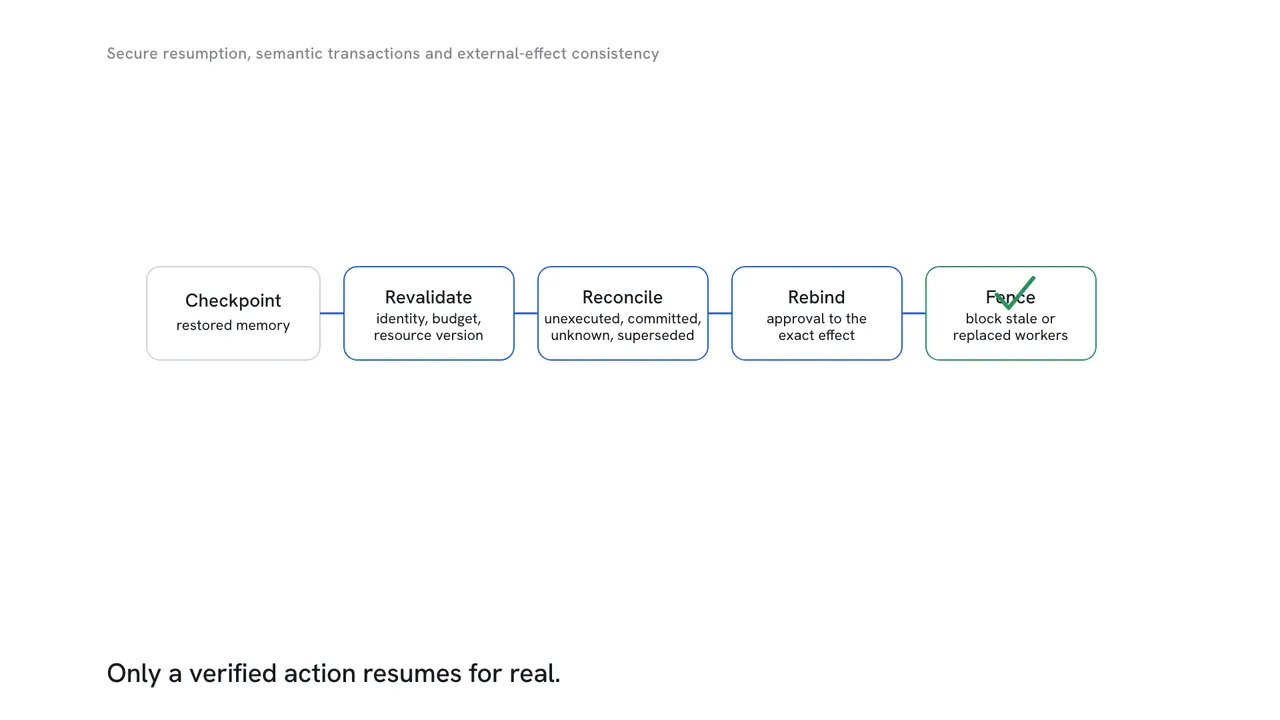
Present moment revalidation rechecks identity, policy, budget, cancellation status and resource versions against the system as it stands now, not as the checkpoint recorded.
A four state ledger tracks every action attempted. Unexecuted requires positive evidence, never silence. Committed requires a receipt tied to the action and resource. Unknown covers timeouts and stays visible, never folded into success or failure. Superseded marks an effect later overtaken by change.
Effect bound approval attaches authorization to the exact recipient, amount, resource and resource version, not a narrative of the plan. A 2026 study of commit time authorization found correct output alone cannot substitute for current permission, and a material change to any bound field invalidates the prior approval.
Service enforced fencing means a handoff, to a human or a new worker, advances a counter the protected service itself checks, so a worker that wakes late cannot push an action through on a lease it no longer holds. A related design, Cordon, stages reversible changes separately from outward effects and intercepted forty five constructed risk cases in its reported setup, though calls bypassing its staging layer would defeat that protection.
Where any check cannot be satisfied, the gate should stop the agent and escalate rather than guess. That is a correct outcome, not a failure.
This is infrastructure, not a feature for one product team. Ownership belongs with the platform or reliability group running the agent fleet, one named individual accountable for the action ledger as a finance team owns the general ledger. Fund the ledger, a credential service reissuing scoped access at resume time, and tooling that checks an action's real status against the service that owns it. Measure the rate of actions sitting in unknown, time to resolve each, and duplicate or omitted effects caught before reaching a customer. Stop funding retry logic that treats a timeout as automatic success or failure: both are guesses. Reserve for an executive which actions require fresh authorization at resume, the default response when status cannot be determined in time, and what counts as sufficient coverage before an unattended regulated workflow runs.
What it is worth
The value here is avoided cost, not new revenue, and the evidence is explicit about its own limits: it documents failure modes and bounded mitigations, not a guarantee of exactly once execution. No study behind this essay puts a return figure on any of it, and none should be assumed.
What the evidence does support is a before and after: actions an incident review cannot classify with confidence, duplicate external effects reaching a customer or ledger, and time between an interruption and a resolved outcome. Before a reconciliation gate exists, those numbers usually are not tracked. After one, they become a standing report.
The cost of ignoring this shows up as a duplicated payment, an audit finding revoked authority acted on, and engineering hours reconstructing what happened instead of knowing it as it occurs. None of that needs a dollar figure to justify the ledger, the authorization service and the escalation path. It needs only the admission that most agent fleets today cannot answer the question their own incident reviews will eventually ask.
Questions leaders ask
- Why isn't restoring a checkpoint enough to safely resume an AI agent?
- A checkpoint restores the agent's memory, not the world that memory describes. It says nothing about whether a payment already cleared, a message already sent, or whether an approval recorded in the checkpoint is still valid now. Secure resumption rechecks identity, authority and the real status of every pending action against the present, not against what the checkpoint recorded as true when it was written.
- What is the reconciliation gate?
- The reconciliation gate is the checkpoint every resumed agent must pass before taking another external action. It revalidates identity, policy and resource versions against the present, classifies every pending action as unexecuted, committed, unknown or superseded, rebinds approval to the exact effect, and enforces fencing so a stale or replaced worker cannot push an action through on an old lease.
- How should an agent handle an action whose outcome it cannot confirm?
- It should leave that action marked unknown and escalate it rather than guess. A 2026 study of 347 agent runs found that treating an unconfirmed action as either a success or a failure was the leading cause of duplicated or dropped external effects. Escalating a genuinely unresolved action to a person is a correct outcome of the system, not a sign the recovery logic failed.
- Can an approved AI agent action still be valid after the plan or the model changes?
- Only if the change does not touch the fields the approval is bound to: recipient, amount, resource and its current version. A material change to any of those invalidates the prior approval and requires a fresh one. A model version change alone does not automatically void a fully specified mechanical effect, but it does if the original approval depended on that model's own judgment.


