
Memory Engineering: How AI Systems Should Govern What They Remember
Persistent AI memory needs governed admission, authority, correction and deletion, not just bigger storage. The memory ledger framework and what to fund.
Yash Sharma5 min readContext, retrieval and memory
Research area 08: Memory and persistent-state engineering
In brief
- AI systems need governed admission, authority, correction and deletion for memory, not just bigger storage.
- The memory ledger checks every new claim's source and authority before it becomes an authoritative record.
- Skipping this governance lets one poisoned claim become a standing rule that biases every future decision.
Memory and persistent-state engineering decides what an AI system may carry from one interaction to the next, on what authority, and for how long. A system that remembers indiscriminately can turn one unverified guess into a fact it repeats for months. The risk is failing to separate what a system believes from what happened.
What it is
Memory here is not one thing. Six functional categories matter, distinguished by purpose and authority rather than resemblance to human recall: an episodic record of something observed, a semantic claim needing support and a time frame before it counts as settled, a procedural lesson that stays a hypothesis until tested on a new task, a preference where an explicit statement from the person it concerns always outranks an inference about them, workflow state kept in a transaction or event store and never inferred from a summary, and a cache valid only under the version and permission it was produced for.
A remembered claim and a committed fact are different categories of information, and collapsing them is the most expensive mistake a memory system can make. A belief that a payment succeeded is not the same as a verified record that it did, and only the verified record should drive a second action. A bigger memory store is not automatically better: every write, read and retention decision carries a cost, weighed against the benefit produced.
Why it matters now
Production systems increasingly write and act on memory without anyone checking the write path, and a mistake there produces a wrong decision that looks like a right one. A local error made once can become an action the system repeats indefinitely once stored as a lesson.
A study first posted in June 2026 and revised in July found that belief-based, Bayesian-style memory updating showed little advantage over simply trusting the most recent record on ordinary conversational memory tasks.
The architecture
The clearest way to operationalize this is what I call the memory ledger: a checked pipeline deciding whether a new claim becomes an authoritative record, beside a separate workflow-state store that memory is never allowed to write to directly.
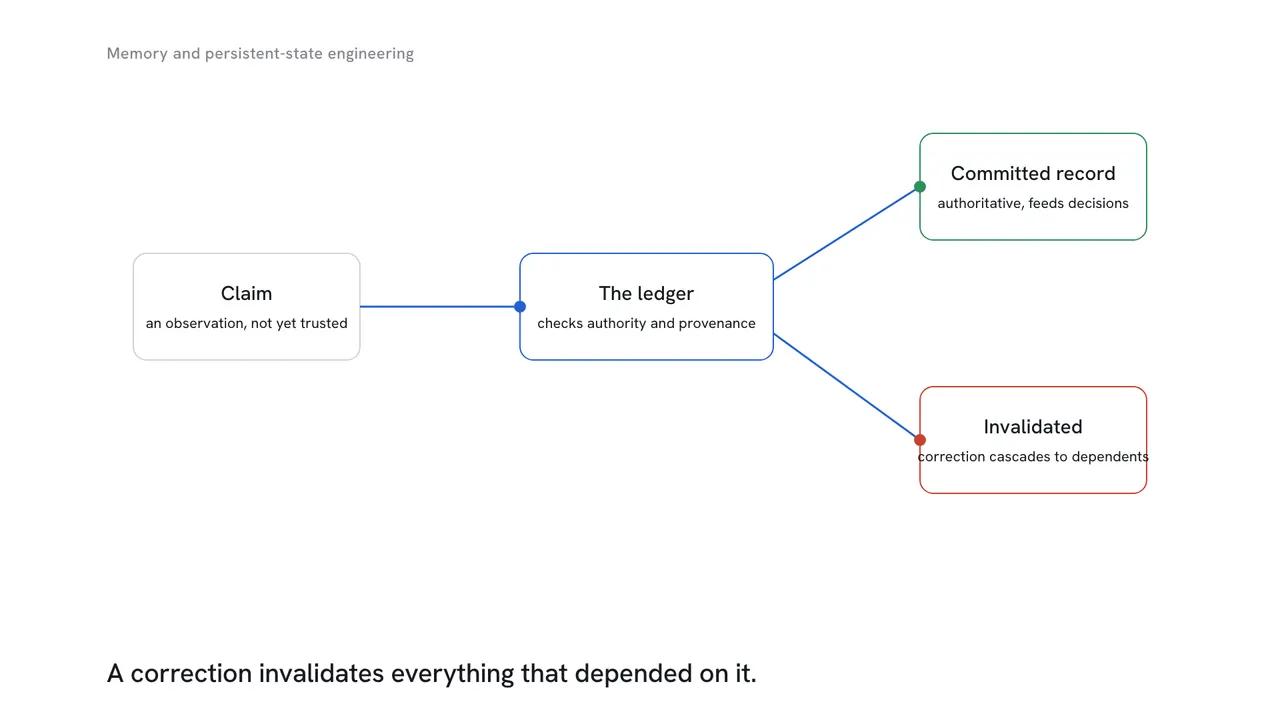
A new claim reaches the ledger as an unverified observation. The ledger checks it against tenant, source, purpose and sensitivity, and compares it with what is already on record using source authority and temporal validity, rather than averaging conflicting claims or trusting whichever version arrived most recently. If independently supported and any conflict resolved, it becomes a committed record, versioned and timestamped for when it was observed and when it was true. If not, it stays a proposal, marked unverified.
An explicit correction outranks the older record it contradicts, and accepting it must invalidate every plan and derived record that depended on the replaced version. Deletion works the same way in reverse: withdrawing a source means blocking every read of the material it influenced before repair begins, then removing that material using identifiers precise enough to survive being summarized or copied elsewhere, because similarity-based search can find unknown copies but never certify that none remain.
Deletion guarantees only cover the influence graph a system actually recorded. Picture a thousand memory entries where twenty depend on a withdrawn source, but the system's lineage records capture only fifteen of those dependencies. Deleting every recorded descendant perfectly still leaves five affected entries untouched.
How to lead it
Ownership belongs with whoever is accountable for the decisions memory feeds, not a platform team by default. Fund simple, versioned structured records for stable facts and preferences first: cheapest to audit, covering most of what a business needs remembered. Add a dependency graph only where correction or deletion genuinely requires tracing influence and its lineage will be kept complete. Pilot adaptive or learned memory managers only against a held-out evaluation and a simpler baseline.
Two decisions belong to the executive alone: setting, before results are reviewed, the smallest improvement worth shipping and the largest regression the business will tolerate, and deciding whether an adaptive memory policy is permitted at all for a given workflow, since a poisoned or self-generated observation admitted once can become a standing rule that biases every decision after it.
What it is worth
The financial and risk exposure shows up in three places: inference spent retrieving material that never changes a decision, downstream errors from a fact that never reached the record needing it, and exposure when sensitive material persists longer than its purpose or consent allows. A poisoned or stale memory adds a fourth cost: a bad record that persists, gets acted on, and must be repaired rather than caught at admission.
Measure before and after against the same baselines the research uses: no memory at all, the full relevant history provided directly, and a simple last-write-wins record. Track deletion effectiveness against an independently audited affected set, not the system's own recorded lineage, since the two numbers differ by exactly the copies the system never knew about.
The 2026 evidence supports testing memory failures at admission and repair, not only at retrieval, and that a more sophisticated belief-updating scheme is not automatically better than a simple versioned record once source reliability is unknown. It does not support a single superior memory architecture, a proven way to certify complete deletion from every unknown copy, or any dollar return figure. None appears in the underlying research, and none should be assumed here.
Questions leaders ask
- What is persistent-state engineering, in practical terms?
- It is the discipline of deciding what an AI system may carry from one session to the next, on what authority, and for how long, and of keeping that decision auditable. In practice it means running every new claim through checks on source, purpose and conflicting prior claims before it can influence a future decision, and keeping the authoritative record of what actually happened in a separate store the model cannot write to directly.
- Is a bigger memory always better for an AI system?
- No. Every stored item carries a write, read and retention cost, along with the risk that persistence itself causes harm through staleness or exposure, and that cost has to be weighed against the benefit the memory actually produces for a given task. A 2026 comparison found that a simple, versioned last write wins record matched a more sophisticated Bayesian updating scheme on ordinary conversational memory, which argues against assuming more complexity is automatically worth funding.
- Can an AI system ever guarantee it has deleted something?
- Only within the influence lineage it actually recorded, not the lineage that truly exists. A dossier modeled example makes the gap concrete: if twenty stored records depend on a withdrawn source but the system's own lineage captured only fifteen of those dependencies, deleting every recorded descendant still leaves five untouched. Similarity based search can help surface unknown copies, but it cannot certify that none remain, so deletion claims should always name the audited set they cover.
- How should a system tell an explicit preference from an inferred one?
- Treat them as different categories of evidence, not different confidence scores on the same claim. An explicit statement from the person it concerns should outrank an inference drawn from their past behavior, and a time scoped correction, such as a temporary change to a standing preference, should update only the scope it names rather than being applied indefinitely or erasing the original record it temporarily overrides.
- What decision about memory should stay with an executive rather than a technical team?
- Two decisions. Setting, before anyone reviews the final evaluation results, the smallest improvement worth shipping and the largest regression the business will tolerate from a change to memory policy. And deciding whether an adaptive or learned memory manager is permitted for a given workflow at all, since a single poisoned or self-generated observation admitted once can become a standing rule that biases every decision that follows it.


